
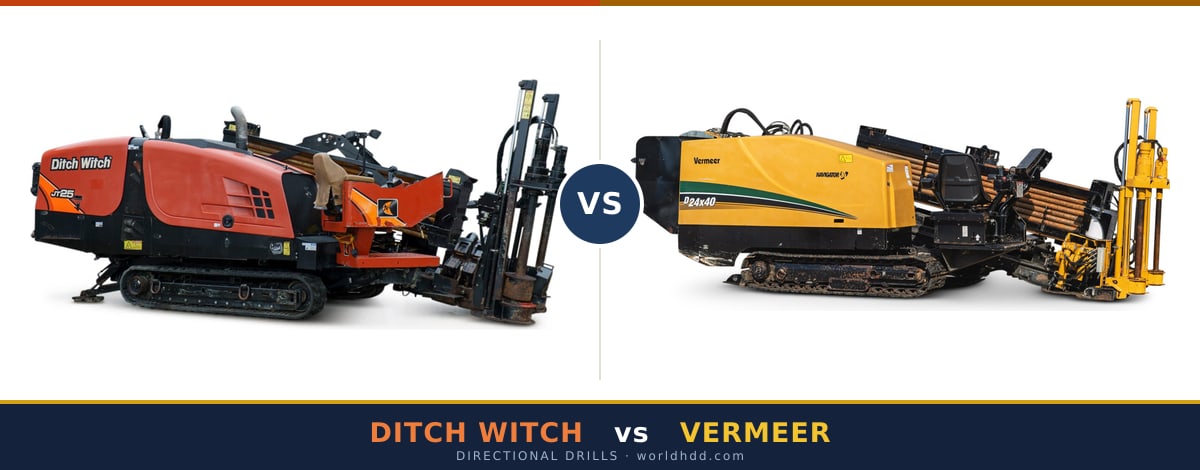
We sell both brands. We take both in on trade, we recondition both in our own yard, and we see which machines come back tired and which ones hold up. So when a buyer asks us whether to go Ditch Witch or Vermeer, we do not answer with a winner. We answer with a question: what work are you actually doing, and who is going to fix the machine when it goes down? This is the class-by-class, spec-by-spec comparison we give those buyers, written so you can match the brand to the job instead of the other way around.
There is a myth in this business that one of these brands is simply more powerful than the other. It is not true, and we will show you exactly why with numbers straight off the manufacturer spec sheets. Through the heart of the lineup the two brands are nearly identical on raw pulling power. The real decision is somewhere else, and most buyers are looking in the wrong place.
Quick verdict, for the skimmers
Five things that actually decide it:
1. Power is basically a tie. The JT40 and D40x55 are dead even at 40,000 lb pullback and 5,500 ft-lb torque. The JT60 and D60x90 match exactly at 60,000 lb and 9,000 ft-lb. Ditch Witch only pulls ahead at the very top, where the JT120 (120,000 lb) outreaches Vermeer's biggest current rig, the D100x140 (100,000 lb). Nobody should pick a brand on pullback.
2. Ditch Witch leans toward simple, field-repairable machines, especially the older JT generation. Vermeer leans toward hydraulic refinement and dealer-supported electronics.
3. Vermeer's Automated Rod Exchange on the new D24 is the one capability the other brand does not currently match. If you are short on experienced operators, that matters.
4. For rock and dual-product pulls, Vermeer offers dual-rod (DR) machines outright; Ditch Witch answers with its separate All Terrain (AT) line rather than a dual-rod option on the JT drills.
5. The real decision is your local dealer's service quality, not the badge on the hood. Visit both. Talk to the service manager, not just the salesperson.
Want to see what is on the ground right now? Browse our current 33 used Ditch Witch directional drills and 22 used Vermeer directional drills.
Two companies, two philosophies
You cannot understand the machines without understanding the companies that build them, because the design choices come straight out of the engineering culture.
Ditch Witch (Charles Machine Works)
Ditch Witch was born in Perry, Oklahoma, in 1949, when Ed Malzahn built the first mechanized compact service-line trencher, the DWP. The business became Charles Machine Works (CMW), and the Malzahn family held it for seventy years. In 2019, The Toro Company acquired CMW for about 700 million dollars, and operations stayed in Perry. CMW is the hub of an "Underground Authority" family that includes SubSite Electronics for locating, American Augers and Radius HDD on the large-diameter side, HammerHead Trenchless for pipe replacement, and MTI. The historical CMW signature is robust mechanical design and field serviceability: machines a contractor can keep running with basic tools.
Vermeer Corporation
Vermeer started in Pella, Iowa, in 1948, when Gary Vermeer built farm equipment. It is still privately held and still run by the founding family, now in its third generation under CEO Jason Andringa, with roughly 3,400 team members and more than 1.5 million square feet of manufacturing locals call "the Vermeer Mile." Vermeer entered horizontal directional drilling in the early 1990s, by its own account fielded one of the industry's first self-contained HDD units in 1993, and by the end of that decade HDD was half the company's business. The Vermeer engineering signature trends the other direction from CMW: hydraulic sophistication, integrated CAN bus electronics, and a dealer ecosystem built around them.
On the Toro acquisition
Some long-tenured Ditch Witch operators and dealers have mixed feelings about the 2019 Toro deal, worried that corporate ownership could dilute the Perry, Oklahoma product culture. Toro committed to keeping operations in Perry. There is not enough post-2019 data to draw a real conclusion either way, so we will note the perception and leave the verdict to time.
One honest caveat on the "simple Ditch Witch, refined Vermeer" framing: it is increasingly a generational story, not a brand law. Post-Toro, Ditch Witch is adding telematics and remote diagnostics (its Orange Intel platform), and both brands now build machines that reward dealer-serviced maintenance. The independent-serviceability edge lives mostly in the older JT machines, not the newest ones.
What operators actually say
The following is synthesized from forum threads, trade-press operator interviews, manufacturer testimonials, and what we observe in our own yard. Treat it as sentiment, not spec.
What operators consistently say about Ditch Witch
Mechanical simplicity and field repairability. The older JT machines are easy to diagnose and fix without a dealer truck in the driveway. The JT10 and JT20 run a Deutz engine with no exhaust aftertreatment to baby, which operators value for short, stop-and-go cycles. (Note that this no-aftertreatment point applies to the JT10 and JT20 specifically; the JT24 and up use Cummins engines with diesel exhaust fluid, like most modern machines.)
The SubSite electronics ecosystem. SubSite locating is native to Ditch Witch and integrates cleanly.
Parts and dealer density. Ditch Witch cites about 170 dealers selling into 110 countries, backed by the CMW family of companies. In its core territory, common wear parts are usually a same-day or next-day item.
Maneuverability and long production runs. The rubber-tracked JT machines are nimble in tight residential right-of-ways, and models like the JT20 ran for many years, so parts commonality is deep and plenty of independent technicians know them.
What operators consistently say about Vermeer
Hydraulic refinement. The CAN bus controls on the S3 generation get praise for smooth, predictable response.
Automated Rod Exchange (ARE). Launched on the D24 in late 2024, ARE adds rod automation that Vermeer pitches squarely at the experienced-operator shortage: faster onboarding for new hands and less tooling damage from over-torquing and spinning rods. There is no announced Ditch Witch equivalent. Operators in Vermeer's own interviews back the training-speed and tooling-wear claims, so weigh it as a mix of marketing and real field feedback.
Confidence Plus and dealer-certified service. The pre-paid maintenance program uses genuine Vermeer parts, is honored at all participating dealers, and is transferable, which operators like for budgeting.
DigiTrak compatibility and a unified used marketplace. Vermeer machines pair with the widely used DigiTrak locators, and vermeerused.com aggregates dealer used inventory in one place, which has no direct Ditch Witch equivalent.
Where operators genuinely disagree
Which brand holds value better: no consensus. It depends on hours, application history, and how strong your regional dealer is. Best brand for fiber: genuinely split, with the simple-and-fast camp leaning Ditch Witch and the newer-engineering-and-quieter camp leaning Vermeer. Parts cost: operators report inconsistent regional pricing for both brands, and neither is universally cheaper.
Class by class, with real spec-sheet numbers
Every number below comes from the current Ditch Witch and Vermeer spec sheets. We have paired the machines by their actual pullback ratings, which is not always how the model names suggest, because the Vermeer naming convention trips up a lot of buyers (more on that in the FAQ).
Compact class: JT10 vs D10x15 S3
| Spec | Ditch Witch JT10 | Vermeer D10x15 S3 |
|---|---|---|
| Pullback | 10,000 lb | 10,000 lb |
| Max spindle torque | 1,100 ft-lb | 1,500 ft-lb |
| Rod length | 6 ft | 6 ft |
| Engine | Deutz, no aftertreatment | Deutz |
Dead even on pullback. The Vermeer carries more spindle torque (1,500 vs 1,100 ft-lb), which helps in tougher soil and on backreaming. The Ditch Witch counters with a no-aftertreatment Deutz that operators like for short residential cycles. Both run 6-foot rods, so connection counts are similar. For a small fiber or service-line crew, this is a close call that comes down to which dealer is closer.
Utility class: JT20 vs D20x22 S3, and JT24 vs D23x30 S3
| Spec | DW JT20 | Vermeer D20x22 S3 | DW JT24 | Vermeer D23x30 S3 |
|---|---|---|---|---|
| Pullback | 20,000 lb | 19,500 lb | 24,000 lb | 24,000 lb |
| Max spindle torque | 2,200 ft-lb | 2,200 ft-lb | 3,000 ft-lb | 3,000 ft-lb |
| Max fluid flow | 35 gpm | 25 gpm | 40 gpm | 35 gpm |
| Engine | Deutz, no aftertreatment | Deutz, 74 hp | Cummins F3.8 | Deutz, 100 hp |
| Operator-ear noise | n/a | n/a | 83 dB(A) | 82 dB(A) |
This is the most common buyer entry point, and it is where a popular myth falls apart. The JT24 and the D23x30 S3 are direct equivalents: 24,000 lb pullback and 3,000 ft-lb torque on both. They are also nearly identical on operator noise, 83 dB(A) for the JT24 against 82 dB(A) for the D23x30, so the idea that Vermeer is dramatically quieter in this class does not survive the spec sheets. Where they differ: the JT24 moves more drilling fluid (40 vs 35 gpm) and its carriage is quick, with 210 feet-per-minute thrust and 216 feet-per-minute pullback for fast cycle times in repetitive fiber work. The JT20 and D20x22 S3 form the rung below, and they too are effectively even at roughly 20,000 lb; the Vermeer D20x22 and D60x90 buyer's guide covers the Vermeer side of that rung in depth.
One forward-looking note: Vermeer is replacing the D23x30 S3 with the new D24, the machine that introduced Automated Rod Exchange. The D24 sits in the same 24,000 lb class (about 24,700 lb peak pullback), runs a touch louder at 88 dB(A), and can be ordered with a 3-year, 3,000-hour extended warranty. If reducing operator training time is a priority for you, the D24 is the machine to look at.
This class is the heart of our inventory. Compare a Ditch Witch JT24 against a Vermeer D23x30 side by side.
Mid class: JT28 vs D24x40 S3, and the JT32 that stands alone
| Spec | DW JT28 | Vermeer D24x40 S3 | DW JT32 |
|---|---|---|---|
| Pullback | 28,000 lb | 28,000 lb | 32,000 lb |
| Max spindle torque | 4,200 ft-lb | 4,200 ft-lb | 4,200 ft-lb |
| Nearest Vermeer match | D24x40 S3 | (this column) | none in current lineup |
Here is where the model names mislead people. The "24x40" in the name describes the original machine: the earlier D24x40 Series II pulls 24,000 lb with 4,000 ft-lb of torque. The current D24x40 S3 was uprated to 28,000 lb and 4,200 ft-lb, so its true Ditch Witch match is the JT28, a near-exact pair at 28,000 lb of pullback and 4,200 ft-lb of torque at the top of the utility-mid band. Either way, the "40" is torque, not pullback: cross-shop a D24x40 against a JT40 and you are comparing a 24k-to-28k machine to a 40k machine, which is not a fair fight. The Vermeer D24x40 used buyer's guide gives that machine the full generation-by-generation treatment.
The Ditch Witch JT32 is interesting because it has no current Vermeer equivalent at all. Vermeer's lineup jumps from the 28k D24x40 to the 40k D40x55, leaving a gap at 32,000 lb that Ditch Witch fills outright. If your work sits right in that band, the JT32 is its own category.
Heavy class: JT40 vs D40x55 S3, JT60 vs D60x90 S3, and the flagships
| Spec | DW JT40 | Vermeer D40x55 S3 | DW JT60 | Vermeer D60x90 S3 |
|---|---|---|---|---|
| Pullback | 40,000 lb | 40,000 lb | 60,000 lb | 60,000 lb |
| Max spindle torque | 5,500 ft-lb | 5,500 ft-lb | 9,000 ft-lb | 9,000 ft-lb |
| Rod length | 15 ft | 10 ft | 15 ft | 10 ft |
| Dual-rod option | AT line (separate) | D40x55DR | AT line (separate) | no |
This is the clearest demonstration that pullback is not a brand differentiator. The JT40 and the D40x55 S3 are identical at 40,000 lb pullback and 5,500 ft-lb torque. The JT60 and the D60x90 S3 are identical at 60,000 lb and 9,000 ft-lb. The "55" and "90" in the Vermeer names are torque designators, not pullback, which is exactly why so many buyers believe Vermeer pulls harder when it does not.
Two real differences do exist here. First, dual rod: Vermeer offers a true dual-rod machine, the D40x55DR, that turns an inner and outer rod for steering through rock. Ditch Witch does not put dual-rod on the JT line; its rock answer is the separate All Terrain (AT) series. Second, the flagships actually favor Ditch Witch. The current Ditch Witch flagship, the JT120, delivers 120,000 lb of pullback and 15,500 ft-lb of torque, while Vermeer's largest current machine, the D100x140 S3, tops out at 100,000 lb and 14,000 ft-lb. At the very top of the range, Ditch Witch leads.
The takeaway on power
Through every shared rung, pullback and torque are at or near parity. Ditch Witch leads only at the 120k flagship level. If a salesperson tells you to buy their brand because it pulls harder, ask to see the spec sheet. Then make your decision on the things that actually vary: dealer support, dual-rod and rock options, and the machine's application history.
Ditch Witch and Vermeer drills in stock
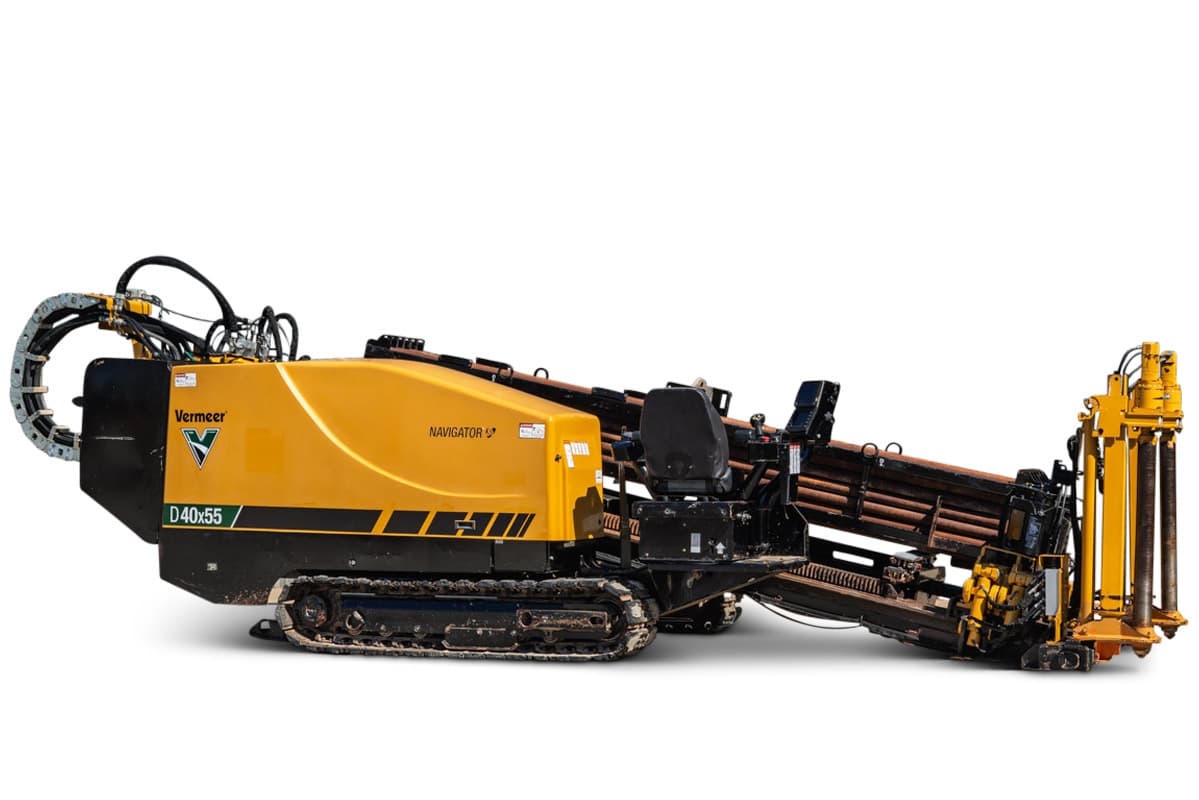
2021 Vermeer 40x55 S3
$299,000
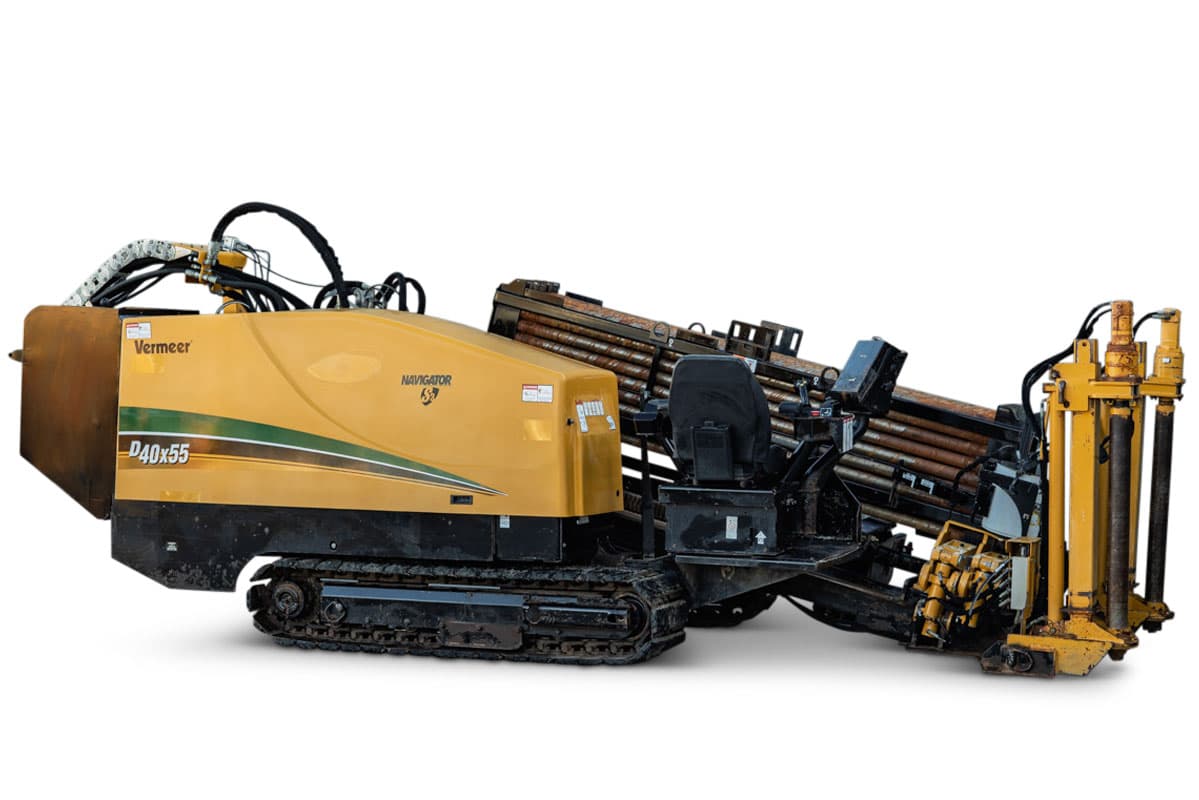
2019 Vermeer 40x55 S3
$199,000
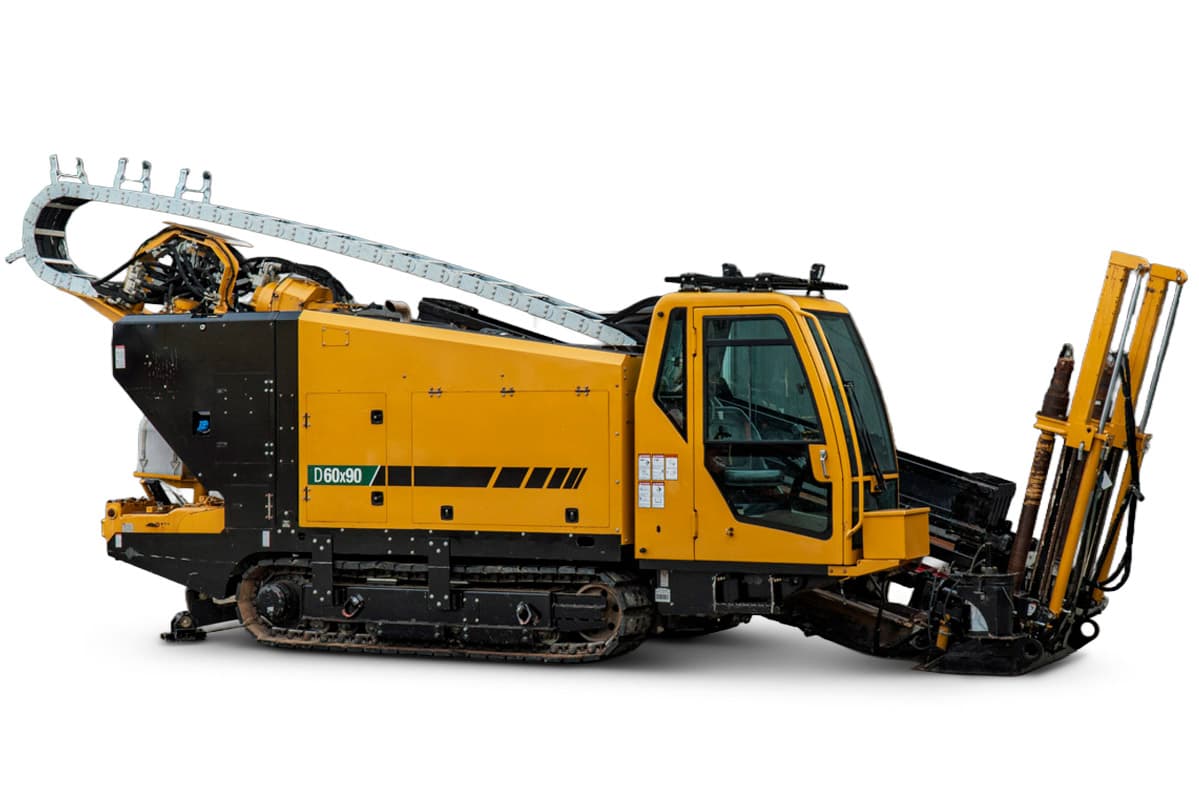
2020 Vermeer D60x90 S3
$469,000
Want a quote today? Call (877) 288-0280.
Dealer network and parts: the part most buyers underweight
Ditch Witch runs a dealer model of roughly 170 dealers across 110 countries, anchored by the CMW family of companies (SubSite, American Augers, HammerHead, Radius HDD, MTI). Its density is strongest in the South, the Texas and Oklahoma corridor, and the Midwest, and thinner in the Northeast and Pacific Northwest. Older JT parts are also broadly available from third-party suppliers, which is part of the independent-serviceability story.
Vermeer sells through independently owned regional dealer groups across more than 60 countries, with US density comparable to Ditch Witch and an edge in the Midwest around its Iowa home. Its Confidence Plus program builds genuine-parts maintenance into pre-paid, transferable plans, and vermeerused.com gives the brand a single national used-equipment storefront. The tradeoff: the S3-generation CAN bus electronics increasingly push fault-code reading and calibration toward dealer tools, so independent shops can do the mechanical work but hit limits on the electronics.
The local-dealer rule
For most buyers, the quality of your nearest dealer matters more than any spec difference between the brands. The same buyer will have a very different ownership experience behind a strong dealer than behind a weak one, regardless of badge. Before you decide, visit both your closest Ditch Witch and Vermeer dealers, and talk to the service manager, not just the salesperson. Ask about parts lead times, loaner availability, and field-service response.
Resale and total cost of ownership
Rather than quote asking prices scraped from across the web, here is what these machines are listed at in our own inventory right now, which we can stand behind. Within any one model, hours and condition drive most of the spread; our guide to hours on a used directional drill explains how to read a meter against an asking price.
| Machine | In stock | Asking range |
|---|---|---|
| Ditch Witch JT10 | 4 units | $84,000 to $99,000 |
| Ditch Witch JT20 | 10 units | $79,000 to $189,000 |
| Ditch Witch JT24 | 2 units | $189,000 to $199,000 |
| Ditch Witch JT28 | 2 units | $139,000 to $149,000 |
| Vermeer D10x15 S3 | 2 units | $99,000 to $109,000 |
| Vermeer D23x30 S3 | 5 units | $99,000 to $159,000 |
| Vermeer D24x40 S3 | 7 units | $99,000 to $294,000 |
| Vermeer D60x90 | 2 units | $149,002 to $469,000 |
From WorldHDD's current inventory, read live each time this page loads. These are our own asking prices, not market averages. Hours, included tooling, and condition move them substantially. For a current quote on a specific machine, contact us.
A few patterns hold up across the data. In the utility-mid class, the two brands depreciate comparably: a five to six year old machine with a few thousand hours trades in roughly the same band regardless of badge. Documentation drives value more than brand: a machine with full maintenance records sells competitively, and one without records gets discounted hard. A tooling package (drill pipe, locator, housings) can swing the price by twenty to fifty thousand dollars. On the Vermeer side, Confidence Plus service history is a documented resale support, because it proves the maintenance was done with genuine parts.
See current pricing on every machine we have: browse all used directional drills, or talk numbers with a WorldHDD specialist. Financing is available; here are your financing options for used HDD equipment.
Which brand fits your work: six buyer profiles
Where one brand has a real edge for a use case, we say so. Where they are even, we say what tips it.
Fiber and telecom (short, repetitive bores)
Genuinely competitive. The JT20 and JT24 have been fiber workhorses for years: simple mechanics, fast carriage cycles, and wide independent parts support, and the JT20's no-aftertreatment Deutz suits stop-and-go cycles. Vermeer counters with the D10x15 S3 and the new D24, where Automated Rod Exchange shortens operator training. For a first-machine fiber buyer, the Ditch Witch has the better-understood risk profile, while the Vermeer offers newer engineering and a stronger warranty path.
Utility crew (mixed gas, water, and fiber)
Genuinely competitive, and a place where the power myth gets expensive. The JT40 and the D40x55 S3 are the workhorses, and they are dead even at 40,000 lb pullback and 5,500 ft-lb torque. There is no pullback reason to choose one over the other. The tiebreaker is local dealer service quality, full stop.
Gas and power infrastructure (long, high-pullback bores)
This is the profile the old advice got most wrong. Pullback is at parity at every shared heavy rung: JT60 and D60x90 are both 60,000 lb, and at the flagship level Ditch Witch actually leads with the 120,000 lb JT120 against the 100,000 lb D100x140. So the decision is not about who pulls harder. It is about dealer-maintenance relationships (these big rigs need dealer support whichever badge you buy), dual-rod and rock capability (Vermeer's DR machines or Ditch Witch's separate AT line), and the machine's prior application history, which at this size matters more than brand.
Owner-operator with one rig
Slight edge to a Ditch Witch JT20 or JT24. A single-rig owner needs resale liquidity, independent serviceability, and broad parts availability, and the long JT production runs plus the active independent aftermarket lower downtime risk (our Ditch Witch JT series decoder maps every model and era). The exception: if you are in a Vermeer dealer stronghold with an excellent local relationship, a D23x30 S3 with Confidence Plus is very competitive, because the program caps your budget risk. The real tiebreaker, again, is local dealer quality.
Larger fleet operations
Either brand works; pick one and standardize. Fleets running ten or more machines benefit from one brand for operator training and parts stocking. SubSite electronics integrate natively with Ditch Witch, and the DigiTrak ecosystem is coherent on the Vermeer side. Both brands now ship real telematics (Vermeer InSite, Ditch Witch Orange Intel). The deciding factor is which brand has stronger dealer coverage across all the territories your fleet works in.
First-time buyer (used, under 150,000 dollars)
Buy what your closest dealer supports. In the first year, a dealer who will train your operator and answer the phone matters more than any spec. With equal dealer quality, a used Ditch Witch JT20 (we have 10 used JT20s in stock, $79,000 to $189,000 as of October 2026) gives a learning operator simpler systems to diagnose, while a Vermeer D10x15 or D20x22 at similar money offers a quieter, refined platform. If you can stretch to a new machine, the Vermeer D24's 3-year, 3,000-hour warranty plus Automated Rod Exchange is a real first-timer advantage.
Honest weaknesses, both brands
Comparison content that admits flaws is the only kind worth trusting. Here is what operators report on each side. Verify any of these on the specific machine you are considering using our used directional drill inspection checklist.
What buyers complain about on Ditch Witch
Rack-and-pinion carriage wear on the JT20 in high-cycle fiber work. Strike Alert false positives that cause annoying work stoppages on JT20-class machines. Tier 4 sensitivity on older units run at sustained low load in short-cycle work. And two lineup gaps: no Automated Rod Exchange equivalent, and no dual-rod option on the JT machines themselves (rock work pushes you to the separate AT line). There is also the unmeasured post-Toro culture concern noted earlier.
What buyers complain about on Vermeer
Hydraulic pump rebuild cost and three-tier-gearbox complexity on the big D60x90-class rigs, which is dealer-shop territory, not independent-shop territory. Vise die wear and encoder failures on the D24x40 in high-cycle applications. Sub-saver transfer damage on the smaller machines, where a neglected sub saver can quietly chew up an entire rod basket. And the broader squeeze on independent service from the CAN bus diagnostics on the S3 generation, which increasingly need dealer tools.
Locator systems: a costly gotcha buyers miss
Your locating system can lock you in or trip you up, so understand it before you buy. SubSite is Ditch Witch's own proprietary locating brand. DigiTrak is made by Digital Control Inc. (DCI), an independent company that is not owned by Vermeer, and it is the dominant aftermarket line you will see paired with Vermeer and other machines. DCI's receiver generations include the F2, F5, and Falcon families (the Aurora is a display add-on that pairs with certain receivers, not a separate locator generation).
The trap: transmitters and receivers must be matched and calibrated, and they are not all cross-compatible across generations. It is entirely possible to buy a transmitter that will not pair with your receiver. If a used machine comes with a locator, confirm exactly which receiver generation it is and which transmitters it accepts before you count on it. When in doubt, ask us or check current DigiTrak and DCI locators for a compatible setup.
So, which one?
If you came here for a single winner, we are going to disappoint you, on purpose. The honest answer is that Ditch Witch and Vermeer are matched closely enough on capability that the brand badge is one of the least important decisions you will make. Match the class to your work using the tables above. Then choose on dealer support, on whether Automated Rod Exchange or dual-rod capability solves a problem you actually have, and on the documented history of the specific machine in front of you. Do that and you will not go wrong with either brand.
Want a second opinion on a specific machine you are considering? Talk to a WorldHDD specialist. We sell both brands, so we have no reason to push you toward one. Ready to move your current rig? Here is how to trade or sell it.
Frequently asked questions
Which is better for fiber optic work, Ditch Witch or Vermeer?
It is genuinely split. The Ditch Witch JT20 and JT24 have been fiber workhorses for years thanks to simple mechanics, fast carriage cycles, and wide independent parts support, and the JT20's no-aftertreatment Deutz suits short stop-and-go cycles. Vermeer counters with the quieter D10x15 S3 and the new D24, whose Automated Rod Exchange shortens operator training. For a first machine, the Ditch Witch has a better-understood risk profile; the Vermeer offers newer engineering and a stronger warranty.
Does Vermeer or Ditch Witch have more dealers near me?
It depends entirely on your region. Ditch Witch runs about 170 dealers in 110 countries and is strongest in the South, the Texas and Oklahoma corridor, and the Midwest. Vermeer sells through independent regional dealer groups in more than 60 countries with a Midwest edge near its Iowa home. US coverage is broadly comparable. Because local dealer quality matters more than brand, look up both nearest dealers and call their service departments before deciding.
What is the main difference between the Vermeer D23x30 and the Ditch Witch JT24?
On the numbers, very little: both are 24,000 lb pullback and 3,000 ft-lb torque, and their operator noise is nearly identical at 82 versus 83 dB(A). The JT24 moves a bit more drilling fluid (40 versus 35 gpm) and has a quick carriage. The D23x30 leans on Vermeer's hydraulic refinement and Confidence Plus support. Note that Vermeer is replacing the D23x30 with the new D24, which adds Automated Rod Exchange in the same 24k class.
Is the Vermeer D24x40 a better value than the Ditch Witch JT40?
They are not actually in the same class, which is the key thing to know. Despite the "40" in its name, the Vermeer D24x40 is a 28,000 lb machine and its true match is the Ditch Witch JT28, also 28,000 lb. The JT40 is a 40,000 lb machine whose real Vermeer equivalent is the D40x55. So compare a D24x40 to a JT28, and a JT40 to a D40x55, or you will misjudge both the capability and the price.
Which brand holds resale value better, Ditch Witch or Vermeer?
There is no clear winner. In the utility-mid class the two depreciate comparably, and what really drives resale is documentation and hours, not the badge. A machine with complete maintenance records sells competitively; one without records gets discounted hard. Included tooling can swing price by twenty to fifty thousand dollars. Vermeer's Confidence Plus service history is a documented resale support because it proves genuine-parts maintenance.
Can I use the same locating system on both brands?
Partly. SubSite is Ditch Witch's proprietary system. DigiTrak, made by the independent company DCI, is an aftermarket line used across many machines including Vermeer. So a DigiTrak setup can move between brands, but a SubSite system is tied to the Ditch Witch ecosystem. More important than brand is matching the transmitter to the receiver generation, since DCI receivers (F2, F5, Falcon families) are not all cross-compatible with every transmitter.
Are Vermeer parts more expensive than Ditch Witch parts?
There is no universal answer; operators report inconsistent regional pricing for both brands. Common wear parts on the older Ditch Witch JT machines trend slightly cheaper on the aftermarket because of long production runs and broad third-party supply. Major hydraulic components are comparable dealer-side. Vermeer's Confidence Plus builds parts cost into predictable pre-paid payments, which many operators value for budgeting even when the per-part cost is not lower.
Which brand has better enclosed cab options for all-weather operation?
Both offer climate-controlled cabs on their mid-heavy and heavy machines, and an enclosed cab is worth specifying for multi-season operations and operator retention. The Ditch Witch JT40 and comparable Vermeer machines can be ordered with enclosed stations. At the smaller utility sizes, open operator stations are more common on both brands. If all-weather work is your norm, make the cab a requirement and shop the machines that offer it.
Is it true that Ditch Witch is now owned by Toro? Does that change anything?
Yes, The Toro Company acquired Charles Machine Works, the maker of Ditch Witch, in 2019 for about 700 million dollars, and operations stayed in Perry, Oklahoma. Some long-tenured operators worry that corporate ownership could dilute the product culture, but there is not enough post-2019 data to draw a conclusion. In practice, the machines you buy today are built in the same plant, and post-acquisition the brand has added telematics and remote-diagnostics tools.
What does Vermeer Confidence Plus cover, and is it worth it on a used machine?
Confidence Plus is a pre-paid maintenance program that uses genuine Vermeer parts, is honored at all participating dealers, and is transferable between owners. On a used machine it does two things: it caps your maintenance budget risk with predictable payments, and its documented service history supports resale value because it proves the work was done correctly. Whether it pays off depends on your hours and how strong your local Vermeer dealer is.
Which brand is easier for an independent shop to work on?
The older Ditch Witch JT machines have the edge, because their long production runs mean high parts commonality and many independent technicians already know them. Vermeer's S3-generation CAN bus electronics increasingly require dealer tools to read fault codes and calibrate, so independent shops can handle the mechanical work but are limited on the electronics. Both brands' newest machines trend toward dealer-ecosystem dependency through telematics and software-controlled hydraulics.
What is the real difference between the Ditch Witch JT20 and JT24?
Size and engine. The JT20 is a 20,000 lb pullback machine with 2,200 ft-lb of torque and a Deutz engine that needs no exhaust aftertreatment, which operators like for short cycles. The JT24 steps up to 24,000 lb and 3,000 ft-lb, moves more drilling fluid, and runs a Cummins F3.8 with diesel exhaust fluid. If your bores are short residential runs, the JT20 is plenty; if you want headroom for larger product and longer pulls, the JT24 is the move. Our Ditch Witch JT20 used buyer's deep-dive covers that machine end to end, including the known issues worth inspecting.
Does the Vermeer D24x40 really have more torque than the Ditch Witch JT40?
No. The JT40 produces 5,500 ft-lb of spindle torque, while the D24x40 produces 4,200 ft-lb, because the D24x40 is actually a smaller 28,000 lb machine, not a 40,000 lb one. The fair torque comparison is the JT40 against the Vermeer D40x55, and there the two are identical at 5,500 ft-lb. The Vermeer naming convention causes a lot of this confusion.
Which brand is better for long bores of 1,000 feet or more?
Neither has an inherent pullback advantage; at every shared heavy rung the brands are even, and Ditch Witch actually leads at the 120,000 lb flagship level with the JT120. For long bores, focus instead on having enough drilling-fluid capacity and the right mud system, a machine with a clean application history, and a dealer who can support a big rig. Pullback rating alone will not tell you which machine finishes the bore.
How does Vermeer's Automated Rod Exchange work, and which machines have it?
Automated Rod Exchange (ARE) automates adding and removing drill rods, reducing the manual steps where inexperienced operators over-torque, under-torque, or spin rods and damage tooling. Vermeer introduced it on the D24 in late 2024 and positions it directly against the shortage of experienced operators, citing faster onboarding and longer tooling life. It is currently a Vermeer feature; Ditch Witch has not announced an equivalent. If your crew turns over or you struggle to find seasoned hands, it is worth a serious look.
Is the Ditch Witch JT40 or the Vermeer D40x55 better for mixed utility work?
They are dead even on capability: both are 40,000 lb pullback and 5,500 ft-lb torque, the genuine workhorses of this class. There is no power reason to prefer one. Decide on your local dealer's service quality, whether you need the dual-rod capability that Vermeer offers as the D40x55DR, and the condition and history of the specific machine. For most mixed gas, water, and fiber crews, the dealer relationship is the deciding factor.
What does dual rod mean on Vermeer drills, and does Ditch Witch have something similar?
A dual-rod machine turns an inner rod inside an outer rod, giving better steering and power in hard ground and rock; Vermeer offers it as the DR variants, such as the D40x55DR. Ditch Witch does not put dual-rod on its standard JT drills. Its answer to rock is a separate product line, the All Terrain (AT) series, which uses its own dual-rod design. So both brands can drill rock, but you reach it differently: a DR option on Vermeer, a dedicated AT machine on Ditch Witch.
Which machine is better suited to rocky or cobble conditions?
For genuine rock, you want a dual-rod machine from either brand rather than a standard single-rod drill. On the Vermeer side that means a DR model like the D40x55DR; on the Ditch Witch side it means the separate All Terrain (AT) line. A standard JT or D-series machine can handle occasional cobble with the right tooling, but sustained rock drilling will wear a single-rod machine quickly. Tell us your soil conditions and we will point you to the right tool.
How do I compare total cost of ownership between a used Ditch Witch and a used Vermeer at the same price?
Look past the sticker at four things: documented maintenance history (the single biggest value driver), the strength of your local dealer for parts and service, what tooling is included (a package can be worth twenty to fifty thousand dollars), and the cost profile of likely repairs for that model. Run the full inspection on each machine before you compare, since a cheaper machine with hidden wear is not cheaper. Our inspection checklist walks through exactly what to check.
If I am starting with one machine and want to grow a fleet, which brand should I commit to?
Commit to the brand whose dealer will support you best across the territories you plan to work in, because standardizing on one brand simplifies operator training, parts stocking, and locating systems as you scale. Both brands support fleets well: SubSite integrates natively with Ditch Witch, the DigiTrak ecosystem is coherent with Vermeer, and both offer telematics. Pick the dealer relationship you trust, then standardize, rather than choosing on a spec difference that barely exists.
Sources and references. The specifications in this article were verified against the manufacturers' official spec sheets and product literature in May 2026 and re-verified in July 2026.
- Ditch Witch directional drill lineup and specifications (Charles Machine Works)
- Ditch Witch JT20 specification sheet (PDF)
- Ditch Witch JT24 specification sheet (PDF)
- Vermeer utility directional drill lineup and specifications
- Vermeer D23x30 S3 specification sheet (PDF)
- Vermeer D24x40 S3 specification sheet (PDF)
- Vermeer: Operators React to the New D24 HDD (source for the Automated Rod Exchange details)
- Digital Control Inc. (DigiTrak locating systems)
- Trenchless Technology: the Toro Company acquisition of Charles Machine Works
Equipment specifications and current model lineups change over time. Always confirm against the latest OEM documentation for the specific machine you are considering, or contact us and we will pull the numbers for you.