
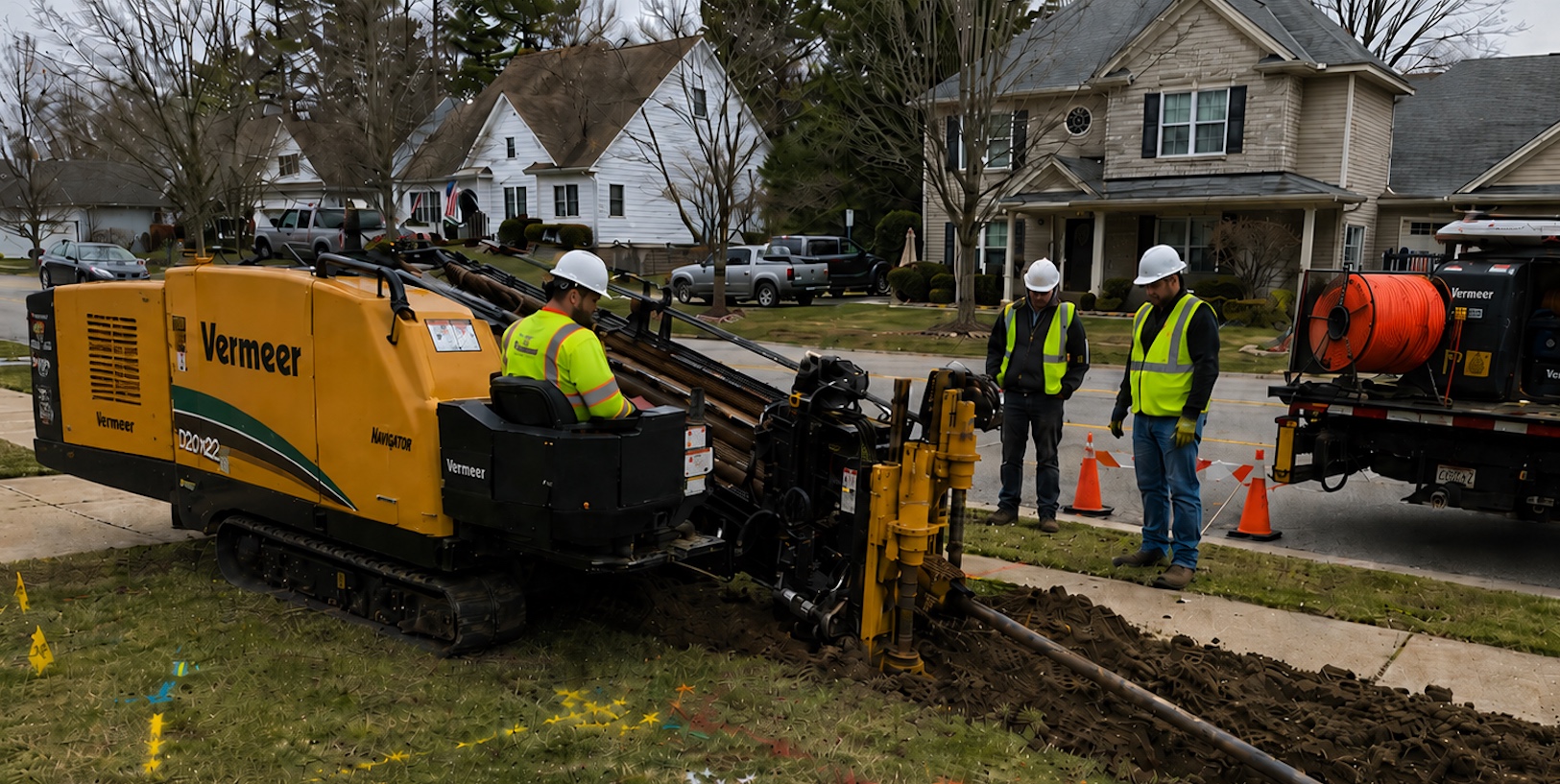
If you are about to spend eighty to two hundred thousand dollars on a used directional drill, the next two hours of your life matter more than any number on the sticker. This is the inspection sequence we use to accept machines into WorldHDD inventory, written so you can take it to a seller's yard, work through it on the side of a flatbed, and walk back to your truck knowing exactly what you are buying.
Free printable PDF. Every check below, plus pass/fail boxes, spec-reference fields, and a final decision matrix, fits on six pages you can clip to a clipboard. Get the printable inspection checklist →
Why a used HDD inspection is not a "used heavy equipment" inspection
A directional drill is not a skid steer. Skid steers fail in obvious ways: hydraulic puddles, broken hoses, loose pins. A drill rig fails in ways you cannot see standing next to it: thread profile worn one one-hundredth of an inch past spec, a hydraulic pump that holds idle pressure but loses it under thrust, a Tier 4 engine whose ECM has logged forty failed regenerations the seller will never mention.
The result: most generic "used heavy equipment" checklists miss the things that actually cost money on a used HDD. The 2012 EquipmentWorld inspection guide that still ranks for this query was written when Tier 4 engines, telematics, and DPF systems did not yet exist on these machines. The checklist below assumes the rig has all three.
It also assumes you can ask one question (where did this machine work?) and that the honest answer is more predictive than the hour meter. A three-thousand-hour rig that pulled fiber drops in residential soil is a different machine than a three-thousand-hour rig that pulled gas main through abrasive gravel at thirty-five-thousand pounds. We will come back to that distinction.
Before you go: documentation and pre-inspection prep
Request the following from the seller before the visit. What they will not send tells you nearly as much as what they will.
- Full maintenance log. Filter intervals, fluid changes, parts replaced. Handwritten is fine if it is consistent.
- ECM / telematics download. Any rig built after roughly 2013 has it. Ask for actual operating hours (not idle), fault code history, regen history, and idle ratios.
- Most recent oil analysis report. Most fleets send samples to a lab like Polaris or Blackstone at every change. If the seller does not, that is information.
- Hydraulic pressure test results, if available, against the model's published spec.
- Title and lien status. Run the serial number through your state's UCC lien search before you sign anything. Banks repossess HDD rigs the same way they repossess pickups.
- OEM Technical Service Bulletin (TSB) compliance for this serial. Your local Vermeer or Ditch Witch dealer can pull it.
- Prior application: fiber, utility, gas main, or oil-and-gas. Ask in writing.
Bring with you: dial calipers, a thread profile gauge, a flashlight, a magnet (for finding hidden body filler), a phone with the camera ready, and a notepad. If the seller has fewer than three of those in their own shop, that is also information.
Take the checklist to one of these
Used drills we have in stock today.
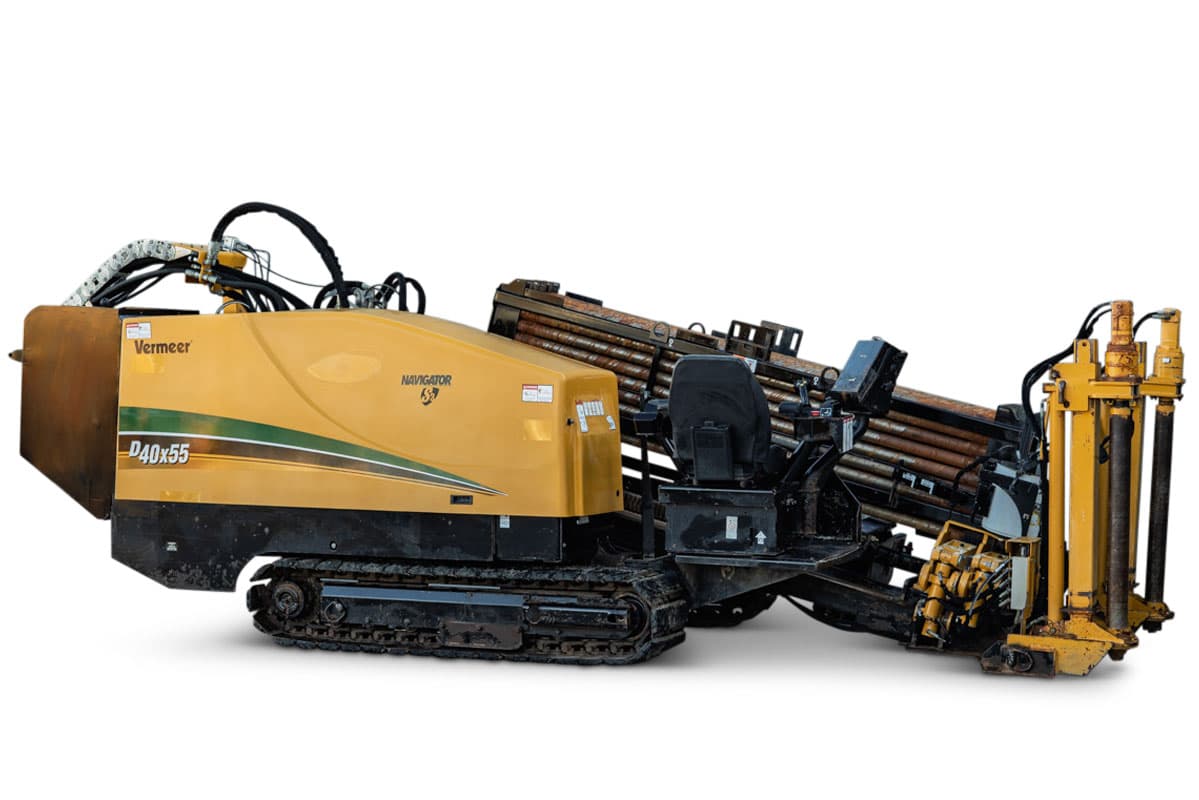
2019 Vermeer 40x55 S3
$199,000
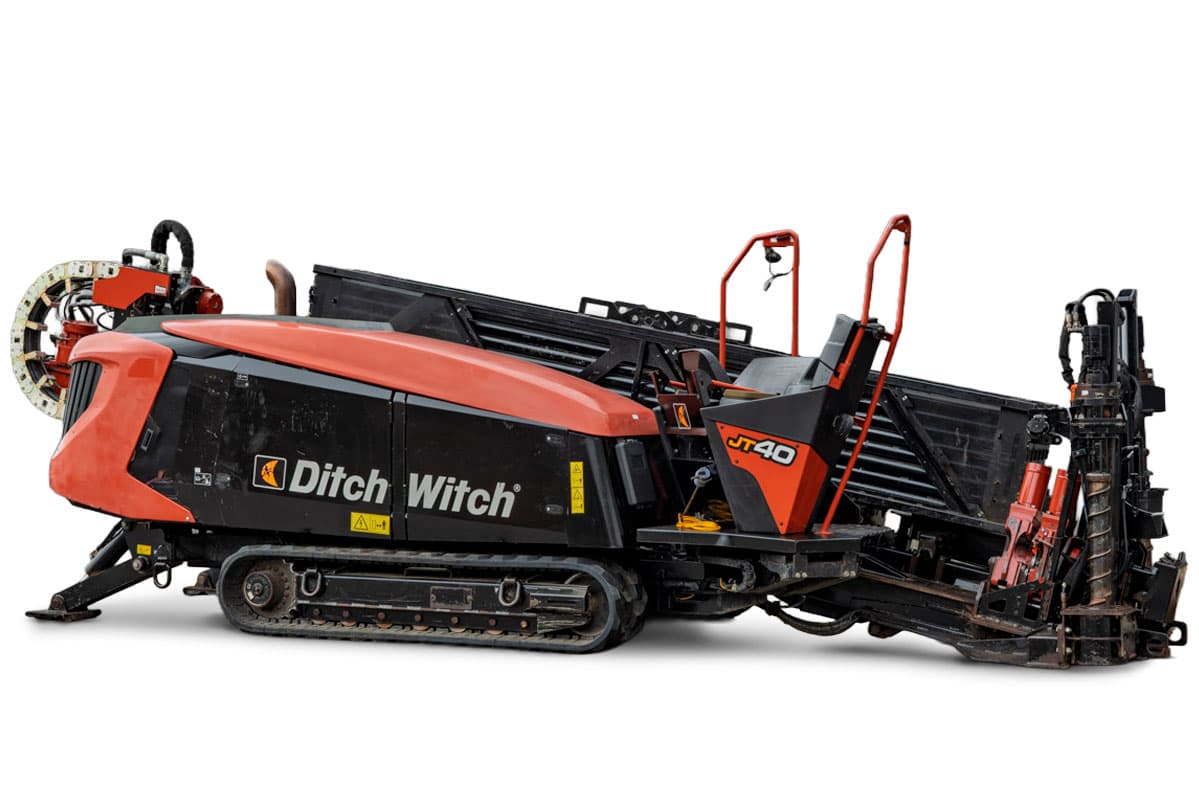
2021 Ditch Witch JT40
SALE PENDING
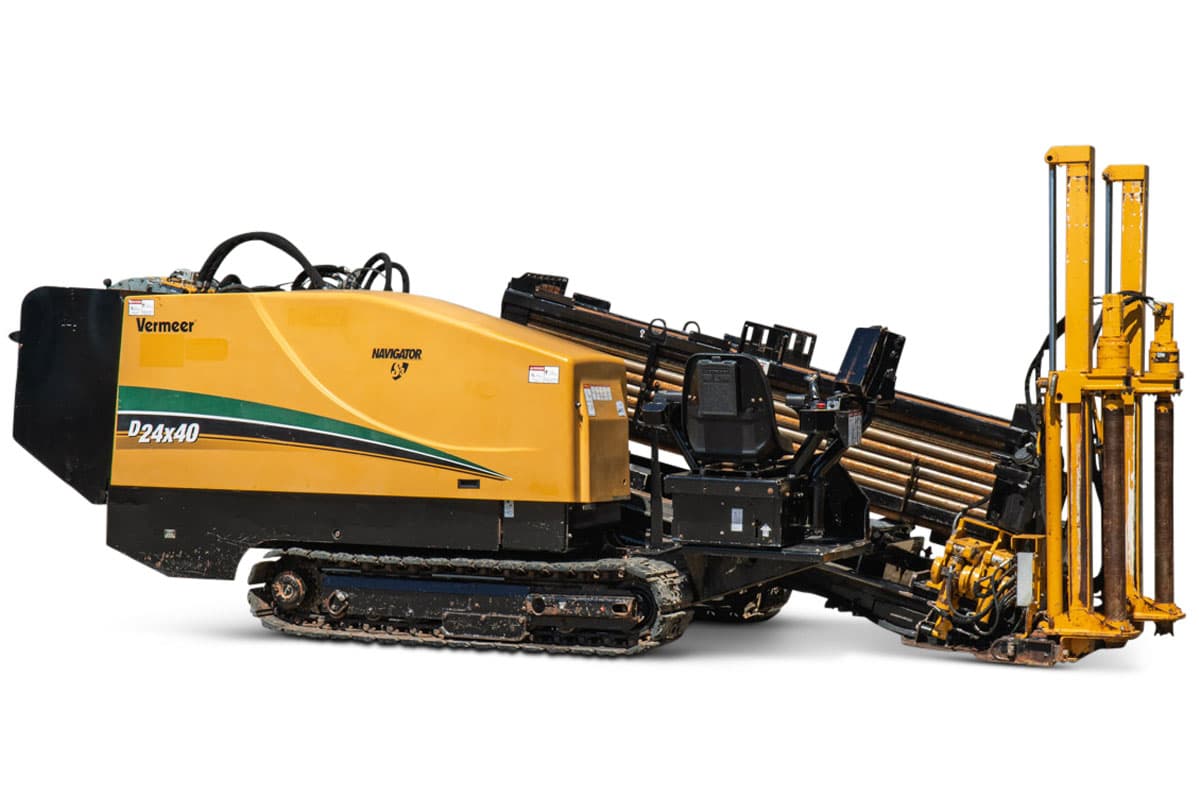
2020 Vermeer D24x40 S3
$179,000
Want a quote today? Call (877) 288-0280.
The nine inspection systems
What follows is the actual sequence used by WorldHDD's intake technicians when a trade-in or buy comes through our yard. You can run it in this order in roughly two hours on a single machine. Skip nothing. Every system below has at least one failure mode that is invisible until you look directly at it.
System 1. Frame and structural integrity
Start by walking the rig from the back, sighting down the length of the boom (what Ditch Witch calls the "rack" and Vermeer calls the carriage track). The rack should look straight as a rifle barrel. Any bow, twist, or kink tells you the machine took an overload event or hit something immovable. A frame that is even slightly out of alignment will eat the rack-and-pinion, the carriage slide, and the gearbox at an accelerated rate for the rest of its life.
What to check:
- Sight the rack from front and rear. Take photos.
- Inspect every frame weld, especially where the stabilizer arms attach. Stress cracks radiate outward from weld toes.
- Look hard at the anchor and stakedown cylinder mounting points. Bent shafts, cracked ears, and recent weld repair all indicate ground that fought back.
- Check the stabilizer attachment points on both sides for cracking under load. On a JT20-class rig, stabilizers transfer roughly eleven thousand pounds into the frame on hard ground.
- Run your hand over the paint. Mismatched panels, overspray on hose carriers, or body filler under a magnet test all mean a cosmetic cover-up, usually of a frame repair.
Red flag. Any visible weld repair on the main rack channel. A broken HDD frame is, in the words of a 45-year Ditch Witch service manager interviewed by EquipmentWorld, "difficult to repair," and component misalignment after a repair is what costs the next owner real money.
Only detectable while running: Whether the carriage tracks straight during thrust and pullback without crabbing, binding, or audible grinding. Save that observation for the live demo (System 9).
System 2. Drill stem and pullback rod
This is the system that breaks the most deals and that buyers most often get wrong. Rods are a wear item. A full string for a mid-size rig costs in the five figures (our HDD drill pipe cost guide puts numbers on it, per rod and per string). Worn rods break underground, and a rod break is a total-loss event for the joint and a day-ender for the bore.
What to check:
- Measure the OD of the drill pipe with calipers at several points along its length. Compare to the OEM factory spec. Ditch Witch publishes this number; Vermeer publishes it; your dealer can confirm it. Wear beyond thirty to forty thousandths of an inch from spec is the threshold: Ditch Witch's own replacement guidance calls it out directly. At roughly half wall thickness, the pipe's failure risk under bending forces becomes real.
- Inspect the thread profile on the pin (male) end with a thread profile gauge. Hold the gauge up to a light. If you see light between the threads and the gauge, the threads are worn past life. Sharp or rounded thread crests both mean replacement.
- Look for Ditch Witch's forged wear-indicator grooves on the male tool joint. They are visual aids that show the engineered wear allowance: Ditch Witch's published replacement guidance says when the grooves disappear, the pipe is at end of life. Vermeer does not use grooves; on Vermeer pipe, the OD measurement is the only proxy.
- Roll each rod on a flat surface. A slight wobble suggests a bend. A pronounced wobble is a reject. Slightly bent rods can be salvaged in a pinch; severely bent rods will not pass back through the pipe boxes cleanly.
- Count the rods. Get the count in writing on the bill of sale. A full rack on a JT2020-class rig is typically forty rods and represents a five-figure replacement cost.
- Confirm the manufacturer. A rod basket of aftermarket pipe with no traceable origin is worth less than the same count of OEM Ditch Witch or Vermeer pipe, even when nominally new.
- Inspect the sub saver. The sub saver is a small, cheap, threaded piece between the spindle and the first rod. Its job is to absorb the wear that would otherwise transfer to the rod basket. Per Vermeer's published guidance, the sub saver has no fixed replacement interval. It should be inspected with a thread profile gauge after every job, and replaced when the thread crests round over or jag. If the previous owner did not inspect it regularly, the damage already transferred to the rods.
Red flag. Thread wear visible to the naked eye, without a gauge. Rods with welds, hammer marks, or visible field repair. A seller who cannot tell you the last time the sub saver was inspected.
The sub saver is the most underrated risk in used HDD. It is the part nobody photographs in the listing. It is the part the seller forgets to mention. And it is the part that silently destroys a forty-rod basket while the operator has no idea. Inspect rods first; trust nothing the seller says about sub-saver maintenance until you have seen the threads yourself.
Only detectable while running: Whether the rod loader picks up and seats each rod cleanly without jamming, dropping, or misaligning.
System 3. Engine and powertrain
On any rig built after 2013, the engine inspection starts with one request: pull the ECM data. Telematics is no longer a luxury; it is the most honest record you have. Idle ratios, regen history, fault codes, derate events. All of it lives in non-volatile memory regardless of what the operator chooses to mention.
What to check:
- Actual operating hours versus what the dash hour meter reads. They usually agree; when they do not, ask why.
- Fault code history, both active and historical. A cleared fault history with no service paperwork is itself a fault.
- DPF regen frequency. Active regens are normal; failed regens or back-to-back regens indicate either sustained low-load operation that loads the filter too quickly, or a filter that is past its service life. Modern telematics typically logs derate and regen events before a hard fault code surfaces on the dash, so the data is in there.
- Idle ratio. A rig that idled forty percent of its life worked harder per operating hour than the hour meter suggests.
- Oil on the dipstick. Grayish or milky means coolant intrusion. Black and thick without recent service paperwork means oil neglected.
- Most recent oil analysis report. Iron and copper levels indicate bearing wear; silicon indicates dirt or seal failure.
- Air filter restriction indicator. Collapsed or red-zoned means the machine ran through its filter service interval more than once.
- Coolant. Rust-brown tells you nobody added inhibitor for years.
- Date stamps handwritten on the fuel and air filter canisters. Undated filters, or filters older than the manufacturer's interval, tell you about the maintenance culture.
- Cold start. Listen for fifteen to thirty seconds before the operator brings throttle up. Knock, rattle, or persistent blow-by smoke is disqualifying on its own.
Red flag. Missing or inoperable ECM on a Tier 4 machine. Any DPF delete or emissions tampering. A regulatory liability for the next owner, and almost always a signal that the engine was run hard by someone who did not invest in keeping it healthy.
Only detectable while running: Exhaust color under load. Blue is burning oil. Black is rich or overloaded. White that persists past warm-up is coolant burn. None of these are acceptable in a machine you are about to buy.
System 4. Hydraulic system
Hydraulics are where surprise costs live. A pump or motor rebuild on a mid-size rig is a five-figure event, and the failure modes are subtle. A machine that holds pressure at idle can cavitate or drop pressure under sustained thrust. You will only see it during a real bore, not a walk-around.
What to check:
- Hydraulic pressure test results, against the model's published spec. Thrust, rotation, and auxiliary circuits each have their own targets. If the seller does not have test results, pay the local OEM dealer two hours of shop rate to run them before you buy. We come back to this in the "Should I pay for a pre-purchase inspection" question below.
- Fluid color. Amber-clear is healthy. Dark or black means oxidation and heat stress. Milky means water contamination, which means contaminated bearings.
- Hose age. Hoses do not last forever; manufacturers rate them at five to seven years regardless of hours. Brittle, cracked, or bulging hoses are safety items. Hose-clamp field repairs are bandages, not fixes. They tell you the operator did not stop to do it right.
- O-ring fittings and manifold faces for seepage. O-ring leaks are cheap to fix; manifold-face damage is not.
- Under the machine. Active drips below the carriage, stabilizers, or stakedowns are cost items you will inherit on day one.
- Hydraulic filter bypass indicator. If it is tripped, the system was running on unfiltered fluid, and the contamination is now distributed through every component.
- Tank bottom for white emulsion. Past water ingestion never fully cleans up.
Red flag. Dark, degraded fluid with no service paperwork. A hydraulic pump or motor that was replaced without a documented reason in the maintenance log. That almost always means the system ran contaminated and the replacement is a symptom, not a fix. Industry rule of thumb: a hydraulic pump rebuild runs roughly half the cost of new, and on a mid-size rig that is well into five figures.
Only detectable while running: Whether full thrust and pullback pressures hold under sustained load, not just at idle.
System 5. Electrical and control system
HDD rigs live in salt water, mud, sun, and freezing winters. The wiring harness is a harsh-environment component, and it shows.
What to check:
- Pull stored fault codes from the controller in addition to the ECM. Drive controllers, joystick controllers, and AutoDrill modules each maintain their own logs.
- Walk the entire wiring harness: engine compartment, around the stakedowns, under the carriage, across the hose carrier. Look for chafing, heat damage, or any splice that is not a factory butt connector with proper heat-shrink.
- Test every rocker switch on the operator panel individually. Worn joystick potentiometers cause erratic carriage movement; vise and wrench switches that fail to engage are how operators round off pipe shoulders.
- Inspect the operator display. Cracked screens and non-functional segments are real money on older units, especially on display generations that the OEM has since superseded.
- Check encoder mounts. Thrust and rotation encoders track carriage position and power AutoDrill features. Loose set screws and broken mounts are common, and a failing encoder makes the AutoDrill the operator paid extra for unusable.
- Test the electronic ground drive / remote lanyard. Must be present, charged, and functional.
- On Tier 4 machines, verify the DEF system is functional and the tank has fluid. A non-functional DEF system derates the engine within a defined time window.
Red flag. Visible spliced or taped harness repairs. Joysticks with free-play or hesitation. Any controller showing a cleared fault history without paperwork to explain why.
Only detectable while running: Whether the display reads all parameters correctly during a live bore (depth, thrust pressure, rotation RPM) and whether AutoDrill engages and holds setpoints.
System 6. Tracks and undercarriage
Tracks are a wear item priced like a wear item. Worn tracks on a slope are dangerous. Worn sprockets that drive new tracks will chew the new tracks within a single season.
What to check:
- Cleat or bar lug depth. Worn cleats slip in soft ground and on grades. A full track replacement on a mid-size class is generally in the low four figures per side, depending on model, and the bill includes labor.
- Rollers, idlers, and drive sprockets for seal leaks, flat spots, and worn teeth. Hook-shaped or sharply pointed sprocket teeth indicate the sprocket is at end of life. If you replace one without the other, the new component wears to match the old one quickly.
- Track tension. If the adjuster is fully extended, the track has stretched to the end of its service life and is about to need replacement regardless of tread depth.
- Rubber track condition on rubber-tracked rigs: exposed cord, cuts, de-bonded cleats.
- Frame rails at the undercarriage mounting points. Elongated bolt holes mean the machine ran with loose components, and the wear is now distributed through the structural rail itself.
Red flag. Oil leaking from any track roller or idler. Hooked sprocket teeth on the same side as new-looking track. The seller replaced the cheap component to make the rig look better.
Only detectable while running: Whether the rig tracks straight without pulling, and whether tracks stay engaged on a grade.
System 7. Mud system integration
The mud pump is a small but critical part of the rig. According to the Drillmaster Advisory Board (Vermeer and Ditch Witch specialists writing in Trenchless Technology), roughly seventy percent of field mistakes trace back to poor mud quality or neglected pump maintenance.
What to check:
- If the mud pump is on-board, run it. Time the fill of a known container; reduced flow against the published spec indicates worn pistons, valves, or liners. Everything in the pump except the crank itself is a wear part.
- Suction and discharge valves are the first wear points. Pop the covers if the seller will let you.
- Piston wash reservoir. Dirty or absent wash water indicates piston scoring. Look for residue and evidence of regular cleaning.
- Leaks at manifold connections from the drill body to any external mixing or pumping system.
- Crankcase oil on the mud pump engine, if it has a separate power unit.
- Pressure capability with a gauge. Spec varies by model and application, but the published number for that rig is the number to test against.
- Mixing equipment if the deal includes a separate mixing truck or trailer: tank condition, plumbing, transfer pump, all inspected as a separate unit.
- Camlock fittings on the manifold. Worn locks leak, leaks make air slugs, and air slugs make inconsistent mud.
Red flag. A significant drop in pump efficiency versus spec: slow fill times, low pressure under load. Evidence the pump was run with abrasive or contaminated water: scaled reservoirs, deeply scored pistons.
Only detectable while running: Whether pump pressure holds at the spec PSI under sustained load. Whether the mixing manifold delivers consistent flow without air slugs.
System 8. Documentation, ownership chain, and prior environment
This is the section that separates an experienced buyer from a first-time buyer. Hours are a proxy. Prior environment is the verdict.
What to check:
- Complete maintenance log. Treat it the way a used-car buyer treats a service-record binder. Inconsistency is information.
- Ownership chain. Run a UCC lien search on the serial number through the appropriate state's secretary of state filing system. A few hours of paperwork is worth catching a bank lien before you sign.
- Prior application, in writing. Ask specifically:
- Fiber and telecom: short, frequent, light bores, usually residential or commercial corridor work. Easy on rods and pumps.
- Power and gas distribution: fewer, harder bores with significant pullback. Harder on hydraulics.
- Oil-and-gas or large-diameter pipeline: extreme pullback loads, abrasive soils, often contaminated drilling fluids. Hardest on every component on the rig.
- Prior operator's name and phone number, if possible. Dealer trade-ins almost always allow this. A real operator will tell you in three minutes what the seller will not tell you in three hours.
- TSB (Technical Service Bulletin) compliance against this serial number, through the OEM dealer. Bulletins that were never completed are deferred maintenance you inherit.
- Hard-rock or oil-field history. Both of those environments stress drill strings and hydraulics in ways the standard utility duty cycle does not.
Red flag. "I don't have the records" combined with high hours equals a walk, unless the price reflects unknown risk. Any oil-field machine without documented fluid changes. Drilling mud contamination destroys seals and hydraulics over time, subtly enough that the rig still seems fine right up until it does not.
Prior environment is more predictive than hours. A three-thousand-hour fiber rig that lived in residential soil is worth meaningfully more than a three-thousand-hour gas-main rig that lived at thirty-five thousand pounds of pullback in abrasive gravel. Ask. Verify. Write it on the bill of sale.
Take this list to the seller's yard. The printable PDF version of this checklist includes pass / needs-work / fail boxes for every item above, plus spec-reference fields you can fill in with calipers in hand. Download the printable inspection PDF →
System 9. The live demo test bore
Everything above is a static inspection. The last thirty minutes are dynamic. A seller who is confident in the machine will run it for you. A seller who is not will find a reason to skip something.
Ask for this sequence, in this order:
- Cold start. If the machine is sitting warm when you arrive, leave it sit and come back. A cold start is non-negotiable.
- Stabilizers down, one side at a time. Confirms independent hydraulic function on each leg, which keeps a rig level on a grade.
- Full rod loader cycle. Pick up a rod, present it to the spindle, and load it. Then unload it. Misalignment or binding is wear; if every rod jams, the loader is at end of life.
- Thrust forward and pullback, with the spindle empty. Listen for cavitation in the pump and watch the pressure gauge for drop-off.
- Rotation left and right at full RPM. Confirms rotation gearbox and motor are healthy.
- Front and rear vise. Torque a joint together and break it out at the spec listed in the operator's manual. Excessive play in the vise dies, or chatter on the wrench, indicates a rebuild is in your future.
- On-board water pump. Verify flow through the spindle and out the bit.
- Fifteen minutes under load. Watch the engine coolant temperature and the hydraulic oil temperature climb. Rapid temperature rise indicates a cooling or hydraulic problem.
If a seller refuses any of these steps, they are telling you the machine has a known issue they would rather not have discovered. That is itself a valid data point. Decide accordingly.
Brand and model gotchas
OEM internal failure-mode data is not public. The patterns below reflect what we and other dealer technicians see across hundreds of intake inspections, supplemented by published OEM service guidance and trade publications.
Ditch Witch JT20 / JT24 / JT25
- Rack wear. JT20-class racks tend to wear faster than competitors at similar hours. A JT20 with high hours and no documented rack replacement should have the rack inspected for sharp or worn pinion teeth, a reliable proxy for how hard the machine was run.
- Strike Alert sensor. The electrical-line proximity sensor on the JT20 family is known to throw false positives, or to go inoperative. Test it. The sensor itself is inexpensive; an inoperative sensor on a rig you take to a job is regulatory exposure.
- Tier 4 DPF behavior. Post-2012 Tier 4 versions accumulate soot faster in short-cycle, low-load urban fiber work. Pull the regen history before you make an offer.
Ditch Witch JT30 / JT40
- Carriage slide wear. Higher class equals more carriage slide stress. Adjustable slides require weekly inspection per OEM guidance. A visibly loose carriage is a cost item.
- Stakedown cylinder mounting ears are known to crack under repeated hard-ground anchoring. Look closely at the weld area.
- Hydraulic manifold O-rings are a documented service item on the JT40 class. If you see seepage, plan to address it before the next bore.
Vermeer D10x15 / D20x22
- Sub-saver damage transfer. Small Vermeers with neglected sub savers reliably transferred thread damage to the entire rod basket before the previous owner caught it. Verify rod thread condition independently of any seller claim about sub-saver maintenance.
- Carriage wear pads are routine maintenance; Vermeer product specialists call out carriage slides as a high-wear area to inspect on any used buy. Check for excessive side-to-side movement at the gearbox.
- Rod loader wear pads on the D23x30 are a documented maintenance-intensive item.
Vermeer D23x30 / D24x40
- Vise die wear, especially on the D24x40 S3 and the D40x55 S3. Worn dies packed with dirt are the most common cause of rod slippage and unplanned Strike Alert events. Inspect dies with a wire brush during the walk-around.
- Encoder failures. Thrust and rotation encoders on the D24x40 class have known failure modes from loose set screws. Verify AutoDrill responds correctly during the demo.
- Carriage slide tightness. Adjustable models require weekly adjustment. No slide adjustment history equals excessive gearbox movement and potential rod box damage.
Vermeer D60x90
- Hydraulic pump capacity. The D60x90 runs a high-output engine driving high-flow hydraulic circuits. High hours with no documented pump rebuild or replacement is grounds for a full pressure test on every circuit before you sign.
- Three-speed gearbox on the D60x90 S3. Confirm all three ranges engage and disengage cleanly. Slippage is gearbox wear.
- Prior application matters more on heavy class. Heavy rigs are often used in oil-and-gas or large infrastructure. A heavy rig that lived in abrasive consolidated ground has accelerated wear on mud pump and downhole components that a utility-duty rig of the same hours does not.
DigiTrak locator integration (rig side)
- Rig-side connection is through the sub saver and the beacon housing. A cracked or water-damaged housing is the precursor to electronic failures.
- Generation compatibility. The current DigiTrak generation is Falcon (F1, F2, F5), with the Aurora touchscreen as the optional display on Falcon F5 receivers. Older Mark Series and Eclipse transmitters are not cross-compatible with Falcon receivers. Confirm transmitter generation and frequency band match the receiver in the deal before you assume the locator package is usable. When in doubt, Digital Control's published compatibility notes are the source of truth; their support line will confirm a specific pairing in five minutes.
- During the demo bore, verify depth readings are stable at multiple positions and that the target / ball-in-box display responds correctly to transmitter movement. Calibration drift is an expensive way to mis-locate a bore.
Hours by class: a reference table
Treat the numbers below as bands, not lines. A small machine punished hard hits its rebuild interval faster per hour than a large machine in moderate utility duty.
Class | Typical use case | "Normal" hours | "High hours" threshold | Major rebuild typically at |
|---|---|---|---|---|
Mini / micro D9x13, D10x15, JT10, JT20 | Fiber, telecom, residential utility | 500 – 2,500 | 3,000+ | 2,500 – 3,500 |
Utility mid D20x22, D23x30, D24x40, JT24, JT25 | Multi-use utility: power, water, fiber | 1,500 – 4,000 | 4,500 – 5,000 | 4,000 – 5,000 |
Mid-heavy D36x50, JT30, JT40 | Larger utility, small infrastructure | 2,000 – 5,500 | 6,000+ | 5,000 – 6,000 |
Heavy D60x90, JT4020 / Mach 1 | Infrastructure, gas main, larger crossings | 3,000 – 8,000 | 8,000 – 10,000 | 6,000 – 8,000 |
The average life of a drill rig is about 5,000 hours before major components will start to wear out… but you can see some drills at 2,500 hours that are completely worn out.
Richard Levings, Ditch Witch, via ForConstructionPros
Two rigs at the same hour reading can be ten years apart in real wear. We treat the hours question in detail in a separate article; the short version is that hours are a starting point, not a verdict.
Walk-away red flags
If you see any of the following, the price has to fall dramatically, or the deal does not exist.
- Visible weld repair on the main rack channel.
- Frame bow you can sight down the rack.
- Disabled, deleted, or non-functional DPF / DEF / Tier 4 emissions system.
- ECM that has been wiped, replaced, or shows a cleared fault history with no service paperwork.
- Hydraulic fluid that is dark, milky, or shows particulate.
- Drill pipe OD worn more than forty thousandths from spec across the rack.
- Vise dies that visibly shear or slip during a torque test.
- Seller refuses the live demo, or refuses to allow a pre-purchase inspection by a third-party dealer.
- No maintenance records, no oil analysis history, no ECM download, and the price is at retail.
How WorldHDD inspects machines we accept
Every directional drill that enters WorldHDD inventory runs through this same nine-system protocol. The intake technician fills out the same form you can download below. Items that fail are repaired before the rig is listed; items that need work are disclosed on the listing. Items that walk the rig back out the gate, walk it out the gate.
This article is built from that internal process. The PDF version of the checklist is the form we hand a customer who wants to inspect a machine they found themselves, before they bring it to us, or before they sign a private-party deal we will not be involved in.
Conclusion: the inspection is the deal
A used directional drill is not a commodity. Two rigs at the same model, same year, same hour reading are almost never the same machine. The only way to know which one you are buying is to look at the systems above with your own eyes, with calipers and a thread gauge in hand, with the ECM data downloaded and the maintenance log printed out next to you.
That is a two-hour job. On a machine you are about to wire money against, two hours is the best return on time in the entire transaction. If you are on the selling side of this inspection, the same nine systems set the number you can credibly ask: see what is my used directional drill worth.
Take this checklist with you. The printable PDF includes pass / needs-work / fail boxes for every check, spec-reference fields for caliper readings, a test-bore observation form, and a final decision matrix. Download the printable inspection PDF →
Looking at a finalist? Every rig in WorldHDD inventory has already passed this protocol. Browse pre-inspected used directional drills →
Narrowed it down to one machine? Talk to a WorldHDD specialist before you sign. We will tell you what we see, even when the rig is not one of ours. Talk to a specialist →
Frequently asked questions
1. How many hours is too many on a used JT20 or D24x40?
On a JT20-class machine, most fleets begin to see major component wear between 2,500 and 3,500 hours; above 3,000 hours is "high hours" territory and should be priced accordingly. On a larger utility-mid machine like the D24x40, the rebuild window runs later (typically 5,000 to 6,000 hours), but the same caveat applies: prior application matters as much as the hour reading. A 3,500-hour JT20 that lived on fiber drops is worth more than a 2,500-hour JT20 that pulled gas main in abrasive ground. See the longer treatment of this question.
2. The seller says the machine runs great but won't let me take it to a dealer for inspection. Is that a red flag?
Yes. A reasonable seller permits an independent pre-purchase inspection at the buyer's expense and on the buyer's schedule. A seller who refuses is either hiding something or telling you they would rather you walk than have the rig examined by a technician who has seen this model fail. Either way, the answer for you is the same: do not buy the machine. The cost of an inspection on an $80,000–$200,000 deal is a fraction of one percent of the purchase price.
3. What's the difference between rack-and-pinion and chain drive on older rigs, and does it matter for a used purchase?
Most modern utility-class HDD rigs use rack-and-pinion drive on the carriage: a fixed gear rack along the boom that the carriage's pinion gear meshes against. Some older or smaller rigs used chain drive. Rack-and-pinion is more precise and easier to inspect (you can see worn pinion teeth and a worn rack with the naked eye). Chain drive is harder to inspect and tends to introduce slack as it wears, which translates to imprecise thrust control. For a used purchase, a rack-and-pinion machine in good condition is generally easier to evaluate and easier to maintain.
4. How do I tell if drill pipe has been stressed without it being visibly bent?
Roll each rod on a flat surface and watch for wobble. Even slight wobble indicates a bend. Measure the OD with calipers at the middle of each rod and compare to the OEM factory spec; wear beyond thirty to forty thousandths of an inch from spec is your replacement threshold. Inspect the threads on each pin end with a thread profile gauge. Look at the wear-indicator grooves if the pipe is Ditch Witch forged. Disappearing grooves mean end of life. None of these checks require taking the rod out of the basket.
5. The machine has a Tier 4 engine but the DPF was deleted. What does that mean for me?
DPF deletes on Tier 4 construction equipment are illegal under EPA regulations and carry significant civil penalties for the operator. Beyond the legal exposure, a delete almost always signals an engine that was run hard without proper regen discipline by an operator who would rather bypass the emissions system than maintain it. Walk away from a deleted machine unless the price reflects a full emissions system restoration cost, which on a mid-size rig is a five-figure investment.
6. I'm buying through an online auction and can't inspect in person. What's the minimum I need to confirm?
Request the ECM download, the most recent oil analysis, the full maintenance log, and high-resolution photographs of: the rack from front and rear, every weld at the stabilizer attachment points, the drill pipe pin ends, the sub saver, the hydraulic fluid color through the sight glass, and the operator panel showing the hour meter. Run a UCC lien search on the serial number. If the auction allows third-party inspections, hire a local Vermeer or Ditch Witch dealer technician to do a walk-around. Buying an HDD rig from photos alone is a meaningful risk; hire the inspection.
7. Is a machine that's been used for fiber/telecom in better shape than one used for gas main?
Generally yes, but verify the application before you assume it. Fiber and telecom work tends to be short, frequent, light-pullback bores in residential or commercial soil, which is easier on rods, hydraulics, and the mud pump. Gas main and large-diameter distribution work runs harder pullback through more demanding ground. The way to verify is to ask the seller in writing what jobs the rig actually ran, and where possible to call the prior operator directly. The ECM idle ratio and pullback pressure history will also tell you indirectly.
8. The hydraulic fluid is dark. Is that an automatic deal-killer or can it be flushed?
Dark fluid alone is not an automatic kill, but it is a signal. Healthy fluid is amber and clear. Dark fluid indicates oxidation from heat or age; in either case, it has been in service longer than it should have been. A full flush plus a new filter restores the fluid, but it does not undo the wear that contaminated fluid caused to pumps, motors, and valves while it was circulating. Pair the dark fluid with the hydraulic filter bypass indicator. If the bypass tripped, the system ran on unfiltered fluid, and the damage is already distributed. Plan a pressure test on every circuit.
9. The seller has handwritten maintenance records that are inconsistent. How much should I trust them?
Treat handwritten records the way you would treat handwritten records on a used pickup. Consistency matters more than format. If the dates line up with the recommended intervals on filters, fluids, and TSB items, and if the entries are in roughly the same handwriting in roughly the same pen over a multi-year span, the records are probably real. If entries are clustered around the sale date, or if hour meter readings jump between entries, the records are reconstruction. Cross-check against the ECM data. That is unforgeable.
10. What questions should I ask about the sub saver?
Ask when it was last replaced, whether the previous owner inspected it after each job with a thread profile gauge, and whether they have an extra one on the truck. The honest answer to "when was it last replaced" is rarely "with the rod basket." Per Vermeer's own guidance, there is no fixed sub-saver replacement interval. It is inspected and replaced on condition, not on hours. If the seller cannot describe a routine inspection process, assume thread damage has already transferred to the rod basket, and inspect the rods independently.
11. Can I negotiate price if the rod string is worn?
Yes, and you should. Get a current OEM quote on a full rod basket for the model in question; your local dealer will provide one. Subtract that figure from the offer, then add labor to install. The seller will push back; the math is the math. Worn rods are not "minor wear"; they are a five-figure replacement event that you will own from day one.
12. What's the DigiTrak system worth, and how do I confirm the transmitter and receiver are compatible?
Falcon-generation packages (F1, F2, F5) hold value better than Mark Series and Eclipse, both of which DCI has superseded. The current top-end pairing is a Falcon F5 receiver with the Aurora touchscreen display. Confirm compatibility by calling Digital Control directly with both the transmitter and receiver serial numbers; they will tell you in five minutes which generations are in front of you and whether the pairing is supported. During the demo bore, verify the depth reading is stable at multiple stages and that the target display tracks transmitter movement smoothly.
13. The frame was reportedly replaced by the OEM dealer. Does that reset the clock?
Partially. A documented OEM frame replacement is meaningfully better than a field weld repair, but the engine, hydraulics, drill string, and electronics did not get a fresh start. Treat a replaced-frame rig as a rig with the hour meter on the engine and powertrain it has, on a frame that is younger. Verify the replacement with the OEM dealer. They will have a record of the work order, the date, and the serial of the replacement frame.
14. Is it worth paying a dealer to inspect a machine before I buy private party?
Yes. A local Vermeer or Ditch Witch dealer technician will perform a pre-purchase inspection for one to two hours of shop rate, generally a few hundred dollars depending on travel. They know the model, they have the pressure specs, and they have seen the failure modes. A general heavy-equipment inspection service is cheaper but will not catch HDD-specific issues like sub-saver damage or rod thread wear. On a deal at $80,000 to $200,000, the dealer inspection cost is a fraction of one percent and is the single best money you will spend in the transaction.
15. The seller says the machine "just needs some hydraulic hoses." Reasonable minor fix or sign of bigger problems?
If one or two hoses are visibly weeping at fittings, that is genuinely minor and inexpensive. If multiple hoses across multiple circuits need replacement, the rig is at the five-to-seven-year hose replacement window, which is fine if priced for it, but the seller should expect the deduction. If the seller offers "needs some hoses" as a one-line summary, ask which hoses, on which circuits, and why. Aged hoses that were never replaced indicate broader deferred maintenance; you are almost never just buying hoses.
Sources & further reading
- EquipmentWorld: How to Inspect a Used Directional Drill (2012). The foundational trade-press guide, interview with a 45-year Ditch Witch service manager.
- Ditch Witch: When Is It Time to Replace Parts on My Horizontal Directional Drill? Official OEM guidance on drill pipe wear thresholds, wear-indicator grooves, and electronic housing inspection.
- Vermeer ProTips: Timely Sub Saver Replacement Maximizes HDD Drill Rod Life. Vermeer's published position on sub-saver inspection and replacement (on-condition, not on-interval).
- Vermeer ProTips: What to Know When Buying a Used Horizontal Directional Drill (Aug 2024). Product specialist Weston Peters on high-wear areas, maintenance records, and dealer-vs-auction risk.
- Vermeer ProTips: Directional Drill Maintenance and Troubleshooting Tips (Apr 2026). Current OEM guidance on vise maintenance, carriage slides, and encoders.
- Trenchless Technology, Drillmaster Report: Maintaining the Life of an HDD Mud Pump. Vermeer and Ditch Witch specialists on pump wear, piston scoring, and the ~70% field-mistake statistic.
- ForConstructionPros: Should You Buy New or Used? Source of the Richard Levings 5,000-hour quote.
- Digital Control Inc.: Multi-Power Transmitter Compatibility FAQs. DigiTrak generation pairing reference.
Reviewed by: Robert Fisk, 11 years of field experience in horizontal directional drilling, formerly with FRS Drilling. This article reflects WorldHDD's internal inspection protocol used on every used directional drill we accept into inventory.