
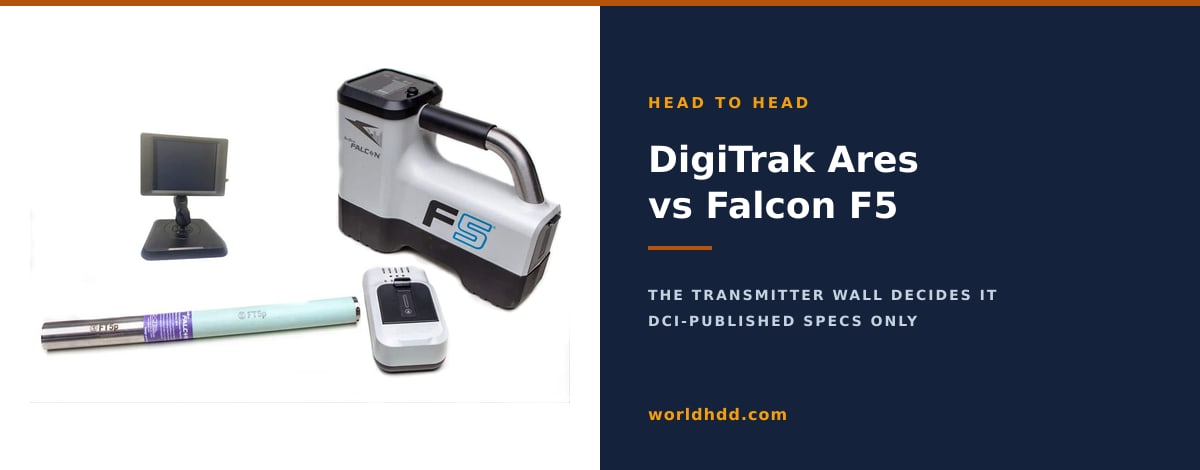
DCI launched the Ares at the Utility Expo in October 2025, and the question every Falcon owner has asked since is some version of "do I need this?" The honest answer is that for a lot of contractors, no, not yet, and the reason has nothing to do with the Ares being a good machine. It is a very good machine. The reason is that upgrading means replacing your transmitters too, and that changes the arithmetic completely. Here is the decision laid out properly, including the case for staying on a Falcon F5.
Where we sit, so you can weight what follows: we are an authorized DCI dealer and can sell you a new Ares, and we also carry 11 Falcon F5 listings on the used side. We make money either way, which is roughly the definition of being able to give you a straight answer.
What actually changed with the Ares
Three things matter to a buyer, and they are not the three that lead the marketing.
The frequency scan became automatic and much wider. A Falcon receiver scans and shows you the quiet bands; you pick. The Ares scans the full spectrum continuously as you walk the path and selects bands from what it measures, using AI-driven selection, across roughly three times the frequency count of the Falcon system. On a site where the interference moves during the day, which is most urban sites, that is a real operational difference rather than a spec-sheet one.
Rebar stopped being a separate transmitter. On a Falcon F5, Sub-k is a capability you buy into with a specific transmitter: an FTR5-series unit alongside your wideband FT5. On the Ares, Sub-k is an assignable band on the SuperCore, so the rebar transmitter and the general transmitter are the same object. If you regularly carry both, that is one fewer thing to own, charge, track and lose.
The connectivity is genuinely new. Over-the-air software updates, built-in GPS without the accessory hood the Falcon needs, and DCI's Trak-It anti-theft features including a silent mode, a lock-out mode and hourly position reporting, free for the first year on registration. For a contractor who has ever had a locator walk off a site, that last one is not a footnote.
Ares against Falcon, on the numbers that are actually published
A note on this table, because it is where most comparisons go wrong. DCI publishes the Ares depth two different ways: the product sheet breaks it out by transmitter power mode, and the website summarises it as a single headline number. Both are DCI figures and we give you both rather than quietly picking the flattering one. Everything else here is limited to what DCI publishes. Several figures that circulate in dealer comparison tables are not DCI-published, so they are not in this table.
| Specification | DigiTrak Ares (SuperCore, 15-in) | DigiTrak Falcon F5 / F5+ |
|---|---|---|
| Wideband frequency range | 4.5 to 45 kHz | 4.5 to 45 kHz |
| Wideband frequency count | Over 8,000 | Nine bands, hundreds of frequencies on the F5; over 1,000 on the F5+ with Multi-Power transmitters |
| Sub-k range (rebar) | 0.33 to 0.75 kHz | 0.33 to 0.75 kHz |
| Sub-k frequency count | 3,800 per DCI's receiver specifications; DCI's transmitter page lists 3,500 for the SuperCore hardware | Available via FTR5-series transmitters |
| Rated depth | 160 ft high power, 140 ft standard, 100 ft low, per DCI's Ares product sheet; DCI's website summarises this as a 162 ft depth range with the 15-in transmitter | 100 ft (FT5p, 15-in); 125 ft (FT5Lp, 19-in); 180 ft on the F5+ with the 24-in transmitter |
| Frequency selection | Automatic full-spectrum scan with AI-driven band selection | Operator selects from bands the receiver scans |
| Rebar capability | Assignable band on the same SuperCore transmitter | Separate FTR5-series Sub-k transmitter |
| GPS | Built in | Requires the iGPS accessory hood |
| Software updates | Over the air, via Wi-Fi | Not over the air |
| Anti-theft | Trak-It: silent mode, lock-out mode, hourly position reporting | Not published |
| Transmitter cross-compatibility | Ares transmitters only. Will not pair with any Falcon receiver. | Falcon transmitters only, region code must match. Will not pair with an Ares. |
Depth ranges vary with housing and with the frequency in use, and DCI rates them under a standard test method rather than as a promise about your ground. Treat any depth number, from any manufacturer, as a ceiling under favourable conditions rather than a working figure.
The compatibility wall is the whole decision
Ares transmitters work with the Ares locator and nothing else. Falcon transmitters work with Falcon receivers and not with an Ares. There is no adapter, no firmware path, and no partial migration. That means upgrading is not "buy a receiver", it is "buy a receiver and replace the transmitter fleet", and for a crew running a wideband transmitter plus a Sub-k transmitter plus spares, the transmitters can be the larger half of the bill. Whether a SuperCore fits the drill housings you already own also depends on the specific housing, and DCI's guidance is to confirm that before purchase rather than assume it. Work out the full number before you fall in love with the receiver.
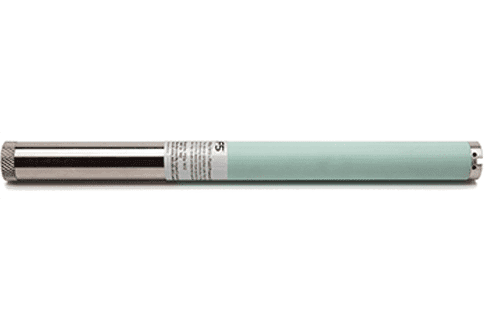
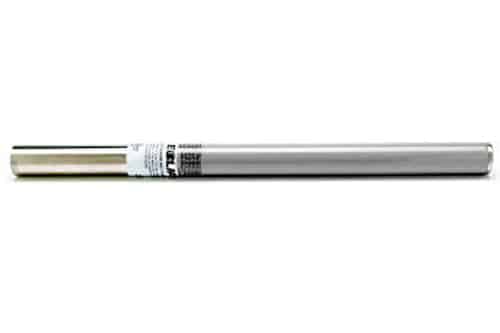
DigiTrak locators in stock
Want a quote today? Call (877) 288-0280.
When the Ares is the right buy
You work where the interference moves. Dense urban corridors, sites with live power and traffic loops, anywhere the quiet band at 8am is not the quiet band at 2pm. Continuous automatic scanning is worth real money there, because the alternative is stopping to rescan.
You are carrying two transmitters today. If rebar work is routine enough that you own an FTR5 alongside your FT5, collapsing those into one SuperCore removes a purchase, a charger, a failure point and a thing to forget on site.
You are standardising a fleet. Over-the-air updates matter more across six rigs than across one, and the built-in GPS and Trak-It tracking answer a fleet manager's problems rather than an operator's.
You are buying new anyway. If the decision was already "new receiver this year", then the compatibility wall is not a penalty, it is just the shape of the purchase. Buy the current generation.
When a used Falcon F5 is the smarter buy
This is the case the rest of the internet is not making, so here it is plainly. The Falcon F5 is not obsolete and it did not become worse in October 2025.
It already does the hard thing. Sub-k rebar capability is the single most important capability step in the DCI line, and the Falcon F5 has it. We stock the Sub-k transmitters that go with it: 8-inch, 15-inch and 19-inch FTR5-series units. If the reason you were looking at an Ares is rebar, a Falcon F5 already solves rebar.
Your transmitters keep working. If you own Falcon transmitters, a used Falcon F5 receiver is an upgrade that costs you a receiver. The same upgrade to Ares costs you a receiver and a transmitter fleet. That gap is usually larger than the difference in receiver price.
The depth you actually drill probably fits. Most utility and fiber work lives well inside what an FT5p reaches. Paying for depth range you will use twice a year is the most common way to overspend in this category.
The used market supports it. Parts, transmitters, displays and knowledge are all abundant for the Falcon generation in a way they are not yet for a system launched in late 2025.
The counter-argument, stated fairly: a used Falcon F5 comes with no manufacturer warranty, and you are buying a machine whose history you did not witness. That is exactly why every locator we list goes through inspection and testing before it reaches a customer, and why the HDD locator buyer's guide includes a test protocol you can run yourself if you are buying from anyone else.
What each side costs
DCI does not publish a list price for a complete Ares package, and we are not going to invent one; contact us for a quote and a lead time. DCI does publish transmitter prices, and those are the number that makes the compatibility wall concrete: a SuperCore transmitter lists at $6,200 and a Classic-Core at $5,200. Multiply by however many transmitters your crew actually runs.
On the used Falcon side, the figures below are read live from our inventory as you load this page.
| What you are buying | In stock | Asking range |
|---|---|---|
| Falcon F5 receivers, transmitters and complete systems | 11 listings | $3,700 to $28,800 |
| Falcon F2, if Sub-k is not part of your work | 9 listings | $3,350 to $23,278 |
| Aurora remote displays | 2 listings | $5,995 to $6,995 |
| The full DCI locator category | 58 listings | see category |
That range spans a single transmitter at one end and a complete system with a remote display at the other, so read it as a ladder rather than a price. Used locating equipment finances the same way rigs do: we do not lend, we connect buyers with First Pacific Funding, pre-approval does not affect your credit score, and turnaround is typically 24 to 48 business hours. Approval and rates are never guaranteed. Section 179 expensing may apply in the year you place equipment in service; consult your CPA, as this is not tax advice. Start from the HDD equipment financing page.
If you are trading up, the trade-in is part of the price
The number that actually decides an Ares purchase is not the Ares price, it is the Ares price minus what your current system is worth. Falcon F5 receivers and Falcon transmitters hold value well, precisely because the used market for them is deep. Before you price an upgrade, get a real number for what you are holding. We buy and take trades on DCI equipment continuously, and the quote takes a phone call.
Frequently asked questions
Will my Falcon transmitters work with an Ares?
No. Ares transmitters pair with the Ares locator only, and Falcon transmitters pair with Falcon receivers only, with a matching region designation. There is no adapter and no firmware path between the two families. This is the single most important fact in the comparison, because it means an upgrade to Ares includes replacing every transmitter you run, not just the receiver.
Does the Falcon F5 do rebar, or do I need an Ares for that?
The Falcon F5 does rebar. Sub-k is the sub-kilohertz band, roughly 0.33 to 0.75 kHz, that gets under the field distortion reinforced concrete creates, and the Falcon F5 reaches it using an FTR5-series transmitter. We stock those in 8-inch, 15-inch and 19-inch. What the Ares changes is not whether you can do rebar but how: on the SuperCore, Sub-k is an assignable band on the same transmitter rather than a second transmitter you buy and carry.
How deep does the Ares go compared with a Falcon F5?
Per DCI's Ares product sheet, the Ares is rated to 160 ft at high power, 140 ft at standard and 100 ft at low power with the 15-inch transmitter; DCI's website summarises this as a 162 ft depth range. On the Falcon side, the FT5p 15-inch is rated 100 ft and the FT5Lp 19-inch 125 ft, while the F5+ receiver with the 24-inch transmitter reaches 180 ft. So the headline depth answer depends heavily on which transmitter is in the comparison, and a Falcon F5+ with a long transmitter is rated deeper than an Ares with a 15-inch one. Depth also varies with housing and frequency, so treat all of these as ceilings rather than working figures.
Is the Falcon F5 obsolete now?
No. It has Sub-k, it has Max Mode signal processing, it has a deep used market for parts and transmitters, and it covers the depth most utility and fiber work actually needs. What it does not have is automatic full-spectrum scanning, built-in GPS, over-the-air updates or anti-theft tracking. Whether those are worth replacing your transmitter fleet for is a question about your sites, not about the F5 having gone bad.
Does WorldHDD stock the Ares?
We are an authorized DCI dealer and can sell and quote the Ares new, including lead time. We do not carry it as used inventory, because a system launched in late 2025 has barely begun to reach the secondary market. If you want an Ares, call us for a quote. If you want something you can inspect and take away, that is the used Falcon side of the lot.
Will a SuperCore transmitter fit my existing drill housings?
It depends on the specific housing, and DCI's guidance is to confirm compatibility before purchase rather than assume it. Housing fit is about internal length and diameter and about the slots that let signal out, and it varies by manufacturer and by head. Tell us which housings you run and we will check before anything is ordered.
How many Sub-k frequencies does the Ares have?
DCI's receiver specifications list 3,800 Sub-kHz frequencies for the Ares system, while DCI's transmitter page lists 3,500 for the SuperCore transmitter hardware. Both figures come from DCI's own published materials and appear to describe different layers of the system. We are not going to resolve that editorially; if the exact count matters to your decision, DCI can confirm which figure applies to what.
What is the Ares battery like?
DCI publishes the SuperCell-R as delivering up to 100 hours of runtime and around 300 charge cycles, reaching 85 percent charge in about two hours and full charge in about four. That is a meaningful change from managing alkaline cells across a shift, and it is one of the quieter reasons fleet operators like the system.
Two different next steps, depending on which way this landed. If it is the Ares, call (877) 288-0280 or ask us for a quote and a lead time, and tell us what you are trading so the number means something. If it is the proven system at a fraction of the price, Browse our 11 Falcon F5 listings and we will confirm generation and transmitter compatibility before anything ships. Not sure which tier you need at all? Start with the HDD locator buyer's guide, or read the DigiTrak Falcon F5: Specs, Used Prices, and the Buyer's Guide for the generation traps in the used F5 market.
Sources and references. Specifications come from DCI's published materials only. Figures that appear solely in third-party dealer comparison tables are deliberately omitted rather than repeated. Verified August 2026.
- Digital Control Inc: DigiTrak Ares
- Digital Control Inc: DigiTrak receiver lineup and specifications
- Digital Control Inc: DigiTrak transmitter lineup, including SuperCore and Classic-Core pricing
- Digital Control Inc: ARES product sheet (data as of March 2026), held on file, for the depth breakdown by transmitter power mode
- Trenchless Technology: "DCI Unveils DigiTrak Ares" (October 2025), for the Utility Expo launch and AI frequency scanning