
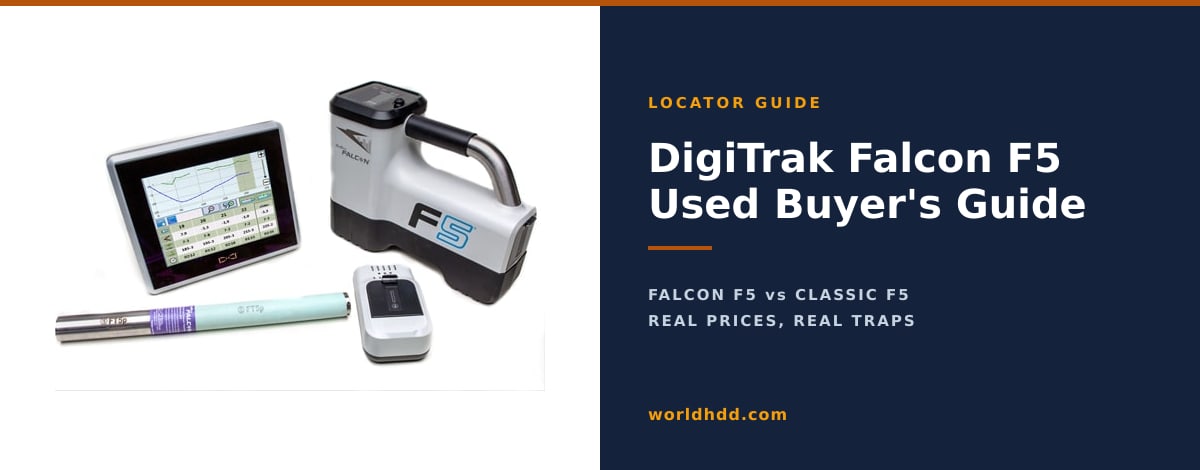
The DigiTrak Falcon F5 is the most common serious locator on the used HDD market, and almost everything written about it is either manufacturer collateral or a listing page. Meanwhile the questions that actually cost buyers money go unanswered: is a "Falcon F5" the same thing as an "F5"? What does a complete system actually include? Why does one listing say $12,000 and another $26,000 for "the same" locator? And is a two-generations-old flagship still worth buying in 2026? We stock more Falcon F5 equipment than any other locator line, 11 units as of July 2026, and this guide answers all of it the way we would across the counter.
The quick verdict up front: for typical utility and fiber work at normal depths, a used Falcon F5 remains fully capable, and the fact that DCI has since shipped two newer flagships is exactly why clean used units exist at used prices. Yesterday's flagship at a working contractor's price is the whole value proposition. The rest of this guide is the fine print that makes that verdict safe to act on.
The sticker check: F5 versus Falcon F5
These are two different products, and sellers use the names loosely. The classic F5 is the older pre-Falcon receiver generation. The Falcon F5 added DCI's Falcon frequency-optimization architecture on top of the F5 feature set, plus Sub-k rebar capability and Max Mode signal processing. We stock both, in separate categories, precisely because they are not interchangeable products at interchangeable prices.
Check the plate, not the listing title
The Falcon F5 receiver carries product ID FF5 and model number FAR5 on its label. If the listing says "Falcon F5" but the plate says otherwise, you are looking at a classic F5, a different generation with different transmitter compatibility and different value. Thirty seconds with the label beats an expensive surprise; it is the locator equivalent of reading the engine plate on a drill.
What Falcon technology actually does
Underground interference is the locating problem: power lines, traffic loops, rebar, and ambient noise all fight the transmitter's signal. The Falcon architecture attacks it by choice rather than brute force. The Falcon F5 scans nine frequency bands spanning hundreds of individual frequencies between 4.5 and 45 kHz, measures the noise at your actual jobsite, and lets the operator pair the two best-performing bands before the bore starts, with the option to flip bands mid-bore if conditions change. In practice that means the machine finds the quiet channels at your site instead of hoping a factory-set frequency happens to be clean.
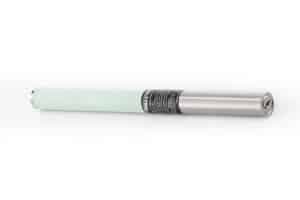
Sub-k rebar capability is the Falcon F5's other headline, and it is widely misunderstood, so here is the precise version: Sub-k means three ultra-low bands at 0.33 to 0.75 kHz that punch through steel-reinforced concrete where normal frequencies die. But Sub-k is a transmitter capability, not a receiver toggle. It requires a dedicated FTR5-series transmitter (FTR5s, FTR5p, or FTR5Lp); a Falcon F5 kit that includes only a wideband FT5p transmitter has no rebar capability at all. When a listing says "Falcon F5 system," read the parts list before you assume it can do rebar work.
What a complete system includes
A working Falcon F5 setup is four things, and partial kits are where used buyers get hurt:
- Receiver (the walkover unit): the FF5/FAR5 itself.
- Transmitter(s) (the beacon in the drill head): wideband FT5p (rated 100 ft depth, 125 ft data range) or the longer FT5Lp (125/150 ft), plus optionally an FTR5-series Sub-k unit for rebar. Sub-k transmitters trade some range for their interference immunity, and the 8-inch FTR5s is a short-range unit for small housings.
- Display (the in-cab screen): the compact FCD at the value end, or the Aurora AF8/AF10 touchscreens at the premium end, which also stretch telemetry range to roughly 1,800 feet against the FCD's roughly 1,000. Officially compatible displays are the FCD (v4.0), MFD (v3.0), FSD, and Aurora family; older FCD/MFD units may need a DCI software update to pair, so confirm the display actually talks to the receiver in hand, not in theory. Our older article on the Aurora AF8 and AF10 displays covers that tier in detail.
- Power and kit: batteries, charger, case. The Falcon-era standard is the Li-ion FBP pack (the receiver runs 8 to 12 hours on one), and usefully, the older NiMH packs and Li-ion packs interchange across DCI's SE, F2, F5, and Falcon receivers, so battery logistics are forgiving. Missing chargers and tired batteries are cheap to spot and annoying to discover later.
The region-code trap
Every DCI receiver and transmitter carries a regional designation, the number inside the globe icon next to the serial number, and the receiver and transmitter must match or they will not communicate. This is the killer gotcha for buyers assembling a system from separately sourced components or imports: a European-region transmitter is a paperweight next to a US-region receiver. Check the globe icons on every component before money moves.
Falcon F5 systems in stock
Want a quote today? Call (877) 288-0280.
Where the Falcon F5 sits in DCI's 2026 lineup
Honesty requires the full ladder: the Falcon F5 is now two flagships back. The Falcon F5+ receiver raised depth and data range to 180 and 220 feet with Multi-Power transmitters drawing on over 1,000 frequencies. Above that, the new DigiTrak Ares scans more than 8,000 frequencies with its SuperCore transmitters. Both are excellent and both are new-equipment money. We put the top of that ladder against this machine directly in DigiTrak Ares vs Falcon F5, and if you are still deciding which rung your work actually needs, start with how to choose an HDD locator.
The compatibility picture has real nuance, and getting it right saves buyers from two opposite mistakes. Ares SuperCore transmitters work only with the Ares receiver, and "+"-suffixed transmitters (like the FT5L+) work only with plus-generation receivers; neither pairs with a classic Falcon F5. But DCI's current V2 Multi-Power 15-inch and 8-inch transmitters are backward compatible with classic Falcon receivers, and your existing Falcon F5 transmitters will also pair with an F5+ receiver if you upgrade later. So a used Falcon F5 is not an ecosystem dead end; it just is not forward-compatible with the plus-only and Ares-only hardware. The practical translation for a used buyer: for typical utility and fiber depths, well under 100 feet on most work, the classic Falcon F5's capability is not the limiting factor on your jobs, and the two newer generations above it are precisely why fleets sell clean Falcon F5s. Our earlier posts on Falcon upgrade options and the DCI upgrade programs describe that churn from the other side: it is the supply engine of the used market this guide is about. If your work genuinely needs 180-foot depth or rebar-dense downtown corridors every week, buy newer; everyone else is the audience for used.
What a used Falcon F5 costs in 2026
| Configuration | Observed range, July 2026 |
|---|---|
| Receiver only | $12,000 to $15,000 |
| Complete system, one wideband transmitter, mid display | $15,000 to $22,000 (the sweet spot) |
| Recent, low-hour, fully accessorized systems | up to about $29,000 |
| Suspiciously cheap full bundles | Verify condition and completeness; assume worn transmitters or missing pieces until proven otherwise |
Our own shelf as of July 2026, for calibration: standalone Falcon F5 transmitters $3,700 to $5,700 depending on size and Sub-k capability, a Falcon F5 receiver at $17,700, a receiver-plus-FT5p pair at $22,400, and complete systems with display from $26,335 (FCD and FT5p) up to $28,800 (Aurora). New-equipment context: dealer pricing for a new Falcon F5 system starts around $17,700 before options, which is why a used complete system in the high teens has to justify itself on condition and hours.
What moves price, in order: transmitter hours first (transmitters are the consumable of the locating world; DCI's own transmitter warranty is hour-metered, which tells you what wears), then the number and type of transmitters (wideband plus Sub-k beats wideband alone), display tier (Aurora commands a real premium over FCD), battery condition, and completeness of the kit. A locator is 5 to 10 percent of a full rig package, and the starter package guide shows where it fits in the whole build's math.
Inspecting a used Falcon F5
The inspection mindset from our used equipment checklist applies to electronics too; here is the locator-specific layer:
- Transmitter hours, in writing. The hour meter is readable; ask for it on every transmitter in the kit. DCI's transmitter warranty runs 3 years or 500 hours (when registered within 90 days of original purchase), which makes 500 hours a useful mental benchmark for how DCI itself thinks about transmitter life, even on units far out of warranty.
- Assume the warranty is gone. DCI's warranty is tied to the original purchaser and does not transfer, and the 5-year/750-hour tier some sellers mention is a paid dealer extension, not a standard feature. Price used units as out-of-warranty hardware.
- But repair is not warranty-gated, and it is not scary. DCI and independent shops service these units regardless of warranty status, with published repair pricing running from about $800 at the low end (UCG's advertised floor) to roughly $2,700 for a full locator repair (Hi-Tech Electro's flat rate). A used Falcon F5 is a repairable asset, which is most of why it is a safe one.
- Power on and run the self-test, then run a frequency-optimizer scan on site and pair a transmitter for real. Watch battery bays for corrosion, check the screen for damage and dead zones, confirm IR pairing works, and verify calibration against a tape measure at 10 feet.
- Match the region codes (globe icons) across receiver, transmitters, and any second-hand additions. Sixty seconds, saves the whole deal.
The SubSite alternative, briefly
If you run Ditch Witch drills, SubSite (the Ditch Witch family's own guidance line, whose current flagship is the Marksman system) is the native alternative: it integrates with Ditch Witch's in-cab displays, and used SubSite gear typically runs meaningfully cheaper than DigiTrak, often $4,000 to $8,000 for a working setup. The trade-off is ecosystem: DigiTrak dominates the used market and the rental-and-crew familiarity pool. Our brand comparison covers the ecosystem question; the short version is that fleet standardization usually decides it, not spec sheets.
Ready to price real units? Browse our 11 Falcon F5 units, from standalone transmitters to complete Aurora systems, or the full DCI locator inventory across every generation. Have a rig but no locator, or a locator kit with a hole in it? Tell us what you are pairing it with and we will spec the right system honestly, including telling you when a cheaper classic F5, an F1, or the mid-tier Falcon F2 covers your work (the Falcon F2 buyer's guide is the full rung-below treatment). Shopping the rig side too? The fiber drill guide covers the machines these locators pair with every day. Financing the whole package? The financing guide covers locators inside a package deal.
Frequently asked questions
Is a "Falcon F5" the same as a "DigiTrak F5"?
No. The classic F5 is the older pre-Falcon generation; the Falcon F5 adds the nine-band frequency optimizer, Sub-k rebar capability, and Max Mode. Sellers blur the names constantly, so verify the plate: the Falcon F5 receiver reads product ID FF5, model FAR5. The two generations price differently, pair with different transmitters, and should never be cross-shopped as equivalents.
Which transmitters work with a used Falcon F5 receiver?
The Falcon wideband units (FT5p, FT5Lp), the Sub-k rebar family (FTR5s, FTR5p, FTR5Lp), and DCI's current V2 Multi-Power 15-inch and 8-inch transmitters, which are backward compatible with classic Falcon receivers. What does not work: "+"-suffixed transmitters (plus-generation receivers only) and Ares SuperCore units (Ares only). And every pairing still requires matching region codes on both components.
Which displays pair with the Falcon F5?
Officially: the FCD (v4.0), MFD (v3.0), FSD, and the Aurora AF8/AF10 touchscreens. Two practical notes: older FCD or MFD units may need a DCI software update to pair with a Falcon receiver they did not ship with, so test the actual pairing before purchase, and the Aurora family roughly doubles telemetry range (about 1,800 feet versus about 1,000 for the FCD), which matters on long bores.
How many transmitter hours are too many?
Think in terms of DCI's own warranty math: transmitter coverage runs 3 years or 500 hours, whichever comes first, which tells you how the manufacturer sizes transmitter life. A transmitter well past 500 hours is not dead, but it should be priced as a wear item with replacement in view. Get hours in writing for every transmitter in the kit, and weight the package price by them; transmitter hours move used system value more than any other single factor.
Is a used Falcon F5 still worth buying in 2026?
For most utility and fiber contractors, yes. Its capability comfortably covers typical depths and interference, and the two newer flagships above it (Falcon F5+ and Ares) are exactly why clean used units keep arriving at sane prices. The honest exception: crews that routinely need 180-foot-class depth and data range or work rebar-dense corridors daily should buy into the newer generations instead.
Can I mix components from different regions or generations?
Generations: within the rules above, yes, but verify every specific pairing live. Regions: no. Receiver and transmitter carry regional designations (the number in the globe icon by the serial) that must match, or they will not communicate at all. This is the single most common trap for buyers assembling systems from separately sourced parts or imported components. Check the globes before you pay.
What does DCI support look like for a secondhand unit?
The warranty will not follow you: DCI coverage is tied to the original registered purchaser and does not transfer. But service does not care about warranty status: DCI and independent shops repair Falcon F5 equipment at published rates from roughly $800 to $2,700 depending on what is wrong. Budget a repair reserve instead of a warranty, and a used Falcon F5 is a fully supportable working asset.
What should I physically test before buying?
Power-on and self-test; a live frequency-optimizer scan on site; real pairing between the receiver and every transmitter in the kit; a depth check against a tape measure at 10 feet; battery bays (corrosion), screen (damage, dead zones), IR pairing, and charger presence; and region-code match on every component. Twenty minutes, in person, before money moves. Any seller who resists a live test is answering your question.
Does a used Falcon F5 include rebar (Sub-k) capability by default?
No. Sub-k is a transmitter capability: it requires a dedicated FTR5-series unit (FTR5s, FTR5p, or FTR5Lp) broadcasting in the 0.33 to 0.75 kHz bands. A system with only a wideband FT5p or FT5Lp has no rebar capability regardless of what the listing title implies. If reinforced-concrete work is in your future, confirm an FTR5 transmitter is in the case, or budget $3,700 to $5,700 for one.
What does a complete used Falcon F5 system cost in 2026?
Receiver-only units run about $12,000 to $15,000; complete working systems with one wideband transmitter and a mid-tier display sit in the $15,000 to $22,000 sweet spot; and recent, low-hour, fully accessorized systems reach the high $20,000s (our current Aurora-equipped systems ask $28,800). Transmitter hours, transmitter count and type, and display tier explain most of the spread. All figures as of July 2026.
Sources and references. Specifications, compatibility rules, and warranty structure verified against DCI's published documentation and named industry sources in July 2026.
- DigiTrak Falcon F5 specification sheet (PDF, dealer mirror)
- DigiTrak Falcon F5 operator's manual (PDF, dealer mirror)
- DCI support: Falcon F5 transmitter overview
- DCI: DigiTrak Falcon F5+ receiver
- DCI: DigiTrak Ares receiver
- DCI warranty structure
- UCG Underground Supplies: Falcon F5 repair service
- Hi-Tech Electro: Falcon F5 locator repair service
- Melfred Borzall: Falcon F5 system pricing