
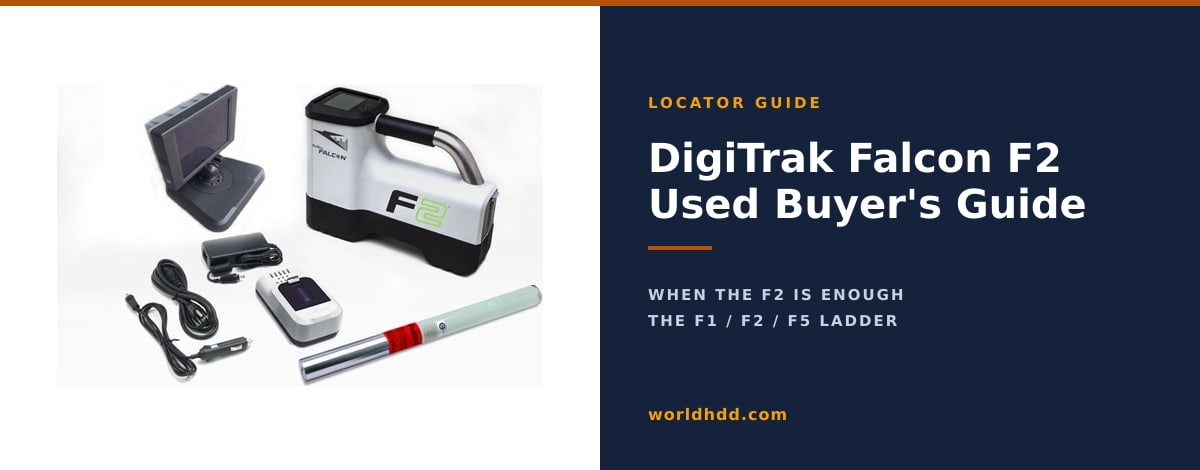
The DigiTrak Falcon F2 is the "do I really need the F5?" question in hardware form. It shares the Falcon frequency-optimization architecture with its bigger sibling, costs meaningfully less, and covers the depths where most utility and fiber work actually happens. It also has one hard structural limit that no software update will ever fix. We stock 9 Falcon F2 units, from bare transmitters to complete Aurora-equipped systems, and this guide is the honest decision framework: when the F2 is enough, when it structurally is not, and the 2026 pricing finding that most buyers get backwards.
Quick verdict: for utility and fiber bores that stay under about 100 feet of depth in active-interference environments, a used Falcon F2 is the right-sized buy, and the money you save over an F5 is real. For rebar, reinforced concrete, or depth beyond its ratings, it is the wrong tool at any price. And when you do shop one, watch the display tier before the receiver generation; that is where the price actually moves in 2026.
The sticker check: classic F2 versus Falcon F2
Same trap as the F5 family, same fix. The classic F2 is DCI's older pre-Falcon receiver generation; the Falcon F2 is the Falcon-architecture machine this guide is about. Sellers use the names interchangeably, and the price difference is not interchangeable at all. We stock both lines separately: complete Falcon F2 systems in the Falcon F2 category, and classic F-series components (transmitters and displays, no complete systems) for crews keeping older kits alive. Verify the model plate on the receiver before you compare prices, and if you are piecing a system together from components, verify every part against the compatibility rules below.
What the Falcon F2 is
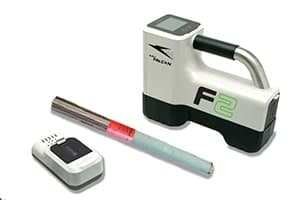
The Falcon F2 scans nine frequency bands spanning 4.5 to 45 kHz, hundreds of individual frequencies, measures your jobsite's actual noise, and pairs the two best bands before you drill, with a documented mid-bore procedure to flip bands if conditions change. That is the same core Falcon idea as the F5: find the quiet channels instead of hoping a fixed frequency is clean. The receiver runs a Li-ion pack for 10 to 14 hours, and the ecosystem around it (chargers, batteries, cases) is shared DCI kit.
What it deliberately lacks defines its place in the ladder. There is no Sub-k: the F2's frequency floor is 4.5 kHz, far above the 0.33 to 0.75 kHz ultra-low bands that punch through steel-reinforced concrete, and Sub-k exists only in the F5 family (F5 and F5+, and even there only with a dedicated FTR5-series transmitter). There is also no fluid-pressure monitoring, no DataLog bore recording, and no TensiTrak pullback monitoring; those are F5-family data features. None of that is a defect. It is the definition of the tier: steering and depth for everyday bores, without the instrumentation layer bigger jobs demand.
The hard line: rebar work is never an F2 conversation
If your bores cross under reinforced slabs, rebar-laced roadways, or mesh-reinforced concrete, stop evaluating the F2 now. The Sub-k bands that make rebar locating possible do not exist in this receiver at any setting, and no accessory adds them. That is an F5-family purchase with an FTR5 transmitter, covered in our Falcon F5 buyer's guide. We would rather say that plainly than sell you the wrong locator.
The system and the transmitters
| Component | Rating | Notes |
|---|---|---|
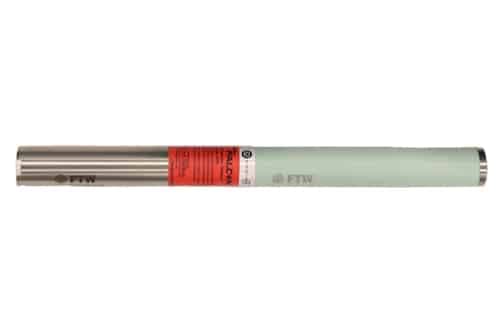
| FT2 transmitter (15-inch) | 100 ft depth / 125 ft data range | The standard beacon for utility housings |
| FT2s transmitter (8-inch) | 25 ft depth / 30 ft data range | Short-range unit for small drill heads |
| FCD display | ~1,000 ft telemetry | The value in-cab screen |
| Aurora AF8 / AF10 display | ~1,800 ft telemetry | Touchscreen tier; both telemetry ranges extend further with an optional external antenna |
Two transmitter details worth knowing before you buy used. First, temperature: the FT2's overheat threshold is 220 degrees Fahrenheit against the FT2s's 180, and those are maximum-exposure numbers whose breach voids DCI's warranty and shows on the transmitter's temperature indicator. Down a hot South Florida bore in August, that 40-degree margin is not academic; check the temperature history indicator on any used transmitter. Second, cross-compatibility: DCI and its dealers document the FT2 as pairing with Falcon F5 receivers too (region codes still must match), which adds resale and fleet flexibility, though at least one refurbisher disputes it, so confirm any cross-generation pairing live before you rely on it. And the region-code rule from the F5 guide applies identically here: receiver and transmitter carry regional designations (the globe icon by the serial number) that must match or they will not communicate.
Falcon F2 systems in stock
Want a quote today? Call (877) 288-0280.
The F1 / F2 / F5 ladder: the decision
| Tier | Frequencies | Depth / data | Who it is for |
|---|---|---|---|
| Falcon F1 | Single band (9 to 13.5 kHz), dozens of frequencies | 50 / 65 ft | Short, shallow, low-interference drops on the tightest budgets. NiMH receiver runs 5 to 7 hours. Software-upgradable to F2 capability later, which protects the entry buy. |
| Falcon F2 | 9 bands, 4.5 to 45 kHz, hundreds of frequencies | 100 / 125 ft (FT2) | Sub-100-ft utility and fiber work in active interference (power, traffic loops): the working middle of the market. No Sub-k, no fluid pressure, no DataLog. |
| Falcon F5 | 9 bands, 4.5 to 45 kHz, plus Sub-k (0.33 to 0.75 kHz) with FTR5 transmitters | 100 to 125 / 125 to 150 ft | Rebar and reinforced concrete, dense urban EMI, crossings, and any job where a re-drill costs more than the price gap. Adds the data layer (fluid pressure, DataLog, TensiTrak). |
The honest framing: the F2 is not a lesser F5; it is the right tool when depth stays under about 100 feet and the interference you fight is active (electrical) rather than passive (steel in the ground). The moment the work involves rebar or needs confident data range past the FT2's ratings, the F2 is structurally out, not merely "less ideal." Multi-rig fleets have quietly standardized on the sensible version of this: F2s on the routine trucks, one F5 kit for the hard jobs. That pattern shows up across independent sources because it prices capability where capability is used. For pairing locators with specific machines, the JT20 deep-dive covers the locator-ecosystem swing inside package prices, and the JT series decoder maps the rigs these ride along with.
Used pricing in 2026, and the finding nobody prints
Our live shelf as of July 2026, all in the Falcon F2 category:
| Configuration | Live price |
|---|---|
| FT2s transmitter (8-inch), standalone | $3,350 |
| FT2 transmitter (15-inch), standalone | $4,100 |
| F2 Falcon receiver, standalone | $12,775 |
| Complete system (receiver + transmitter, no display) | $16,875 |
| Complete system + FCD display | $20,810 |
| Complete system + Aurora (AF10 / AF8) | $23,275 / $23,278 |
Market-wide, complete used Falcon F2 systems run roughly $13,000 to $19,000 depending on display and transmitter, so our fuller-kit systems sit at the accessorized end of an honest range. Now the finding worth leading with, straight from the table: the display tier moves used price more than the F2-versus-F5 choice does. The Aurora premium over a base system is about $6,400 on our shelf. Meanwhile a base Falcon F2 system at $16,875 lands within a couple thousand dollars of the low end of complete used Falcon F5 systems, and an Aurora-equipped F2 prices above them. A buyer chasing savings should optimize the display tier first and the receiver generation second, and a buyer stretching for an F5 should notice that dropping the touchscreen, not dropping the receiver tier, is often what actually closes the gap. All figures as of July 2026; a locator is 5 to 10 percent of a full package, and the starter package guide places it in the whole build.
The F2+ successor, positioned honestly
DCI's Falcon F2+ raised the ceiling: with the new 19-inch FT2L+ transmitter it reaches 160 feet of depth and 200 feet of data range (the 15-inch stays at the classic 100/125), drawing on a pool of over 500 frequencies with Multi-Power's three selectable power modes, 24 roll positions against the classic F2's 12, and Quick Scan Pair. It is a genuinely better instrument at new-equipment money. The compatibility fine print matters for used buyers: "+"-suffixed transmitters like the FT2L+ pair only with plus-generation receivers, but DCI's current V2 Multi-Power 15-inch and 8-inch transmitters are backward compatible with classic Falcon receivers, so a used Falcon F2 can still buy new beacons. The classic F2 is surpassed at the top end, not obsolete under 100 feet, and that sentence is the entire used value proposition. If you are choosing between rungs rather than pricing one, how to choose an HDD locator works through receiver, transmitter and display as a single decision.
Inspecting a used Falcon F2
Everything in the Falcon F5 guide's inspection section applies here: transmitter hours in writing, assume the warranty is gone (DCI coverage does not transfer), region-code match, battery bays, screen, pairing. The F2-specific layer:
- Per-band calibration discipline. The 1-point calibration is depth-only and must be re-run for each newly optimized band, per the operator's manual. A unit that has cycled transmitters or bands without re-calibration will read depth wrong while looking healthy. Run your own calibration before the first bore regardless of what the seller did.
- The live acceptance test. The manual gives you hard pass/fail numbers: calibration fails below 300 or above 950 signal-strength points, and a persistent "A" attenuation symbol at 10 feet means excessive noise (never calibrate while it is displayed). That is a concrete pre-purchase test you can run in minutes, and at our yard in Miami you can run it on the actual unit before you buy.
- Verify the thermometer. DigiTrak transmitters carry an internal thermometer that also stores the maximum temperature seen. Confirm the readout is live and sane, and read the stored max against those 220/180-degree thresholds; it is the transmitter's own testimony about how it was treated.
Right-sized on the F2? Browse our 9 Falcon F2 units, from bare transmitters to complete Aurora systems, or the full DCI locator inventory. Not sure which rung of the ladder your work needs? Tell us your typical bores and we will spec it honestly, in either direction: plenty of buyers leave here with the cheaper locator, and some leave with the F5 because their ground genuinely demands it. On-site testing at our Miami yard is available before you commit.
Frequently asked questions
What is the difference between an "F2 System" and an "F2 Falcon System"?
Two different receiver generations. The classic F2 predates DCI's Falcon architecture; the Falcon F2 adds the nine-band frequency optimizer that finds quiet channels at your jobsite. We stock both in separate categories, and they price differently. Check the model plate on the receiver, not the listing title, and never pay Falcon money for a classic-generation unit.
What is the maximum depth on a Falcon F2?
With the standard 15-inch FT2 transmitter: 100 feet of depth and 125 feet of data range. With the short-range 8-inch FT2s: 25 and 30 feet. Those are rated maximums, not comfortable working numbers; interference and ground conditions eat into them. If your work regularly pushes past those ratings with confidence required, that is the F2+ or F5 conversation.
Does the Falcon F2 have a rebar or Sub-k mode?
No, and it never will. The F2's frequency floor is 4.5 kHz; Sub-k rebar locating happens at 0.33 to 0.75 kHz, exists only in the F5 family, and even there requires a dedicated FTR5-series transmitter. No setting, update, or accessory adds it to an F2. If your bores cross reinforced concrete, buy into the F5 family; anything else is buying the wrong tool.
How many bands and frequencies does it scan?
Nine bands spanning 4.5 to 45 kHz, covering hundreds of individual frequencies; the optimizer measures your site's noise and the operator pairs the two best-performing bands, with a documented mid-bore flip procedure if conditions change. For comparison, the Falcon F5 spans the same wideband range plus the Sub-k bands below it, and the newest DCI flagships scan far larger pools at new-equipment prices.
What displays work with a Falcon F2?
The FCD compact display and the Aurora AF8/AF10 touchscreens. Telemetry range is the practical difference: roughly 1,000 feet on the FCD against roughly 1,800 on Aurora, both extendable with an external antenna. Mind the money: on our shelf the Aurora option adds about $6,400 over a base system, which is the largest single price lever in the used F2 market.
Is an FT2 transmitter compatible with a Falcon F5 receiver?
DCI and its dealers document yes: the FT2 pairs with Falcon F5 receivers, with region codes still required to match. One prominent refurbisher lists it as incompatible, so our practical advice is to confirm the specific pairing live before building a purchase around it. Cross-generation flexibility is a real resale and fleet asset when it works, and a five-minute test settles it.
What does a complete used Falcon F2 cost in 2026?
Roughly $13,000 to $19,000 across the market depending on transmitter and display, with fully accessorized Aurora systems reaching about $23,000. Our own live shelf as of July 2026: complete systems from $16,875 base, $20,810 with FCD, and $23,275 with Aurora, plus standalone transmitters at $3,350 to $4,100. Transmitter hours and display tier explain most of the spread between any two listings.
Is the F2-versus-F5 price gap still big?
Smaller than most buyers assume, and that is the key 2026 finding. A base used Falcon F2 lands within a few thousand dollars of the low end of complete used Falcon F5 systems, while an Aurora-equipped F2 can price above them. The display tier now moves price more than the receiver choice. Decide the receiver on capability (rebar, depth, data needs) and the display on budget, not the other way around.
Should I buy a Falcon F2+ or a used classic Falcon F2?
Buy the F2+ if you genuinely need its ceiling: 160 feet of depth and 200 of data range with the 19-inch FT2L+, Multi-Power modes, and the larger frequency pool. Buy the used classic if your bores stay under 100 feet, which describes most utility and fiber work, and bank the difference. The classic is surpassed at the top end, not obsolete beneath it, and new V2 Multi-Power beacons still pair with it.
What should I test before buying a used one?
The plate (Falcon, not classic), region-code match on every component, transmitter hours in writing, and the live tests from the operator's manual: run a calibration and confirm it lands between 300 and 950 signal-strength points, check for a persistent attenuation symbol at 10 feet, and verify the transmitter's thermometer reads live and its stored maximum is sane. We run exactly this sequence on-site in Miami before any unit ships.
Sources and references. Specifications, calibration thresholds, and compatibility rules verified against DCI's published documentation and named sources in July 2026.
- DigiTrak Falcon F2 specification sheet (PDF, dealer mirror)
- DigiTrak Falcon F2 operator's manual (PDF, dealer mirror)
- DCI support: Falcon F2 transmitter overview
- DCI: current transmitter lineup (Falcon F2+ and Multi-Power)
- DCI: Multi-Power transmitter compatibility FAQs
- Melfred Borzall: DigiTrak Falcon transmitter compatibility and pricing
- DigiTrak Falcon F1 specification sheet (PDF, dealer mirror)