
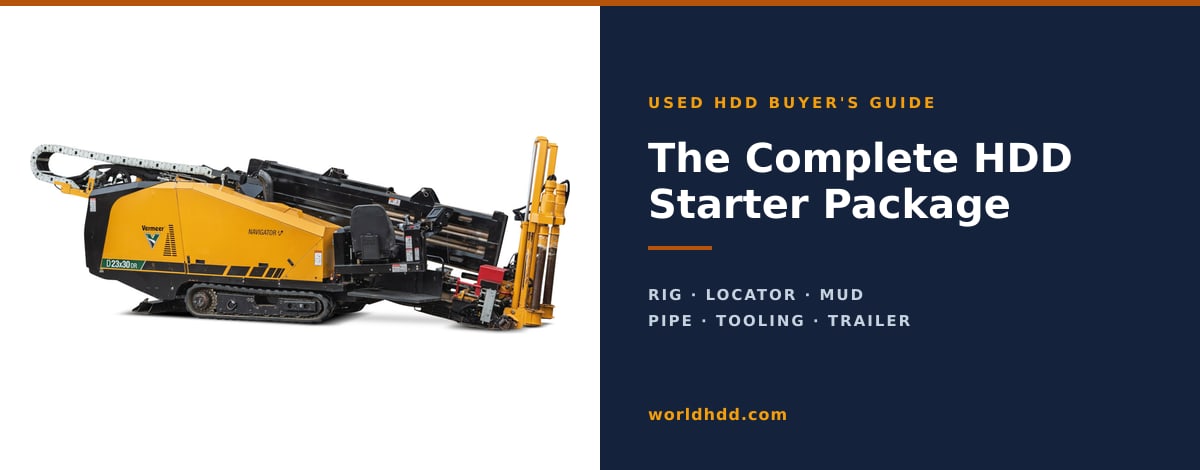
First-time buyers price the rig and stop there. That is the most expensive mistake in this business, because the rig is only about half of a working setup. A complete HDD outfit is rig plus locator plus mud system plus drill pipe plus tooling plus trailer plus the ancillary kit, and the other half of that bill is just as real as the machine. This guide makes the whole bill visible: what each of the seven pieces does, what it costs used, and three example builds with honest totals, so you walk into a yard knowing the real number instead of finding it out one surprise at a time.
We package complete setups for a living, so this is the parts list from the dealer's seat, not a manufacturer brochure. We will tell you where to spend, where you can defer, and what a realistic all-in total looks like at three levels. When you are ready, the fastest path is to tell us your work mix and budget and let us build you a quote against current inventory. But first, the education, because a buyer who understands the whole package negotiates from a much stronger position.
Our three builds at a glance
For skimmers, here are the three example builds and roughly where each lands all-in. The sections below defend every line.
| Build | Work it fits | Rig class | Typical all-in |
|---|---|---|---|
| Entry | Residential fiber drops, light utility | Mini (JT20, D10x15 S3) | ~$150,000 to $190,000 |
| Recommended | Fiber plus distribution, mixed utility | Utility-mid (JT24, D23x30 S3) | ~$220,000 to $290,000 |
| Premium | Trunk fiber, gas main, infrastructure | Mid-heavy (JT40, D40x55 S3) | ~$330,000 to $450,000 |
Those are typical, defensible bands, not floors or ceilings. A real build does not land at the sum of every line item's maximum or minimum at once, which is exactly why the itemized tables further down show ranges and these headline numbers show where most buyers actually end up.
What a complete HDD setup contains
Before the deep dive, the whole list. There are seven components, and a buyer needs to understand all seven before pricing a build. The percentages are share of total starter cost.
- The rig (about 50 to 60 percent). The visible centerpiece: thrust, pullback, rotation.
- Locator system (about 5 to 10 percent). Transmitter, receiver, display. Without it you cannot steer the bore.
- Mud system (about 8 to 15 percent). Mixing and pumping drilling fluid. Without it you cannot drill.
- Drill pipe (about 5 to 10 percent). The column of rods pushed through the earth.
- Tooling (about 3 to 7 percent). Bits, reamers, housings, swivels, sub savers.
- Trailer (about 5 to 10 percent if buying new). Transport for the rig and kit.
- Stakedowns and ancillary (about 2 to 5 percent). The small items that add up.
Skip any one of the first five and you do not have a working crew. Here is each, in order, with what it does, the options, and what it costs.
Component 1: The rig
The machine itself, and about half to sixty percent of your total outlay. The one decision that drives everything else is class, because the rig class sets the mud volume, pipe size, tooling, and trailer rating you will pair with it.
| Class | Examples | Fits | Used range |
|---|---|---|---|
| Mini | Ditch Witch JT20, Vermeer D10x15 S3 | Fiber drops, residential utility | ~$80,000 to $130,000 |
| Utility-mid | Ditch Witch JT24, Vermeer D23x30 S3 | Fiber plus distribution | ~$120,000 to $200,000 |
| Mid-heavy | Ditch Witch JT40, Vermeer D40x55 S3 | Utility plus small infrastructure | ~$130,000 to $285,000 |
| Heavy | Vermeer D60x90, Ditch Witch JT100 and up | Gas main, large crossings | ~$200,000 to $500,000+ |
We will not duplicate the rig-selection detail that lives in our other guides. For fiber-specific picks, see the best used directional drills for small fiber contractors. For the broader brand decision, see our Ditch Witch vs Vermeer comparison. To read the hour meter on any specific machine, see how many hours is too many. And before you buy any specific rig, run it through our inspection checklist.
Component 2: Locator system
You cannot steer a bore without knowing where the drill head is underground. The locator tells the operator depth, pitch, roll, and position in real time. Without it, you are drilling blind. It is roughly 5 to 10 percent of the build, and it has three parts:
- Transmitter (beacon). Sits in the drill-head housing and broadcasts the position, pitch, and roll signal.
- Receiver (walkover unit). The handheld the locator carries on the surface above the bore; it reads the transmitter.
- Display. The in-cab screen that repeats the receiver's data to the rig operator.
The dominant brand is DigiTrak, from Digital Control Inc. The older classic F2 and F5 receivers are common and well supported on the used market. The current generation is the Falcon line (F1, F2+, F5+), with the Aurora color touchscreen as the in-cab display and the newer ARES at the top. Ditch Witch rigs also have their own native option, SubSite, which tends to run cheaper used.
The used-locator gotcha: generations are not interchangeable
This is where buyers assembling a kit piecemeal get burned. Transmitters are model and generation specific, so a classic-F transmitter will not run in a Falcon receiver, and even within the Falcon line the F2 transmitter is not compatible with the F5. The receiver reads the transmitter, the display repeats the receiver, and they all have to match: the Aurora display, for example, pairs with F2 and F5 class receivers but not the entry Falcon F1 or the older Eclipse and Mark systems. Before you buy a used system, confirm every piece is compatible, and if a used package mixes generations, call DCI with the serial numbers before you wire money.
Used pricing (current market, sold as complete transmitter plus receiver plus display):
- DigiTrak F2 system: roughly $13,000 to $16,000
- DigiTrak F5 system: roughly $16,000 to $21,000
- DigiTrak Falcon F1 system: roughly $13,000 to $16,000
- Falcon F5 with Aurora display: roughly $20,000 and up (the premium tier)
- SubSite locators: generally cheaper, often in the $4,000 to $8,000 range
DCI does not publish a public retail price list, so the used market is your only reliable reference, and these figures move. Browse our current DCI DigiTrak locator inventory for live pricing, and verify generation compatibility before any used purchase. For the full Falcon F5 treatment, including the compatibility and region-code traps, see our DigiTrak Falcon F5 used buyer's guide. Our DigiTrak Falcon F2 used buyer's guide does the same for the cheaper Falcon, which is the locator the entry build below is specced around.
Machines that anchor a starter package
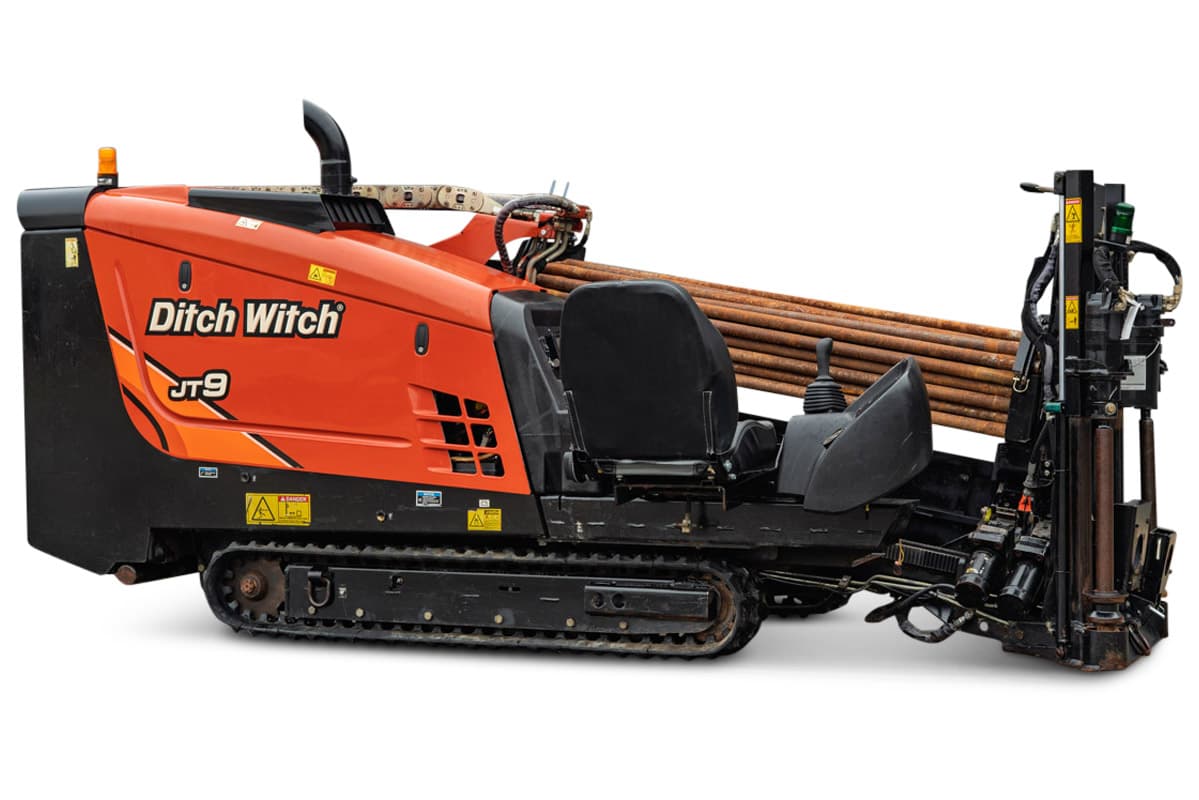
2016 Ditch Witch JT9
$79,000
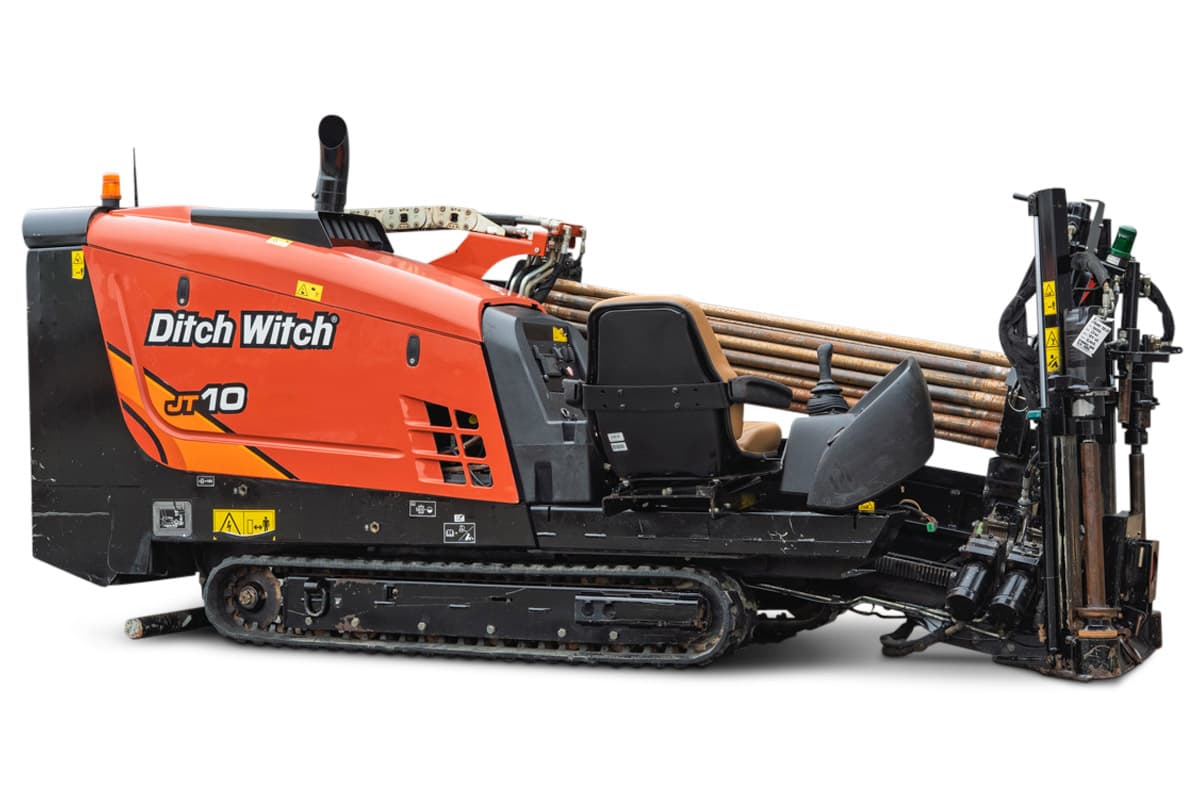
2022 Ditch Witch JT10
$99,000
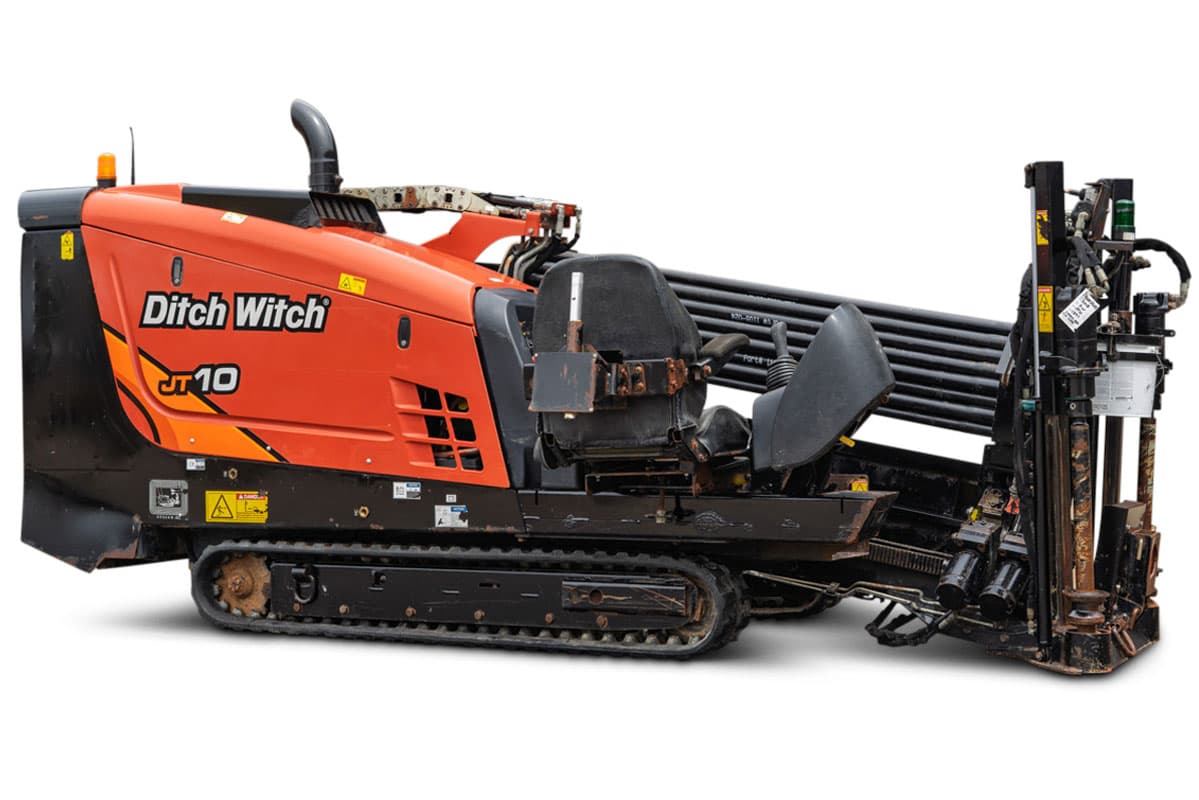
2018 Ditch Witch JT10
SALE PENDING
Want a quote today? Call (877) 288-0280.
Component 3: Mud system
Drilling fluid, the mud, lubricates the drill string, suspends and carries out cuttings, stabilizes the bore wall, and powers downhole tools. The mud system mixes water with bentonite and polymer additives and pumps it down the string. You cannot drill without one, and it is roughly 8 to 15 percent of the build. Options scale with the rig:
- Skid-mounted small mixer plus pump (roughly 250 to 500 gallon capacity), for fiber-drop work and mini-class rigs.
- Trailer-mounted mixer for utility-mid work, with a dedicated mud pump.
- Mixing-and-reclaiming systems such as the Mud Technology MCT-450, which clean and recycle fluid as well as mix it. These are a step up in capability and cost, more than a bare mixer.
- Truck-mounted mud systems for mid-heavy work and up, self-contained on a chassis.
A mud system is not a vacuum excavator
Buyers conflate these constantly. A mud system mixes and pumps drilling fluid into the bore. A vacuum excavator (the Ditch Witch FX and FXT units, the Vermeer CV series, and similar) is a separate machine that potholes and daylights to expose existing utilities and sucks up spoil. Utility crews working around buried lines often want one, but it is a separate $25,000-and-up purchase, not part of the mud system. Do not budget a vacuum unit and a mud system as the same line. Our used vacuum excavator buyer's guide for HDD crews covers the vac side on its own terms.
Used pricing (planning ranges): a skid mixer plus pump combo runs roughly $8,000 to $18,000 (entry units start lower new); a mid-class trailer-mounted mixer roughly $20,000 to $45,000; a reclaiming system or truck-mounted setup $50,000 to $100,000 and up.
Do not over-economize here
According to a Vermeer and Pentair report published in Trenchless Technology, roughly 70 percent of field mistakes trace to poor-quality drilling mud. The mud system is the last place to cut corners to save a few thousand dollars, because the failures it causes downhole cost far more. Browse current mud equipment inventory, and inspect any used mud pump carefully (our inspection checklist covers it). For the full treatment of this component, mixers against reclaimers and what each costs used, see our used HDD mud system buyer's guide.
Component 4: Drill pipe
The hollow steel rods that thread together end to end and form the column thrust through the earth. The pipe carries fluid to the head and transmits rotation and thrust. A used rig comes with some pipe, but you will often need to add to it. Roughly 5 to 10 percent of the build.
Length and brand. Mini and small rigs (like the JT9 and JT10) typically run 6-foot rods; utility-mid and larger run 10-foot rods as standard. The dominant aftermarket brand is Premier Drill Pipe, made in Houston, Texas, widely trusted and far cheaper than OEM. OEM pipe (Vermeer's Firestick on the D-series, Ditch Witch's own on the JT-series) is the premium reliability tier and runs a meaningful premium, commonly cited around 20 to 40 percent over aftermarket. Avoid no-name generic pipe; a pipe failure underground is a day-ending, sometimes bore-ending, event.
How much do you need? Enough total pipe length to complete your longest planned bore plus about a 10 percent buffer. A 300-foot maximum bore needs roughly 330 feet, which is 33 ten-foot rods. A starter set is typically 30 to 50 rods depending on rig class, and many used rigs come with around 40 rods already.
Used pricing (current market). New aftermarket JT20-class rods run about $279 each from suppliers like PilotTrack, so a fresh 40-rod set is roughly $11,000 new. Used rods, which almost always sell in lots rather than individually, typically come in well under new, often in the rough neighborhood of $100 to $175 a rod, putting a used 40-rod mini-class set around $4,000 to $7,000 and a utility-mid set in the low to mid five figures. Full per-rod and per-string pricing by rig class is consolidated in our HDD drill pipe cost guide. Used pipe condition matters enormously: measure outside diameter against the factory spec, and treat pipe worn past spec as worth zero, to be replaced and deducted from the rig price. Our inspection checklist covers drill-stem wear measurement.
Component 5: Tooling
The downhole components on the leading end of the string: the bit drills the pilot hole, the reamer enlarges the hole to product size on pullback, the swivel lets the product spin freely while being pulled, and the housing carries the transmitter. Roughly 3 to 7 percent of the build, but soil-dependent.
- Pilot bits matched to soil: sand and clay versus rock versus cobble.
- Reamers in several styles and sizes (fluted, hole-opener, fly-cutter, hard-rock) for your job mix.
- Bent housings and sondes that carry the transmitter, sized to the bit and rig class.
- Swivels rated to your maximum pullback force.
- Sub savers, the small replaceable component that protects the rig's threads.
Basic starter tooling runs roughly $5,000 to $10,000 for a mini-class crew and $15,000 to $25,000 for mid-heavy work. Soil-specific tooling adds to that; a crew in rocky ground needs hard-rock reamers and bits, easily another $5,000 to $10,000.
The sub saver: cheap part, expensive neglect
A sub saver is the threaded sacrificial component between the rig's output shaft and the drill string, and it is the single most underrated tooling-side risk on a used machine. Vermeer's guidance is condition-based, not on a fixed schedule: inspect the threads after every job and replace at the first sign of wear, before a worn sub saver starts transferring thread damage into the rod basket. Replacing one runs roughly $135 to $650 depending on size and thread; letting a worn one go can damage an entire set of rods worth many thousands of dollars. Check it on any used rig (see our fiber rig guide, which flags this on Vermeer machines specifically).
Component 6: Trailer
The trailer moves the rig, tooling, and kit between jobs. It is often overlooked in starter planning, sometimes because a buyer assumes an existing trailer will do. Verify the rating before you assume. Roughly 5 to 10 percent of the build if you are buying one.
Sizing math. Rated capacity has to exceed the rig weight plus tooling plus a working margin. A JT20 at about 11,890 pounds plus a roughly 1,500-pound tooling kit is about 13,400 pounds of working weight. A 14,000-pound-rated trailer is bare minimum at that load (only a few hundred pounds of headroom), and a 16,000-pound rating gives proper margin. Mid-heavy rigs want 20,000 to 25,000-pound trailers.
Brand. Belshe is the dealer standard for HDD hauling. Read the model numbers carefully: the T16 is a 16,000-pound GVWR trailer and the WB14 is 14,000-pound, but the BF-series numbers denote the axle rating, not the total trailer rating, so a BF11 is actually a roughly 23,000 to 24,000-pound GVWR trailer, not an 11,000-pound one. Match the trailer's true GVWR to your loaded weight.
Used pricing. A bare used trailer is a modest line item, but the higher numbers you will see on HDD listing sites usually reflect trailers packaged with a mounted mud or bentonite system, not the bare trailer. Price the trailer for what it is. Browse current trailer inventory and confirm the GVWR against your loaded weight.
Component 7: Stakedowns and ancillary
The small items that quietly add up, roughly 2 to 5 percent of the build but the difference between a working crew on day one and a crew waiting on a $200 part:
- Stakedown anchors to hold the rig to the ground
- Fuel cans and storage
- Water containers and hoses for mud mixing
- Spare hydraulic hoses (a mid-class kit is roughly $300 to $800)
- Spare sub savers as consumable inventory
- Hand tools and tool storage
- Safety equipment and PPE, plus a first-aid and jobsite kit
Budget roughly $3,000 to $8,000 for a complete first-job ancillary kit. It is the most commonly underbudgeted line in the whole package.
Three example builds
This is the section buyers scroll to. Each build shows itemized line ranges and a typical all-in total. Remember: the line ranges are wide because they span best case to worst case per item, while the typical total reflects where a real, sensibly specced build actually lands. You will not hit every line's maximum or every line's minimum at once.
Entry build: residential fiber and light utility
For a small crew getting into residential fiber drops and light utility work. A mini-class rig and a foundational kit, the lowest barrier to entry. Typical all-in: about $150,000 to $190,000.
| Component | Example | Used range |
|---|---|---|
| Rig | Ditch Witch JT20 (2015 to 2019, around 2,500 hours) | $85,000 to $120,000 |
| Locator | DigiTrak F2 system | $13,000 to $16,000 |
| Mud system | Skid-mounted mixer plus pump | $8,000 to $15,000 |
| Drill pipe | 30 to 40 used rods (10-foot) | $5,000 to $8,000 |
| Tooling | Basic bit, reamer, housing, swivel kit | $5,000 to $10,000 |
| Trailer | Belshe T16 (16,000-pound rated) | $12,000 to $18,000 |
| Stakedowns and ancillary | Anchors, hoses, fuel cans, basic spares | $3,000 to $5,000 |
| Typical all-in | Sensibly specced, not all-max | ~$150,000 to $190,000 |
Recommended build: utility-mid, all-purpose
The most common starter package, and the one we steer most buyers toward. It handles fiber drops, distribution, and mixed utility work without compromise, and it holds the strongest resale liquidity. Typical all-in: about $220,000 to $290,000.
| Component | Example | Used range |
|---|---|---|
| Rig | Ditch Witch JT24 or Vermeer D23x30 S3 (2018 to 2022) | $120,000 to $200,000 |
| Locator | DigiTrak F5 or Falcon F1 system | $13,000 to $21,000 |
| Mud system | Trailer-mounted mixer plus dedicated pump | $20,000 to $45,000 |
| Drill pipe | 40 to 50 used rods (10-foot) | $12,000 to $20,000 |
| Tooling | Multi-soil reamer set, multiple bits, housing, swivel | $10,000 to $18,000 |
| Trailer | Belshe WB14 or BF-series (16,000 to 24,000-pound rated) | $15,000 to $30,000 |
| Stakedowns and ancillary | Full kit, hose spares, sub-saver inventory | $5,000 to $8,000 |
| Typical all-in | Sensibly specced, not all-max | ~$220,000 to $290,000 |
Premium build: gas and utility infrastructure
For contractors planning trunk fiber, gas-main work, or infrastructure crossings. A mid-heavy rig and a comprehensive kit, higher upfront for a faster revenue ramp. Typical all-in: about $330,000 to $450,000.
| Component | Example | Used range |
|---|---|---|
| Rig | Ditch Witch JT40 or Vermeer D40x55 S3 (2018 to 2023) | $135,000 to $285,000 |
| Locator | DigiTrak Falcon F5 with Aurora display | $18,000 to $32,000 |
| Mud system | Reclaiming or truck-mounted mud system | $50,000 to $90,000 |
| Drill pipe | 50 to 60 used rods, mid-heavy class | $20,000 to $35,000 |
| Tooling | Comprehensive multi-soil plus rock package | $15,000 to $30,000 |
| Trailer | Belshe heavy-duty (20,000 to 25,000-pound rated) | $20,000 to $35,000 |
| Stakedowns and ancillary | Comprehensive kit with spare-parts inventory | $7,000 to $12,000 |
| Typical all-in | Sensibly specced, not all-max | ~$330,000 to $450,000 |
Infrastructure crews working around buried utilities often add a vacuum excavator for potholing, a separate purchase of roughly $25,000 and up that is not included in these totals.
The financing reality
At the Recommended and Premium levels, most first-time buyers finance rather than tie up six figures of working capital. WorldHDD partners with First Pacific Funding, whose pre-approval application takes a few minutes, does not affect your credit score, and typically returns a decision within 24 to 48 hours. As a rough illustration, a $250,000 package often lands somewhere around $5,000 to $7,000 a month depending on term length, rate, and down payment, a number a crew completing one to two commercial bores a week can plan around. Our full guide on how to finance used HDD equipment covers loan versus lease, realistic rates, and the 2026 Section 179 picture; or go straight to financing options for used HDD equipment.
What you can skip or defer
Naming what you can postpone reduces your initial outlay and is the honest thing to do. None of these is operationally required on day one:
- A full spare-parts inventory. Beyond essential consumables (sub savers, hydraulic hoses), build the spares shelf as you encounter real failures. Saves roughly $2,000 to $5,000 up front.
- An enclosed cab. Used machines without a cab run 10 to 20 percent cheaper. A cab adds comfort and seasonal flexibility but is not operationally necessary.
- A backup locator transmitter. One transmitter is enough for most starter operations; add a spare after your first failure or once volume justifies it.
- Premium and specialty tooling. Buy the basic bit and reamer set for the soils you will hit first, and add hard-rock or large-diameter tooling only when a project demands it.
- A vacuum excavator. Unless your work requires daylighting around existing utilities, defer it; fiber-only crews rarely need one to start.
- OEM drill pipe. Premier is dealer-trusted and well cheaper than OEM. OEM is the premium tier, not a requirement for most work.
Deferring sensibly can trim roughly $15,000 to $40,000 off the initial outlay and let a first-time buyer enter at lower capital risk.
Bundle versus piecemeal
For a first-time buyer, acquiring the package from one dealer is almost always the right call, for reasons beyond convenience:
- Pre-paired compatibility. The components are selected to work together, the locator generation matches across the kit, the mud system suits the pipe, the trailer is rated for the rig. That alone saves you from the expensive compatibility mistakes this guide keeps warning about.
- One transaction to finance. Financing a single package is far simpler than financing six separate purchases through different sellers.
- One inspection and service relationship. A bundled package from a dealer comes with unified inspection and a single point of contact after the sale.
There is no published study putting an exact number on the bundle savings, and we will not invent one; honestly, the dealer total is often modestly cheaper or roughly break-even against carefully shopped piecemeal, with the real win being the compatibility and time saved. Piecemeal makes sense if you already own some components, if you are deliberately mixing channels (an auction rig plus dealer tooling), or if you need a specific component a single dealer cannot supply.
The bottom line
The rig is the centerpiece, but it is only about half the bill. A working HDD setup is seven components, and the six beyond the rig routinely add $80,000 to $150,000 and decide whether your crew can actually work on day one. Price the whole package, not the headline machine, match every component to your real work mix, defer what you genuinely can, and use financing to keep your working capital intact. Do that and the intimidating six-figure number becomes a plan instead of a surprise.
Tell us your target work mix, your budget, and your timeline, and we will build you a complete starter-package quote against current WorldHDD inventory, with every component matched and priced. Request a starter package quote. Most buyers also finance; you can apply for financing through First Pacific Funding (typical decision in 24 to 48 hours). Have a machine to put toward it? We also take trade-ins.
Frequently asked questions
What is the realistic minimum total budget to start directional drilling with everything I need?
For a complete, working setup, plan on roughly $150,000 to $190,000 at the entry level: a used mini-class rig plus locator, mud system, drill pipe, tooling, trailer, and ancillary kit. The rig alone is only about half of that. You can trim toward the low end by deferring spares, a cab, and premium tooling, but the floor for a genuinely working crew, not just a parked machine, is in that range. Below it, you are usually missing something you will need in week one.
Can I start with just a rig and rent the rest until I am cash-positive?
For some components, yes. Mud systems and vacuum excavators are commonly rented, which can lower your day-one outlay. The locator and a basic tooling set are harder to rent practically, because you need them on every bore and rental availability is spotty. A common middle path is to buy the rig, locator, pipe, and core tooling, and rent the larger mud or vacuum equipment until volume justifies owning it. Just price renting honestly against owning; over a busy season, rental costs can exceed a used purchase.
How much of a starter package can I finance, and how fast is approval?
Most of it. WorldHDD finances virtually any equipment in inventory, including rigs, locators, mud systems, drill-pipe packages, vacuum systems, and trailers, through First Pacific Funding. The pre-approval application takes a few minutes and does not affect your credit score, and a decision typically comes within 24 to 48 hours. Approval is based on the overall financial picture of your business, not a credit score alone, so a range of credit profiles can qualify, with stronger credit earning better terms.
If I already have a trailer rated for similar weight, do I need a new one?
Maybe not, but verify the rating before you assume. The trailer's GVWR has to exceed your rig weight plus tooling plus a working margin. A JT20 plus tooling is about 13,400 pounds, so a 14,000-pound trailer is bare minimum and a 16,000-pound rating gives proper headroom. Watch the Belshe model numbers: a T16 is 16,000-pound GVWR, but the BF-series numbers refer to axle rating, so a BF11 is actually a roughly 23,000 to 24,000-pound trailer. Match true GVWR to your loaded weight, not the model name.
Is it cheaper to buy a complete package from a dealer or assemble components from different sources?
For a first-time buyer, a dealer package is almost always the better deal once you account for everything. The components come pre-matched for compatibility, you finance one transaction instead of six, and you get a single inspection and service relationship. The straight dollar comparison is often modestly in the dealer's favor or roughly break-even, but the real savings is avoiding the compatibility mistakes and the time cost of sourcing seven components separately. Piecemeal makes sense mainly if you already own pieces or are deliberately mixing channels.
Do I need a DigiTrak Falcon, or is an F2 or F5 enough for residential fiber work?
For residential fiber drops in typical conditions, a classic F2 or F5 system is usually plenty and saves real money over a current Falcon. The Falcon line's advantage is advanced interference handling, which matters most in electrically noisy urban environments and congested utility corridors. If your work is mostly suburban residential, start with an F2 or F5. The more important rule on any used locator is compatibility: make sure the transmitter, receiver, and display are all the same generation before you buy.
What is the bare-minimum tooling kit to start fiber drop work?
A basic bit matched to your soil, one or two reamers sized to the conduit you pull, a bent housing or sonde for the transmitter, a swivel rated to your rig's pullback, and a sub saver, plus a spare. That runs roughly $5,000 to $10,000 for a mini-class fiber crew. Add soil-specific tooling, like hard-rock reamers, only when a job actually calls for it. The one item not to skimp on or neglect is the sub saver: inspect it after every job and replace it at the first sign of thread wear.
How many drill rods come with a typical used rig, and how do I know if I need more?
Many used mini and utility-mid rigs come with around 40 rods, roughly 400 feet of pipe. To know whether that is enough, take your longest planned bore and add about 10 percent: a 300-foot bore needs about 330 feet, or 33 ten-foot rods, so 40 rods covers it with margin. If you plan longer bores, count the rods you actually need and add to the set. New aftermarket rods run about $279 each, and used rods sell in lots for considerably less, so topping off a set is not a major expense.
What is the difference between a vacuum-based system and a traditional mud system for first-time buyers?
They do different jobs and are separate purchases. A mud system mixes and pumps drilling fluid down the bore, and you cannot drill without one. A vacuum excavator potholes and daylights to expose existing utilities and removes spoil; it is a safety and utility-strike-avoidance tool, not a drilling-fluid system. Fiber-only crews can usually start without a vacuum unit and add one later if utility work demands daylighting. Do not budget the two as one line, and do not let a seller present a vacuum unit as your mud system.
If I plan to hire experienced operators, do I need the same starter kit as if I am operating myself?
Yes, the equipment list is the same; the bore does not care who is steering. What changes is what you can skip on the margins. Experienced operators are harder on assumptions and easier on machines: they will catch a worn sub saver or a marginal mud mix before it becomes a failure, which can let you run leaner on spares early. But every core component, rig, locator, mud, pipe, tooling, trailer, is still required. Hire the experience for the judgment, not as a substitute for any part of the kit.
Sources and references. Specifications and the cited industry figure were verified against manufacturer and trade sources in May 2026. Used-component prices are planning ranges drawn from current listings (HDD Broker, PilotTrack, and dealer inventory) and move with the market.
- Ditch Witch directional drills (official specs)
- Vermeer horizontal directional drills (official specs)
- Digital Control Inc. (DigiTrak locating systems)
- Premier Drill Products (aftermarket drill pipe, Houston, TX)
- Belshe Trailers (trailer GVWR and model specs)
- Mud Technology International (mud mixing and reclaiming systems)
- Vermeer Pro Tips, sub saver maintenance and replacement (condition-based replacement guidance)
- Trenchless Technology, "Drillmaster Report: Maintaining the Life of an HDD Mud Pump" (Vermeer and Pentair; source of the 70 percent mud-quality figure)
- PilotTrack and HDD Broker (used drill pipe and locator market pricing)