
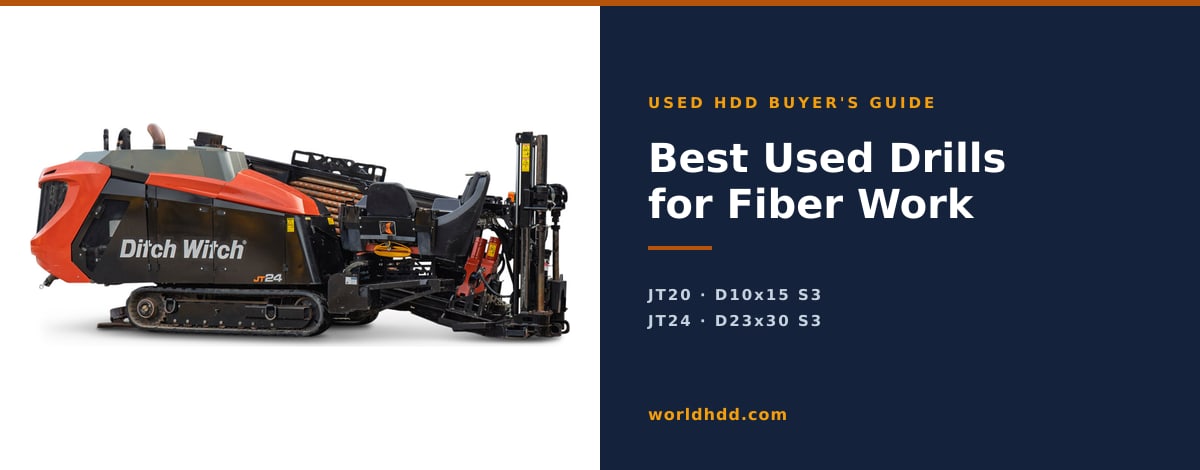
If you are a small fiber contractor buying your first or next used directional drill, four machines should be at the top of your list: the Ditch Witch JT20 and Vermeer D10x15 S3 in the mini class, and the Ditch Witch JT24 and Vermeer D23x30 S3 in the utility-mid class. Two brands, two size classes, no single winner. Which one is right depends on your bore mix, your service options, and where you work. Here is the case for each, the watch-outs that matter, and a link straight to the ones we have in stock.
We sell both brands, so we have no reason to talk you into one badge over the other. What follows is the dealer's-seat version: the machines we would actually point a fiber crew toward, defended on the things that matter to fiber work, and honest about where each one falls short. If you want the broader brand argument, our Ditch Witch vs Vermeer comparison covers it. This article is narrower and more practical: which specific used rigs to buy for fiber, and why.
The timing is not an accident. The $42.45 billion federal BEAD program has cleared its biggest hurdle. As of spring 2026, the NTIA has approved 54 of the 56 state and territory final proposals, nearly every state has both NIST clearance to spend and signed award agreements with subgrantees, and the first projects are breaking ground this year. Even after the 2025 restructuring made the program technology-neutral and dropped the explicit fiber preference, fiber is still the majority technology at roughly 64 percent of funded locations. Translation: a multi-year wave of buried-fiber construction is moving from planning to shovels, and the contractors who own the right equipment are the ones who will catch it.
Our four picks at a glance
For skimmers, here is the whole article in one table. The sections below defend each choice.
| Pick | Class | Pullback | Best for |
|---|---|---|---|
| Ditch Witch JT20 | Mini | 20,000 lb | Lowest-friction independent service; higher mud flow for distribution backreaming |
| Vermeer D10x15 S3 | Mini | 10,000 lb | Tight residential access; dealer-supported maintenance; lightest footprint |
| Ditch Witch JT24 | Utility-mid | 24,000 lb | High daily bore counts; fastest cycle times; mixed drop plus distribution |
| Vermeer D23x30 S3 | Utility-mid | 24,000 lb | Quietest in class; CAN bus refinement; strong Vermeer dealer territories |
Two mini machines for drop-heavy work, two utility-mid machines for crews that also run distribution. One Ditch Witch and one Vermeer at each level, so the decision comes down to your operation, not our inventory.
What makes a drill good for fiber
Before the picks, the framework that justifies them. Fiber is not an edge case for compact HDD; it is the main event. As Jeff Davis, a Ditch Witch HDD product manager, put it, "the fiber market is probably what 75 percent of these drills are used for." Calibrate the criteria to where the work actually is.
1. Footprint and maneuverability
Fiber work is mostly suburban and residential: tight rights-of-way, easements, sidewalks, and lawns. A machine much wider than about 54 inches starts to lose you jobs in cramped residential settings. Mini and utility-mid rigs, roughly 44 to 52 inches wide, dominate fiber for this reason. The Vermeer D10x15 S3 at 44 inches slips into places the 51.5-inch JT20 cannot. Track machines also tread more gently on finished lawns than wheeled units, which matters when the customer is a homeowner.
2. Cycle speed over peak pullback
Fiber crews live on bore count, not on raw power. A drop crew may run several short bores in a shift, so carriage thrust speed and rod-handling cycle time matter more than the top pullback number. This is where the JT24 stands out: its carriage runs 210 feet per minute on thrust and 216 on pullback, among the fastest in the utility-mid class. Over a day of short bores, faster cycles convert directly into more completed work.
3. Noise, and an honest word about it
Municipalities are tightening noise rules, and some restrict early-morning or late-evening operation, so the operator-ear sound rating is a real spec, not a nicety. But be careful with the folklore. At the newer-generation utility-mid level the cross-brand gap is small: the Vermeer D23x30 S3 is rated 82 dB(A) at the operator's ear and the Ditch Witch JT24 is 83 dB(A), a one-decibel difference you will not hear. The "loud Ditch Witch" reputation comes from older pre-Tier-4 JT-series machines, not from the current JT24. The real noise gap is old generation versus new, not Vermeer versus Ditch Witch.
4. Pullback class matched to bore mix
Match the machine to the work, not to the biggest job you might someday land.
- Residential drops (roughly 50 to 200 feet, light pullback): mini class is plenty.
- Distribution (roughly 200 to 600 feet, moderate pullback): a mini can struggle; utility-mid is the safer baseline.
- Trunk and long bores (600 feet and up, heavier pullback): utility-mid as the floor, occasionally a step up.
5. Tier 4 emissions and the DPF question
Short-cycle fiber work, with lots of light, low-load bores, is exactly the duty that stresses a diesel particulate filter, because the exhaust never gets hot enough to burn off cleanly and the engine forces more frequent regenerations. Here the two size classes split. The mini machines in this article use sub-75-horsepower Tier 4 engines that meet emissions with an oxidation catalyst and no DPF aftertreatment, so they sidestep the regen problem entirely. The JT20's Deutz is the clearest example, certified Tier 4 with no particulate filter to clog. The utility-mid machines (the JT24's Cummins F3.8 and the D23x30's Deutz) are larger engines that do carry full aftertreatment, so on those you should pull the regeneration history before you buy. More on reading that data is in our guide to how many hours is too many.
Bonus: independent serviceability
Small fiber contractors often cannot absorb a week of dealer-shop downtime. Machines with broad independent-shop support and easy parts availability, especially the long-running Ditch Witch JT series, carry lower total-downtime risk. Newer CAN bus Vermeer machines are superb to operate but lean more on dealer tools for deep electronic diagnostics. Neither is wrong; just know which world you are buying into.
Fiber-sized drills on the lot
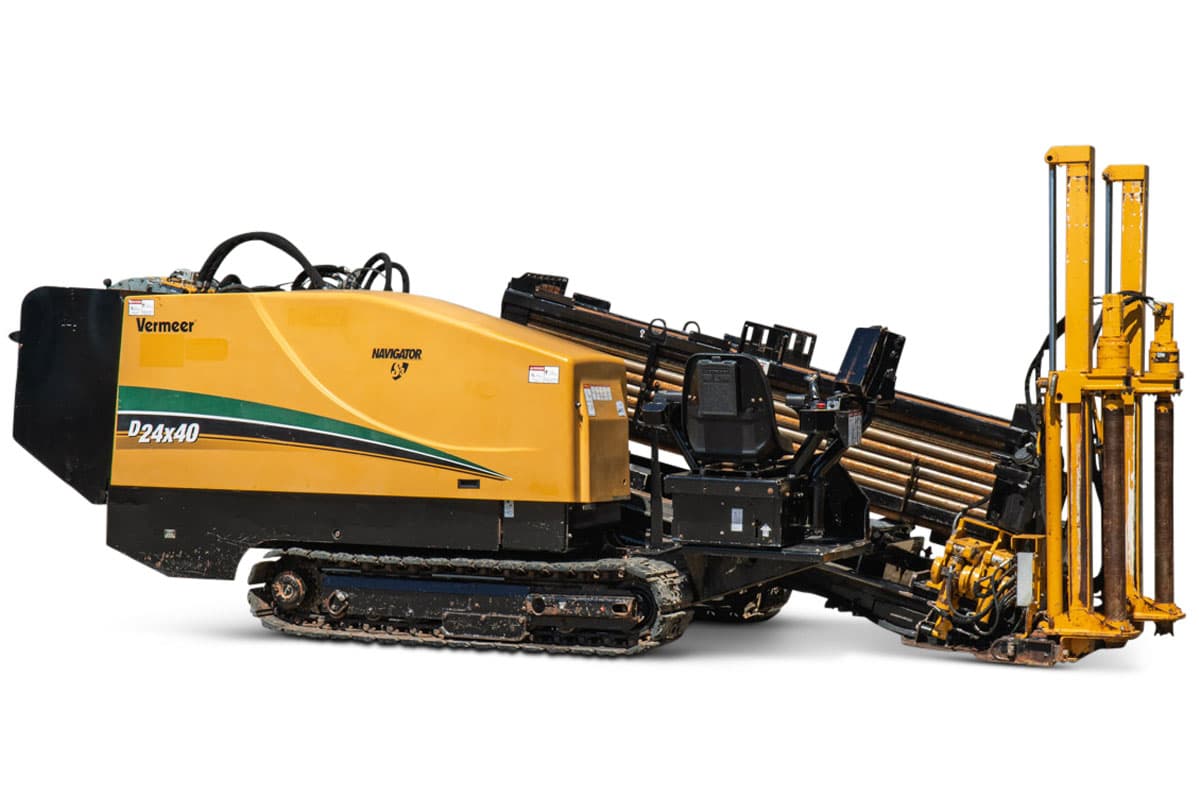
2020 Vermeer D24x40 S3
$179,000
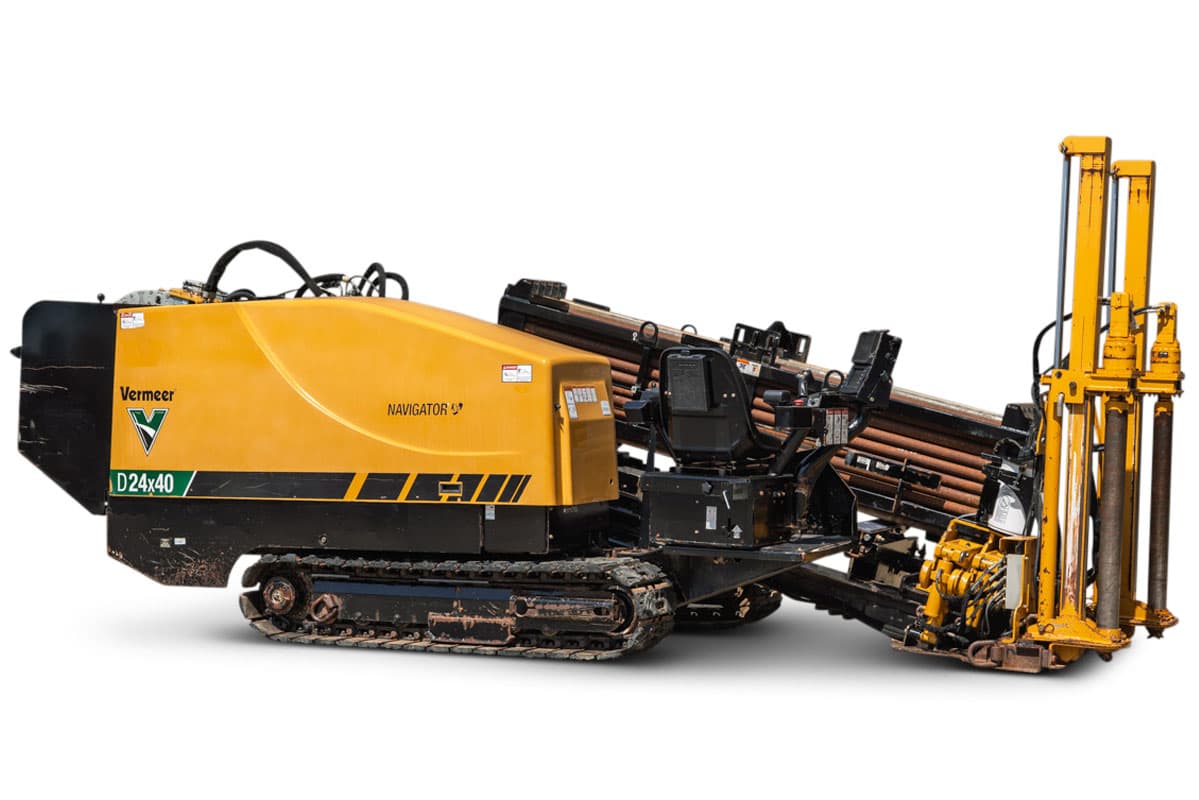
2020 Vermeer D24x40 S3
$179,000
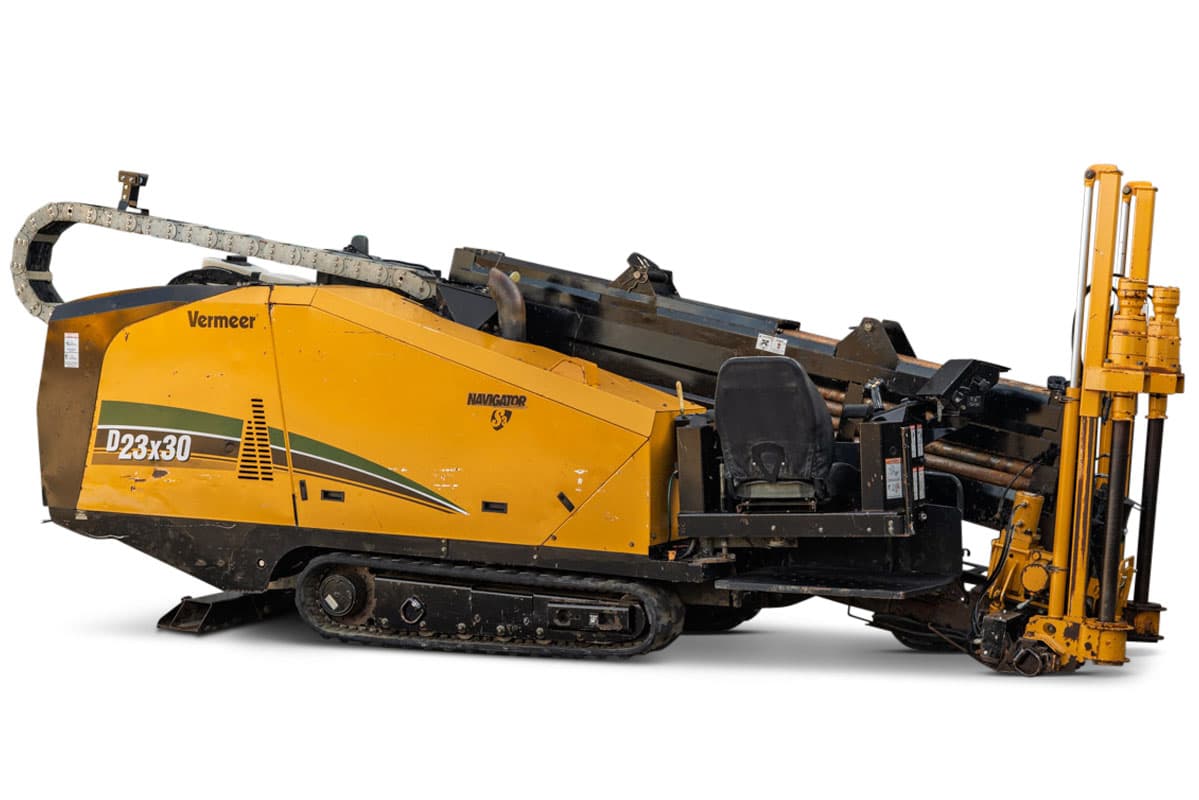
2016 Vermeer 23x30 S3
$99,000
Want a quote today? Call (877) 288-0280.
The four recommendations
Each pick gets the same treatment: who it is for, the specs that matter, why it fits fiber, what to expect on hours, the brand-specific watch-outs to verify, a word on pricing, and the tiebreaker against its same-class rival. Every spec below was checked against the manufacturer's own published figures.
Pick 1: Ditch Witch JT20 (mini class)
Buy this if you are entering fiber on a tighter budget, you want the lowest-friction independent service path, and you run enough distribution that mud flow matters. The historical fiber-market workhorse, and still a smart used buy; the JT20 deep-dive guide covers this machine end to end.
| Spec | Value |
|---|---|
| Thrust / pullback | 17,000 lb thrust / 20,000 lb pullback |
| Rotary torque | 2,200 ft-lb |
| Max fluid flow | 25 gpm |
| Transport width | 51.5 in |
| Weight | about 11,890 lb |
| Engine | Deutz Tier 4, oxidation catalyst, no DPF |
Why this for fiber. The JT20 has been in production for more than a decade, long enough that a deep parts and service ecosystem grew up around it. Mechanical simplicity, a well-understood rack-and-pinion carriage, and a Tier 4 Deutz with no particulate filter all suit high-cycle short-bore work. Its 25 gpm mud flow is meaningfully higher than the D10x15 S3's 15 gpm, which helps when you are backreaming the larger conduit common on distribution fiber. The tradeoff is size: at 51.5 inches the JT20 is wider than the smallest Vermeer, which costs you some flexibility in the tightest residential rights-of-way while adding stability on uneven ground.
Hours expectations. Mini-class machines run a normal band of roughly 500 to 2,500 hours, with "high hours" starting around 3,000 and a major rebuild milestone in the 2,500-to-3,500 range. Read any specific listing through that lens; our hours-by-class framework explains how to adjust for application and maintenance.
Watch-outs to verify.
- Rack wear. JT20s worked hard in high-cycle fiber duty wear the rack-and-pinion carriage faster than average. Sight down the rack for hooked or worn teeth.
- Strike Alert. Confirm the electric-strike sensor reads and triggers correctly. Cheap to fix, but a liability if it is dead.
- Drill string. Measure pipe outside diameter against the factory spec; worn pipe sold with the rig should be valued at zero.
Run the full sequence in our used directional drill inspection checklist before you commit.
Pricing. Used JT20s span a wide band depending on year, hours, and the tooling package, and a rig that includes rod, a mud system, and a locator can carry tens of thousands more than a bare machine, so always compare total packages, not headline prices. For current numbers, check what is actually on our lot.
Choose the JT20 over the D10x15 S3 if independent serviceability and mechanical simplicity matter more to you than the last increment of residential maneuverability, or if your bore mix leans toward distribution where the higher mud flow earns its keep.
Pick 2: Vermeer D10x15 S3 (mini class)
Buy this if you work tight residential fiber, you want the smallest, lightest footprint and newer hydraulic refinement, and you value dealer-supported maintenance through a Vermeer dealer. The precision choice for drop-focused crews.
| Spec | Value |
|---|---|
| Pullback | 10,000 lb |
| Rotary torque | about 1,500 ft-lb |
| Max fluid flow | 15 gpm |
| Transport width | 44 in |
| Weight | about 7,200 lb |
| Rod length / engine | 6 ft Firestick / Deutz Tier 4 |
Why this for fiber. The D10x15 S3 is the easiest machine here to put where fiber work happens. At 44 inches wide and around 7,200 pounds it tucks into tight residential rights-of-way and tows behind a lighter truck, and its CAN bus hydraulic control gives smooth, predictable carriage response that is forgiving for operators you are still training. It is purpose-built for the drop and short-distribution work that makes up the bulk of residential fiber. What it is not is a distribution backreaming machine: at 10,000 pounds of pullback and 15 gpm of mud flow it is deliberately smaller than the JT20, so match it to lighter bore loads.
Hours expectations. Same mini-class thresholds apply: roughly 500 to 2,500 hours is normal, 3,000-plus is high, and the rebuild milestone lands around 2,500 to 3,500. As Vermeer's own used-buying guidance notes, a small machine at high hours is generally less favorable than a larger drill at the same reading, so weigh hours more heavily on a mini than you would on a utility-mid rig.
Watch-outs to verify.
- Sub saver. A neglected sub saver on a Vermeer mini quietly transfers thread damage into the entire rod basket. This is the single most underrated risk on used Vermeer mini-class machines. Verify rod condition yourself, independent of any seller claim about sub-saver upkeep.
- Carriage wear pads. A routine wear item; check for excessive side-to-side play at the gearbox.
- Electronics. Deep CAN bus fault diagnosis on the S3 increasingly wants Vermeer dealer tools. Independent shops handle the mechanical work but are limited on the electronics, so factor your local dealer support into the buy.
Pricing. Late-model D10x15 S3 units typically sit at a slight premium to an equivalent JT20, and a documented service history through a Vermeer dealer is part of what you are paying for. Compare total packages, and check current inventory for live pricing.
Choose the D10x15 S3 over the JT20 if your work is mostly residential drops where the tighter footprint pays off, if you want dealer-supported maintenance, and if the lower mud flow is a non-issue for your bore mix.
Browse our 2 Vermeer D10x15 S3s
Availability on the D10x15 comes and goes; we have sold four. If we are between them when you read this, the nearest Vermeer machines on our lot are no D8x12s below it and 3 D20x22s above it, and the Ditch Witch JT10 covers the same class with 4 units in stock.
Pick 3: Ditch Witch JT24 (utility-mid class)
Buy this if your fiber work spans residential drops and distribution, you run high daily bore counts, and you want the fastest cycle times in the class. The natural step up for a crew that has outgrown a mini, or that is doing mixed work from day one.
| Spec | Value |
|---|---|
| Pullback | 24,000 lb |
| Rotary torque | 3,000 ft-lb |
| Max fluid flow | 40 gpm |
| Carriage speed | 210 fpm thrust / 216 fpm pullback |
| Engine | Cummins F3.8, Tier 4 (DPF) |
| Operator noise | 83 dB(A) |
Why this for fiber. Ditch Witch positions the JT24 for fiber alongside urban and residential gas and other utility work, and the spec sheet backs the fiber case. Carriage speeds of 210 feet per minute on thrust and 216 on pullback are among the fastest in the utility-mid class, and for a crew running a high count of distribution bores per day, faster cycles mean more completed work. The 40 gpm mud pump handles distribution backreaming comfortably. And at 83 dB(A) at the operator's ear it is one of the quieter Ditch Witch machines, a useful corrective to the dated "loud Ditch Witch" reputation. This is the workhorse for fiber crews growing into distribution.
Hours expectations. Utility-mid machines run higher: roughly 1,500 to 4,000 hours is normal, with high hours starting around 4,500 to 5,000 and rebuilds landing in the same band. The class buys you more runway than a mini at the same reading.
Watch-outs to verify.
- DPF and regen history. The Cummins F3.8 is a Tier 4 engine with a particulate filter. Pull the ECM data for regeneration frequency; frequent regens point to short-cycle or heavy-idle use that stresses the emissions system.
- Carriage slide wear. Check for excessive side-to-side movement.
- Vise and wrench. Confirm the rig breaks and makes pipe joints cleanly under torque.
Pricing. Utility-mid rigs cost more than minis, and a JT24 with a full tooling package runs well above a bare machine. Year, hours, and configuration all move the number, so compare like for like and check current inventory.
Choose the JT24 over the D23x30 S3 if cycle speed is your priority, if your crew prefers Ditch Witch mechanical simplicity, or if you have strong independent and dealer support for the brand in your region.
Pick 4: Vermeer D23x30 S3 (utility-mid class)
Buy this if noise compliance is operationally important, you want CAN bus hydraulic refinement, or you operate in a strong Vermeer dealer territory and value dealer-backed maintenance planning. The refined alternative to the JT24.
| Spec | Value |
|---|---|
| Pullback | 24,000 lb |
| Rotary torque | 3,000 ft-lb (2.375 in rod) |
| Max fluid flow | 35 gpm |
| Engine | Deutz, 100 hp, Tier 4 |
| Rod length | 10 ft Firestick |
| Operator noise | 82 dB(A) |
Why this for fiber. The D23x30 S3 meets the JT24 head-on at 24,000 pounds of pullback and 3,000 foot-pounds of torque. At 82 dB(A) it is marginally the quietest of the four, though as noted above the one-decibel edge over the JT24 is smaller than folklore claims. Its real advantages over the Ditch Witch are CAN bus hydraulic refinement, which smooths carriage control and helps when training new operators, and the Vermeer ecosystem: the VermeerOne telematics platform for fleet visibility, the Confidence Plus asset-protection program for predictable maintenance budgeting, and the price transparency of vermeerused.com, where Vermeer aggregates used inventory in one marketplace. In a strong Vermeer dealer region, those add up.
Hours expectations. Same utility-mid bands as the JT24: roughly 1,500 to 4,000 normal, 4,500 to 5,000 high. Year and configuration push back hard against the hour number on this model, so do not read hours in isolation.
Watch-outs to verify.
- Encoder and AutoDrill. Encoders in this class have known failure modes, often a loose set screw causing gear dropout. Confirm AutoDrill responds correctly.
- Vise dies. Worn dies are a common cause of rod slippage; inspect them.
- Sub saver. The same silent rod-basket risk as on the mini-class Vermeer applies here. Verify it.
- DPF and regen history. The 100-horsepower Deutz carries Tier 4 aftertreatment, so pull the regen data as you would on the JT24.
Pricing. The D23x30 S3 typically commands a slight premium over an equivalent JT24, helped by Confidence Plus marketability and the resale transparency of a unified used marketplace. As always, compare total packages against live inventory.
Choose the D23x30 S3 over the JT24 if you want CAN bus refinement, dealer-backed maintenance planning, or you are in a strong Vermeer territory. Choose the JT24 if cycle speed leads your priorities or you want the broadest independent-shop support.
Honorable mentions and edge cases
The four picks cover most fiber crews. A few machines deserve a look at the margins.
Ditch Witch JT28 and JT9
The JT28, at 28,000 pounds of pullback, fills the gap above the JT24 and below the bigger mid-heavy rigs. Worth a look if your fiber work occasionally pushes into trunk bores that need more pullback. The JT9, at 9,000 pounds, is the compact, tight-access option for crews doing almost nothing but short residential drops in very cramped settings.
Vermeer D9x13 S3 and D20x22 S3
The D9x13 S3, at 9,000 pounds of pullback, is the smallest drill in the current Vermeer lineup and suits drop-only operations. The D20x22 S3, at 19,500 pounds, splits the difference between mini and utility-mid, a fit for crews doing mostly distribution with the occasional drop.
One to watch: the Ditch Witch JT21
Ditch Witch introduced the JT21 in early 2025 as the JT20's successor, claiming a 53 percent faster carriage speed and up to 40 percent more downhole horsepower, the latter through hydraulic and direct-drive efficiency rather than a bigger engine. It is genuinely promising, but as of 2026 it is thin on the used market and short on field-proven operator history, so we flag it rather than recommend it. Buy the JT20 now with eyes open that its replacement exists.
What we do not recommend for fiber, and why
Naming what does not fit is as useful as naming what does.
Mid-heavy machines (D40x55, JT40)
Strong rigs, but oversized for fiber in the large majority of cases: higher purchase and operating cost, and no real benefit on short bores. Buy mid-heavy only if your fiber work routinely includes trunk bores past roughly 1,000 feet.
Heavy machines (D60x90, JT60 and up)
The wrong tool for fiber, full stop. These are infrastructure rigs for gas main and large crossings. If that genuinely is your work rather than fiber, our Vermeer D20x22 and D60x90 specs and used buyer's guide covers what to check on one.
Pre-Tier-4 machines (roughly 2010 and earlier)
The hours-to-price math can look tempting, but emissions rules vary by jurisdiction and some municipalities restrict pre-Tier-4 diesel operation. Confirm your local rules before considering an older unit.
Auction buys without inspection
A dealer carries a premium over an auction-equivalent machine, and for a fiber contractor without an in-house shop that premium buys documented inspection and service history. Our hours guide walks through the auction-versus-dealer math in detail.
Pairing the rig: locator, mud, pipe, and trailer
The drill is the centerpiece, not the whole kit. A complete fiber setup pairs it with four things.
- Locator. A DigiTrak system is the versatile, widely supported choice and works with both Vermeer and Ditch Witch rigs. Verify generation compatibility on used gear, since the Falcon, Aurora, and earlier families are not fully cross-compatible. Browse DigiTrak locating systems in inventory.
- Mud system. A small mud trailer suits a mini doing residential drops; a utility-mid rig running distribution wants more mixing and pumping capacity. Size it to your daily fluid demand. See mud equipment.
- Drill pipe. Match the pipe to the machine and inspect any pipe included in a sale; worn-out pipe is a day-ending failure underground, so treat it as worth zero and budget replacement.
- Trailer. Size the trailer to the full package weight: rig plus mud system plus tooling. Browse current trailers.
For first-time buyers
Pricing a rig, locator, mud system, and trailer as one package is often better economics than buying piecemeal. If you are assembling your first fiber outfit, ask us to put a complete starter package in front of you rather than quoting the drill alone.
The bottom line
There is no single best directional drill for fiber, which is exactly why we gave you four. In the mini class, the Ditch Witch JT20 wins on independent serviceability and mud flow while the Vermeer D10x15 S3 wins on footprint and dealer-backed refinement. In the utility-mid class, the JT24 wins on cycle speed while the D23x30 S3 wins on noise and the Vermeer ecosystem. Pick the size class from your bore mix, pick the brand from your service options and your region, then verify the specific machine with a disciplined inspection before you sign. Do that and you will buy a rig that fits the work, not just the budget.
Not sure which of the four fits your fiber operation best? Talk to a WorldHDD specialist. Tell us your bore mix, your region, and your budget, and we will point you at the right class, the right brand, and the actual machines we have in stock. Financing is available; see financing options for used HDD equipment.
Frequently asked questions
Is the JT20 still the right choice for fiber in 2026, or has the D10x15 S3 surpassed it?
Neither has surpassed the other; they solve different problems. The JT20 brings more pullback (20,000 versus 10,000 pounds), higher mud flow, and a deeper independent-service ecosystem, which suits crews doing distribution and those who service their own equipment. The D10x15 S3 is smaller, lighter, and easier to place in tight residential work, with newer hydraulic refinement and dealer-supported maintenance. Choose by bore mix and service preference, not by which is "newer." A drop-only crew often prefers the Vermeer; a mixed drop-and-distribution crew often prefers the Ditch Witch.
For a two-person crew doing mostly residential drops, do I need a utility-mid machine or is a mini enough?
For mostly residential drops, a mini-class machine like the JT20 or D10x15 S3 is usually enough and saves you money on purchase, transport, and operating cost. Step up to a utility-mid rig like the JT24 or D23x30 S3 only if you regularly run distribution bores in the 200-to-600-foot range or expect to soon. A common smart path is to start on a mini for drop work and add a utility-mid machine when distribution volume justifies it, rather than overbuying on day one.
What is a realistic budget to buy a used fiber-class drill with full tooling and a trailer?
Budget for the package, not just the drill. A used mini or utility-mid rig is the largest line item, and rod, a mud system, a locator, and a trailer can add a substantial amount on top, easily tens of thousands of dollars depending on what is included. Two machines at the same headline price can differ widely once you account for tooling, so always compare complete packages. The most reliable way to get a current number for your configuration is to look at live inventory and ask us to price a full outfit.
If I only ever do short residential drops, is the JT20's higher mud flow worth the size and noise tradeoff?
Probably not. The JT20's 25 gpm mud flow earns its keep on distribution backreaming, which a drop-only crew rarely does. If your work is genuinely all short residential bores, the smaller, lighter, 44-inch-wide D10x15 S3 is easier to place and gentler on finished lawns, and you will not miss the extra flow. Save the higher-flow Ditch Witch for crews whose bore mix actually includes the larger conduit that uses it.
How loud are these machines really, and does brand make a difference?
At the newer-generation utility-mid level the brands are effectively tied: the Vermeer D23x30 S3 is rated 82 dB(A) at the operator's ear and the Ditch Witch JT24 is 83 dB(A), a difference you will not hear. The "loud Ditch Witch" reputation traces to older pre-Tier-4 JT-series machines, not to the current JT24. If noise compliance is critical for evening residential work, both newer machines are reasonable; do not pay a large premium chasing a one-decibel spec gap between current-generation rigs.
Should I worry about Tier 4 emissions systems on a used fiber drill?
It depends on the size class. The mini machines here use sub-75-horsepower Tier 4 engines that meet emissions with an oxidation catalyst and no diesel particulate filter, so they avoid regeneration problems entirely; the JT20 is the clearest example. The utility-mid machines, the JT24 and D23x30 S3, do carry particulate filters, and short-cycle fiber work can stress them, so on those pull the regeneration history from the engine data before buying. Never accept any machine with its emissions controls deleted, which is illegal and a reliability red flag.
Should I prioritize a newer machine with high hours or an older machine with low hours?
Read the maintenance records before you read either number. A documented, dealer-serviced machine at higher hours is frequently a better buy than an undocumented private-sale machine at lower hours, because maintenance history is the single biggest reliability variable. On a mini in particular, weigh hours more heavily, since small machines have less runway. The decision is rarely "new versus old"; it is "documented and well-kept versus not." Our hours-by-class guide explains how to turn the hour reading into a negotiating position rather than a pass-fail line.
Are there Vermeer or Ditch Witch dealer regions with better fiber-contractor support?
Yes, and it should influence your brand choice. Both brands have strong and weak territories, so before you commit, find out who actually supports the machine near where you work: which dealer stocks parts for your model, how fast they turn a service job, and whether independent shops in your area know the rig. A Vermeer is a stronger buy in a strong Vermeer territory, and the same is true for Ditch Witch. The best machine on paper is the wrong machine if it sits waiting on parts.
I want to start with one drill and add a second crew within two years. Should I standardize on one brand?
If you are confident you will grow, standardizing on one brand has real advantages: shared spare parts and tooling, operators who can move between machines, one set of dealer relationships, and simpler maintenance planning. The counterargument is flexibility, since the best-priced used machine when you expand may be the other brand. A reasonable middle path is to standardize on a brand and size class for your core fleet while staying open on opportunistic buys. Our brand comparison covers the standardization question in more depth.
What about the new Ditch Witch JT21? Should I wait for it instead of buying a JT20?
For most buyers right now, no. The JT21 is a genuine step forward, with a claimed 53 percent faster carriage and up to 40 percent more downhole horsepower, but as of 2026 it is scarce on the used market and short on field history, so used pricing and proven reliability are not yet there. Buy a well-inspected JT20 today for work you have now, knowing the successor exists. Revisit the JT21 in a year or two once used inventory and operator track record have built up. Our Ditch Witch JT20 used buyer's deep-dive is the full treatment of that purchase.
Sources and references. Specifications were verified against the manufacturers' official published spec sheets and product pages in May 2026. Market context reflects NTIA and industry figures current as of spring 2026.
- Ditch Witch JT20 directional drill (official specs)
- Ditch Witch JT24 directional drill (official specs)
- Vermeer D10x15 S3 Navigator (official specs)
- Vermeer D23x30 S3 Navigator (official specs)
- Ditch Witch, JT20 product profile (source for the Jeff Davis "75 percent" fiber-market estimate)
- NTIA BEAD Program Progress Dashboard (state plan approvals, NIST clearance, award agreements)
- Fiber Broadband Association (BEAD construction timeline and fiber-share context)
- Vermeer Used Equipment marketplace