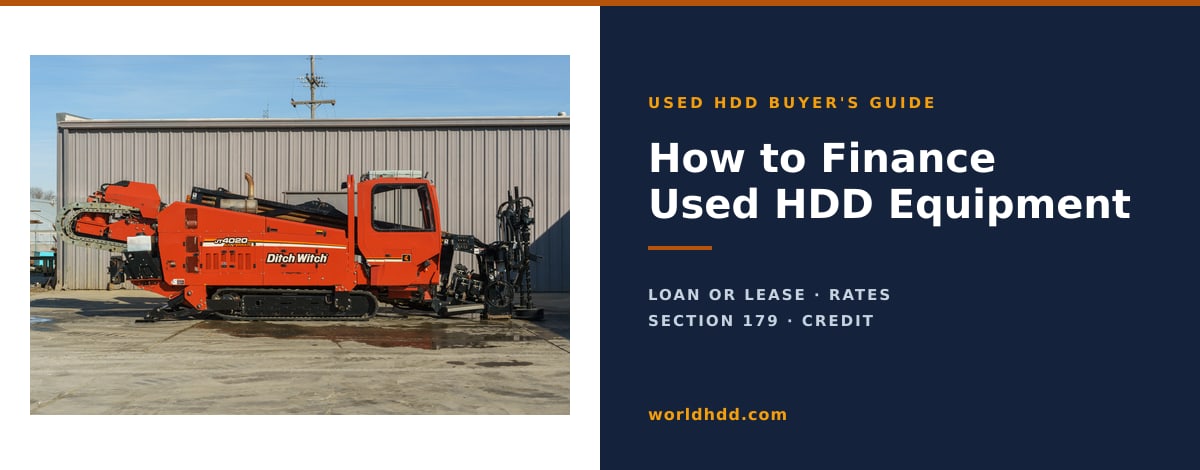
You have found the machine. Now you are solving the money. The good news that most first-time buyers do not expect: used HDD equipment is financeable, used equipment bought through a dealer is easier to finance than a private-party machine, and a pre-approval to find out what you qualify for takes a few minutes and does not touch your credit score. This guide explains how equipment financing actually works for used directional drills, loan versus lease, what rates and terms are realistic, how Section 179 and bonus depreciation can offset the cost, and what it really takes to qualify, so the six-figure number on the machine turns into a monthly payment you can plan around.
We sell and finance used HDD equipment for a living, so this is the dealer's view of how buyers actually pay for machines, not a lender's sales pitch and not a generic finance-blog explainer. A quick but important boundary first: WorldHDD is the equipment dealer, not the lender. Financing is provided through our partner, First Pacific Funding, which makes the credit decision and sets your actual rate and terms. Nothing here is a quote, a rate promise, or financial or tax advice. It is the lay of the land so you walk into the application knowing what to expect.
The short answer
Yes, you can finance used HDD equipment, and you do not need new equipment or perfect credit to do it. WorldHDD partners with First Pacific Funding to finance virtually any used machine in our inventory, including directional drills, locators, mud systems, drill pipe, vacuum systems, and trailers. The path is three steps: apply online for pre-approval, get a decision (typically within 24 to 48 hours), then take delivery. The pre-approval does not affect your credit score, so there is no downside to finding out what you qualify for before you commit.
The one thing to know before anything else
The most common reason buyers stall is the fear that applying and getting turned down will hurt their credit. It will not. First Pacific Funding's pre-approval is a soft inquiry that does not affect your credit score. That single fact removes the only real risk of finding out where you stand. Start a no-impact pre-approval.
Why finance instead of paying cash
Even buyers who could write a check often finance, and for good operational reasons. Tying up six figures in a single machine is rarely the best use of a working contractor's capital.
- Working-capital preservation. A $220,000 cash purchase drains the reserves that fund payroll, fuel, mobilization, and the gap between finishing a job and getting paid. Financing keeps that cash available for the operating costs that actually keep crews in the field.
- The machine earns while you pay for it. A rig completing one to two commercial bores a week generates revenue that, for many crews, exceeds the monthly payment. Financing lets the equipment start paying for itself immediately instead of waiting until you have saved the full purchase price.
- Fleet expansion without depletion. Established contractors add capacity for a new contract or a busy season without draining the reserves they need to run the rest of the business.
- Possible tax efficiency. Depending on how the deal is structured, financing combined with Section 179 or bonus depreciation can offer tax advantages over a cash purchase (see the tax section below, and talk to your CPA).
- Building business credit. An equipment loan paid on time builds your company's credit profile, which makes the next machine easier and cheaper to finance.
The honest counterpoint: financing has a cost, and that cost is interest. A buyer with deep reserves and a tax situation that does not favor financing may be right to pay cash. We are not selling financing as universally correct. We are explaining when and why it makes sense, which for most working contractors buying their first or next machine, it does.
Want to know your actual numbers before you read further? Apply for pre-approval through First Pacific Funding. It takes a few minutes and does not affect your credit score. Prefer to talk it through? Call WorldHDD at (877) 288-0280.
Loan versus lease, and the structures that exist
"Financing" is not one thing. There are a few distinct structures, and which one fits depends on whether you want ownership, the lowest payment, or specific tax treatment. First Pacific Funding determines the exact structures available for your situation at application; this is the landscape.
| Structure | How it works | Best for |
|---|---|---|
| Equipment loan | You own the machine from day one, the lender holds a lien, and you pay it off over the term. Own it free and clear at the end. | Buyers who want ownership and long-term use of the machine |
| $1 buyout lease (capital lease) | Structured as a lease, but you buy the machine for $1 at the end. Functionally close to a loan, with different accounting and tax treatment. | Buyers who want ownership but prefer the lease structure for tax or accounting reasons |
| Fair market value lease (operating lease) | Lower payments during the term. At the end you buy at fair market value, return the machine, or renew. You do not own it during the lease. | Buyers who want the lowest payment and the flexibility to upgrade |
| Application-only financing | Simplified approval with no full financial package, typically available up to a dollar threshold (commonly up to about $250,000). | Smaller packages and buyers who want the fastest, lightest-touch approval |
The tax treatment differs meaningfully between these structures, which matters more than most buyers realize. A loan or $1 buyout lease lets you take depreciation on the full equipment value plus deduct interest. A fair market value lease is generally treated as a deductible operating expense instead, with the lessor taking the depreciation. For buyers who want to maximize first-year deductions, a loan or $1 buyout lease is usually preferable. More on that in the tax section.
Rates, terms, and down payment
This is where buyers most want hard numbers and where we have to be the most careful. Every figure below is a market observation, not a WorldHDD or First Pacific Funding quote. Your actual rate and terms are set by the lender based on your full financial picture. With that said, here is what the market looks like.
Rates
For well-qualified borrowers, equipment financing in this category commonly lands in roughly the 7 to 15 percent range, a band cited in published guidance on directional-drilling startups. Stronger credit, time in business, and revenue push you toward the low end; weaker or thinner credit pushes you higher, and specialty lenders that serve challenged credit can run well into the twenties or higher. Treat 7 to 15 percent as a typical band for solid applicants, not a ceiling or a promise.
| Borrower profile | Illustrative rate band |
|---|---|
| Strong (established business, healthy revenue, good personal and business credit) | Low end of the 7 to 15 percent range |
| Solid but newer or mixed credit | Middle of the range |
| Fair credit or short time in business | Upper end of the range |
| Challenged credit or startup with thin history | Above the range; specialty-lender territory |
Bands are illustrative market observations, not quotes. As a reference point for the floor, some lenders publish minimum credit scores of around 610 (Blue Bridge Financial) or as low as 575 for bad-credit specialists (Triton Capital), which gives a sense of how wide the qualifying range is.
Terms
Common terms run 36, 48, and 60 months, with some lenders offering 24 to 84 months depending on credit strength and the equipment. The catch specific to used equipment: lenders limit the term to the machine's remaining useful life. A newer used rig may reach 60 months or more, while an older machine might cap at 24 to 36 months. The older the machine, the shorter the term you can expect.
Down payment
- Zero down is possible for well-qualified buyers; some specialty lenders advertise 100 percent financing with no down payment for qualified applicants.
- Challenged credit or startup buyers typically need 10 to 20 percent down, often alongside a personal guarantee.
- Cross-collateralization is an underused option: some lenders let you pledge other free-and-clear equipment in place of a cash down payment, which is a real path for buyers who are asset-rich but credit-thin.
The monthly-payment reframe
A complete starter package can run into the low-to-mid six figures, and that number is intimidating in isolation. Financing reframes it. As a rough, illustrative example only, a $250,000 package financed over 60 months at a representative rate lands somewhere in the neighborhood of $5,000 to $7,000 a month, depending on the actual rate, term, and down payment. For a crew completing one to two commercial bores a week, that is a number you can plan around rather than a wall you have to save your way over. This is an illustration, not a quote; apply for pre-approval to see your real figures. For what actually goes into that package total, see our complete HDD starter package guide.
Machines our finance partners fund
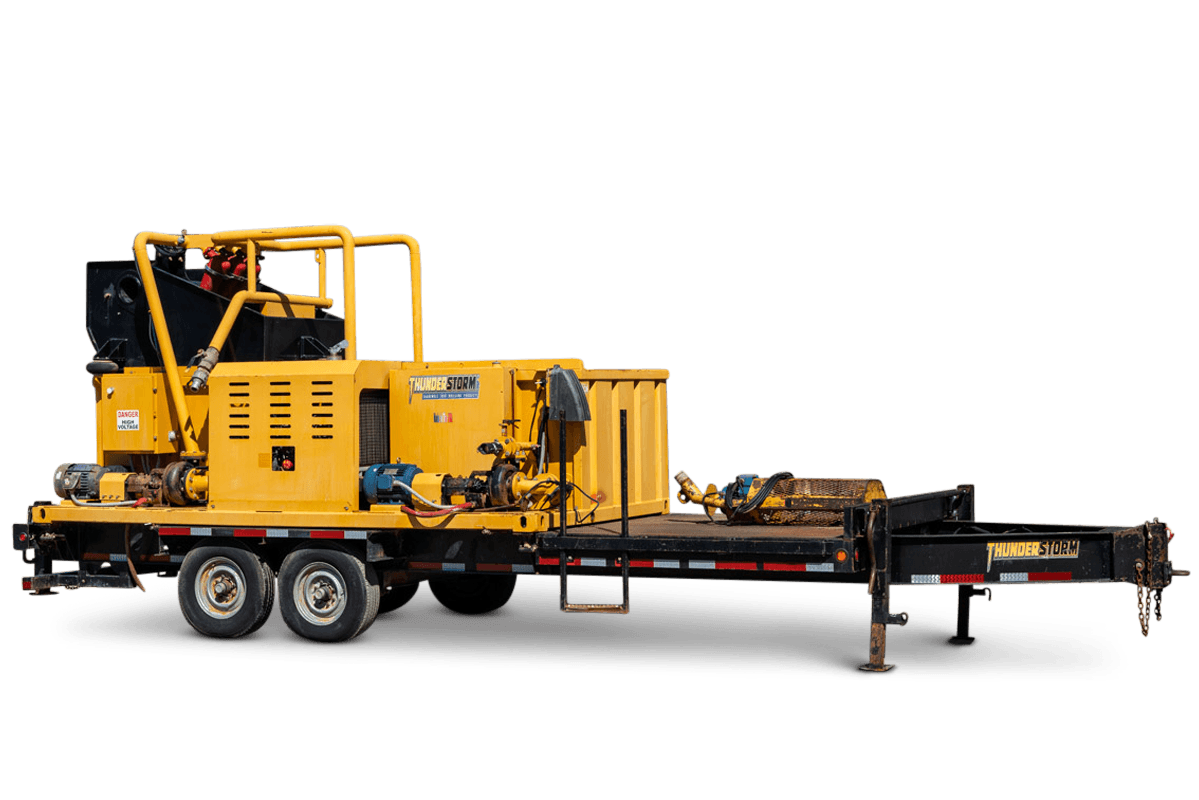
2015 Vermeer Thunderstorm
$69,000
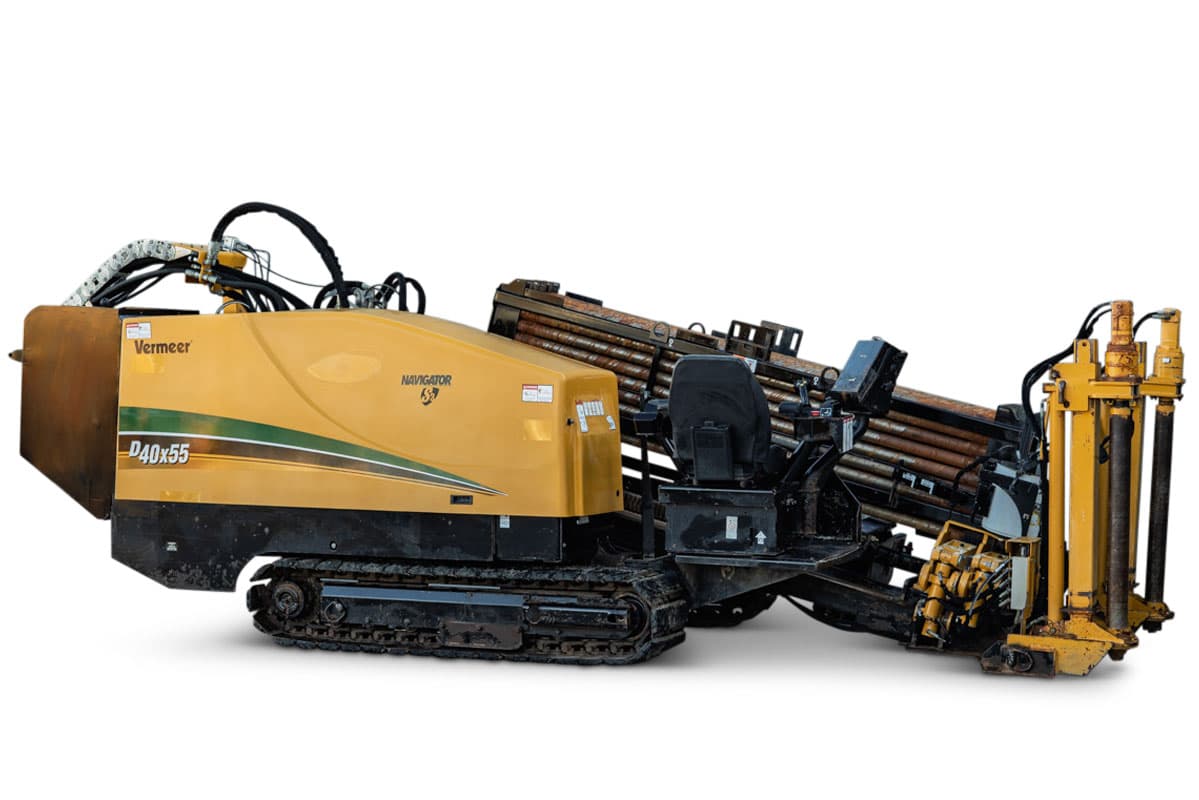
2019 Vermeer 40x55 S3
$199,000
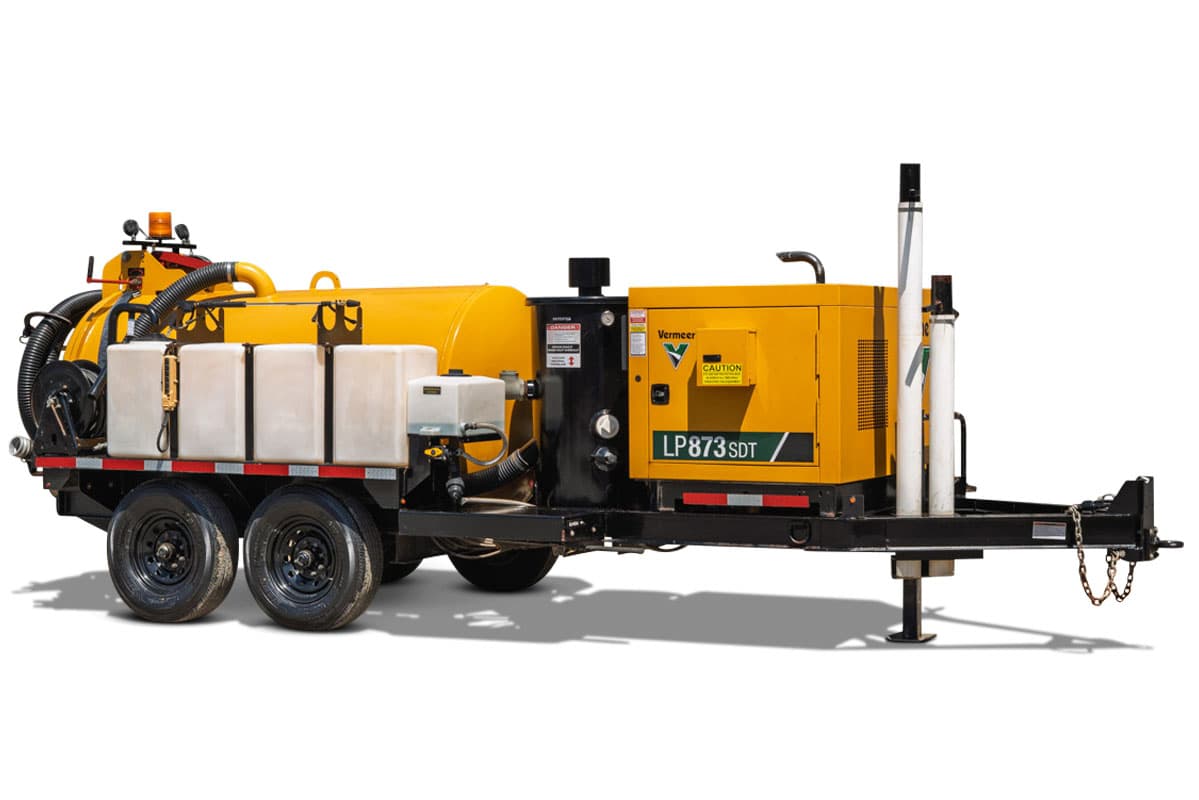
2025 Vermeer LP873SDT
$94,000
Want a quote today? Call (877) 288-0280.
Tax treatment: Section 179 and bonus depreciation
This is not tax advice
The section below explains the general tax landscape for equipment financing. It is not tax advice. Section 179 limits, bonus depreciation rules, and eligibility change and depend on your specific business situation and state. Consult your CPA or tax advisor before making any decision based on tax treatment. The figures here are current for tax year 2026 as of this article's publish date and should be re-verified for your tax year.
Used HDD equipment can carry real first-year tax benefits, and for tax year 2026 those benefits are unusually strong. Two mechanisms matter: Section 179 expensing and bonus depreciation.
Section 179 (tax year 2026)
- The maximum Section 179 deduction for tax years beginning in 2026 is $2,560,000. The deduction begins to phase out once you place more than $4,090,000 of qualifying property in service and is fully eliminated at $6,650,000. These are the inflation-indexed 2026 figures; the One Big Beautiful Bill Act of 2025 raised and made these limits permanent, so the cap is higher than it was under the prior law.
- Used equipment qualifies, as long as it is used more than 50 percent for business and bought from an unrelated party.
- It works on financed equipment. The deduction is tied to placing the equipment in service, not to paying it off. Finance a rig, put it to work in 2026, and you may be able to deduct the qualifying amount that year even though you have only made a few payments.
- Section 179 cannot create a net operating loss. The deduction is limited to your business's taxable income, and any excess carries forward to future years.
- Most HDD assets (drills, mud systems, locators, trailers) are generally treated as 5-year property for depreciation. Some related assets, such as over-the-road haul trucks, can fall in a different class, so confirm specific items with your CPA.
Bonus depreciation: the 2026 headline
- The One Big Beautiful Bill Act, enacted July 4, 2025, permanently restored 100 percent bonus depreciation for qualified property acquired after January 19, 2025. The old phase-down schedule (80, 60, 40, 20 percent) is repealed for property acquired after that date.
- Bonus depreciation is automatic unless you elect out, has no dollar cap, and, unlike Section 179, can create or increase a net operating loss.
- Used equipment qualifies for bonus depreciation, provided you have not previously held a depreciable interest in that specific machine and the seller is unrelated.
- A common 2026 approach is to apply Section 179 first, up to the income limit, then take bonus depreciation on the remaining basis, which means many qualifying used HDD purchases can be fully expensed in the first year.
Two traps to flag for your CPA
First, the acquisition-date rule: equipment under a written binding purchase contract signed before January 20, 2025 is treated as acquired on the contract date and may be stuck on the old phase-down schedule even if you place it in service in 2026. Second, state conformity: not every state follows the federal rules. California, for example, caps Section 179 far lower (around $25,000) and does not allow federal bonus depreciation, and New Jersey decouples from federal bonus as well. Your state treatment can differ materially from the federal picture above.
Can you actually qualify? Credit reality
The honest answer to "can I qualify?" is the same one the financing page gives, and we will not promise more than it does.
First Pacific Funding works with a wide range of credit profiles. While stronger credit may result in better terms, approval is based on the overall financial picture of your business, not just a credit score.
That is the ceiling of what we claim, and it is genuinely the way these decisions work. Lenders evaluate more than your score:
- Credit score, as one factor among several, not the whole decision.
- Time in business. Established companies get better terms; startups face more scrutiny.
- Revenue and cash flow. The ability to service the payment matters as much as the score.
- Industry experience. Operator background carries weight in a specialized trade like HDD.
- The equipment itself. Used machines from major brands hold their value as collateral, which works in your favor.
Startups can finance equipment, typically at higher rates, with more down, or with a personal guarantee. A new operator with real field experience and a signed first contract is more financeable than the credit score alone suggests. Challenged credit is not an automatic no; options exist, usually at higher rates or higher down payment. The article's honest position is neither "everyone qualifies" nor "bad credit means no." The right move is the same in every case: apply for pre-approval to find out, because it does not affect your credit score.
Why financing used differs from new
Financing a used machine is not the same as financing a new one, and a couple of the differences are genuine advantages of buying through a dealer.
- Collateral valuation. Lenders look harder at used-equipment value. An established model with good resale liquidity (a Ditch Witch JT-series, a Vermeer D-series) is easier to finance than an obscure brand.
- Age limits. Some specialty lenders cap financing on equipment over a certain age; Mak Global Corp, for example, cites a guideline of roughly 10 years or newer for used machines. Very old equipment can be harder to finance.
- Term limits. As noted above, used equipment often carries shorter maximum terms because lenders cap the term to remaining useful life.
The dealer advantage is real, not marketing
Buying a used machine through a dealer with a financing partner is materially easier to finance than a private-party purchase. The dealer relationship, the documented condition, and a clean title chain all reduce the lender's risk. Try to finance a private-party rig off a classifieds listing and you will often find worse terms or no financing at all. A WorldHDD machine financed through First Pacific Funding is a clean, fast path by comparison. Before you finance any specific machine, it is still worth running it through our used drill inspection checklist and checking the hour meter against our guide on how many hours is too many, because a sound machine is both a better buy and better collateral.
The application process
The flow mirrors the three steps on our financing page exactly:
- Apply online for pre-approval. Complete the First Pacific Funding pre-approval through WorldHDD. It takes a few minutes and does not affect your credit score.
- Get approved. First Pacific Funding reviews your application and typically returns a decision within 24 to 48 hours, with competitive rates and flexible terms for qualified buyers.
- Get your equipment. WorldHDD coordinates delivery or pickup nationwide so there is minimal downtime for your operation.
What you will typically need. Application-only programs (under the threshold mentioned earlier) may need little more than the application itself. Larger amounts can call for business financials, bank statements, or tax returns. First Pacific Funding's actual requirements govern; the point is to set expectations, not to over-specify.
What slows or stops an application: an incomplete application or missing documents, equipment older than a lender's age limit, a private-party purchase rather than a dealer one, or a severe recent credit event. Most of these are avoidable, and the first one is entirely in your control.
The lowest-risk next step is the one that costs you nothing: apply for pre-approval and see what you qualify for. It will not affect your credit score. Prefer to talk to a person first? Call us at (877) 288-0280.
The bottom line
Used HDD equipment is financeable, and for tax year 2026 the timing is unusually good, with 100 percent bonus depreciation back and Section 179 limits higher than ever. The machine you have chosen does not have to be a six-figure obstacle; it can be a monthly payment your work pays for. Buying used through a dealer makes the financing easier, not harder, and the only way to know your real numbers is to apply. The pre-approval is fast, it does not affect your credit, and it tells you exactly where you stand.
See what you qualify for. Apply for pre-approval through First Pacific Funding: a few minutes, no impact on your credit score, and a decision typically within 24 to 48 hours. Prefer to talk it through? Call WorldHDD at (877) 288-0280. Still choosing the machine? Browse used directional drill inventory or read our guide to the equipment you need to start a directional drilling business.
Frequently asked questions
Can I finance used HDD equipment, or only new?
You can finance used. WorldHDD's program through First Pacific Funding is specifically designed for used HDD equipment, and virtually any machine in our inventory is eligible, including rigs, locators, mud systems, drill pipe, vacuum systems, and trailers. Used equipment from major brands holds its value well as collateral, which actually helps the financing. You do not need to buy new to get financed.
What credit score do I need to finance a directional drill?
There is no single cutoff. Approval is based on the overall financial picture of your business, not just a credit score, so time in business, revenue, and operator experience all factor in. As a sense of the market floor, some lenders publish minimums around 610, and bad-credit specialists go as low as 575. Stronger credit earns better terms, but a wide range of profiles can qualify. The only way to know your situation is to apply, which does not affect your credit score.
Does applying for pre-approval hurt my credit score?
No. First Pacific Funding's pre-approval does not affect your credit score. This is the single most important thing to understand, because the fear of a credit hit is what stops most buyers from finding out where they stand. There is no downside to applying to see what you qualify for.
How long does financing approval take?
Most applications receive a decision within 24 to 48 hours. Once you are approved, WorldHDD coordinates delivery or pickup nationwide, so the equipment can be working quickly with minimal downtime for your operation.
What is the difference between an equipment loan and a lease for HDD equipment?
With an equipment loan you own the machine from day one, the lender holds a lien, and you own it free and clear once it is paid off. A $1 buyout lease is structured as a lease but lets you buy the machine for a dollar at the end, so it is functionally close to a loan with different tax and accounting treatment. A fair market value lease has lower payments but you do not own the machine during the term and you buy, return, or renew at the end. Loans and $1 buyout leases generally allow depreciation plus an interest deduction; fair market value leases are usually treated as deductible operating expenses. Your CPA can advise which fits your situation.
Can I deduct a used directional drill under Section 179?
Generally yes, if it is used more than 50 percent for business and bought from an unrelated party. For tax year 2026 the Section 179 limit is $2,560,000, and the deduction applies even on financed equipment because it is tied to placing the machine in service, not paying it off. On top of that, 100 percent bonus depreciation is back for 2026 and also covers qualifying used equipment. Many used HDD purchases can be fully expensed in the first year. This is not tax advice, and the rules and your state's treatment vary, so confirm with your CPA before relying on it.
How much down payment do I need for a used HDD machine?
It depends on your profile. Well-qualified buyers can sometimes finance with zero down, and some lenders advertise 100 percent financing for qualified applicants. Challenged-credit or startup buyers typically need 10 to 20 percent down. If you are asset-rich but credit-thin, some lenders allow cross-collateralization, pledging other free-and-clear equipment in place of a cash down payment. Pre-approval will tell you what your down payment looks like.
Can a brand-new HDD business get equipment financing?
Yes, though startups face more scrutiny and often higher rates, more down payment, or a personal guarantee. The encouraging part is that lenders weigh the whole picture, so a new operator with genuine field experience and a signed first contract is more financeable than a bare credit score suggests. Apply for pre-approval to find out what is available; it does not affect your credit.
Is it harder to finance a private-party purchase than a dealer purchase?
Usually, yes, and this is a real reason to buy through a dealer. A private-party purchase off a classifieds listing often means worse terms or no financing at all, because the lender has less assurance about the machine's condition and title. Buying through a dealer with a financing partner gives the lender a documented condition, a clean title chain, and an established relationship, all of which reduce risk and make approval faster and easier.
What is a realistic monthly payment on a $250,000 HDD package?
As a rough illustration only, a $250,000 package financed over 60 months at a representative rate lands somewhere around $5,000 to $7,000 a month, depending on the actual rate, term, and down payment. That is the kind of number a crew completing one to two commercial bores a week can plan around. It is an illustration, not a quote; your real payment depends on your approved rate and terms, which a pre-approval will show you.
Sources and references. First Pacific Funding process claims match the WorldHDD financing page. Tax figures were verified against IRS guidance and Rev. Proc. 2025-32 for tax year 2026 and must be re-verified annually. Rate and market figures are drawn from published lender and industry sources and are illustrative, not quotes.
- WorldHDD financing (First Pacific Funding partnership and pre-approval)
- IRS Publication 946 (How to Depreciate Property: Section 179 and bonus depreciation)
- IRS guidance on 100 percent bonus depreciation under the One Big Beautiful Bill Act
- Section179.org (2026 Section 179 limit and phase-out reference)
- JIM.com, How to Start a Directional Drilling Company (equipment-loan rate range)
- Blue Bridge Financial, directional drill financing (minimum credit and eligibility)
- Mak Global Corp, directional drill financing (used-equipment age guideline)
- Crest Capital, equipment financing (application-only threshold)