
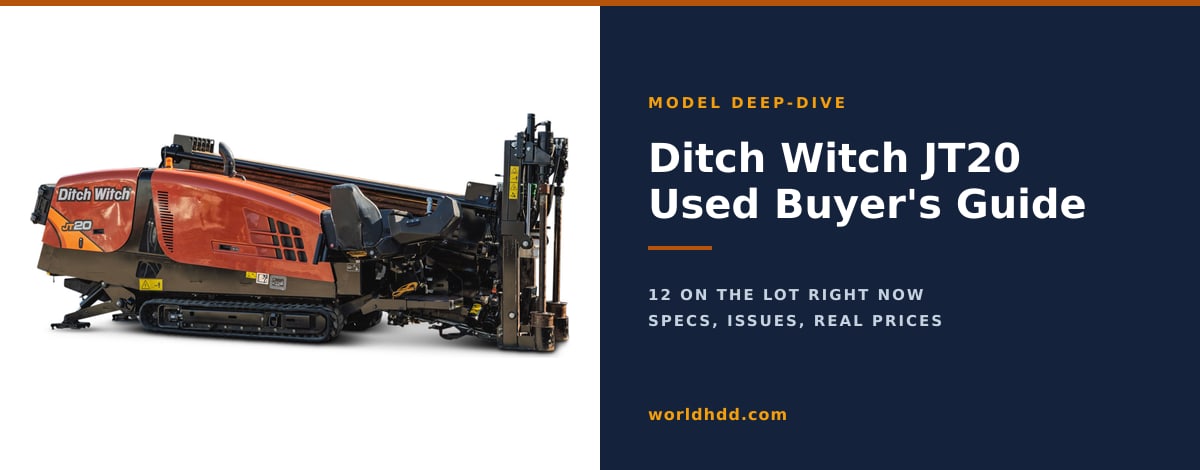
The Ditch Witch JT20 spent roughly twelve years as the best-selling compact directional drill in the business, and its era is now officially closing: Ditch Witch introduced the JT21 in January 2025 as the JT20's upgraded replacement. That makes "should I still buy a used JT20?" the most-asked question in the compact class, and the short answer is yes, with eyes open. This is the full treatment: what the machine actually is, the twelve-years-unchanged story that reprices how you should shop it, the known issues, what a complete package really costs, and the JT2020 versus JT20 versus JT21 decision. We have 11 JT20s on the lot right now, which is both our credential and our bias; judge the reasoning on its merits.
Quick verdict for the impatient: the succession is a buying opportunity, not a warning. The JT20 is mature, mechanically simple, and supported by the deepest parts ecosystem in the compact class, and the machine replacing it reuses core JT20 components. Buy on hours and records, not model year, and the used JT20 market is about as low-risk as used iron gets.
What the JT20 is
The real numbers, from Ditch Witch's own spec sheet: 20,000 lb of pullback, 17,000 lb of thrust, 2,200 ft-lb of spindle torque, a 35 gpm onboard fluid system at 1,000 psi, and a 74 hp turbocharged Deutz TD2.9, all in a machine weighing about 11,890 lb with pipe, with an open operator's station. It is a mini-class rig built for fiber drops, residential services, and short utility bores, and it became the industry's default compact drill by doing exactly that work without drama.
The lineage matters to a used buyer. The JT20 nameplate ran from its 2013 to 2014 introduction until the JT21 succession, but the platform is older: Ditch Witch's own launch release describes the JT20 as a re-engineering of the JT2020, the 2004 Mach 1-era best-seller. Where the JT20 sits in the family, and how to read every other JT name on a listing page, is covered in our Ditch Witch JT series decoder.
Watch for AI-generated spec sheets online
A widely indexed comparison page currently claims the JT20 has a 160 horsepower engine, weighs 23,000 lb, and carries an enclosed cab with rollover protection and fire suppression. None of that is true of any JT20 ever built. The real machine is 74 hp, roughly 11,890 lb with pipe, and has an open operator's station; there is no cab. If a "review" quotes specs that do not match the OEM sheet linked in our sources below, walk away from the page, not the machine.
Twelve years, essentially one change
When the JT21 launched, Ditch Witch HDD product manager Britton Yunker put the JT20's history on the record more candidly than any dealer could: "The JT20 has been a staple of the industry and has been our most popular drill but having been on the market for 20 years, the time had come for an upgrade." He was counting from the 2004 platform, and he was specific about what changed along the way: "The JT20 arrived in 2013, but the only significant adjustment made was to the machine's engine emissions, going from an 85-hp engine to a 74-hp engine." And then the sentence that reprices the whole used segment: "So, technically we've had a 20-year-old machine with hardly any improvements. It was definitely time."
Read that as a used buyer and the conclusion writes itself: a 2015 JT20 and a 2023 JT20 are mechanically near-identical machines. Hours, maintenance records, and how the machine was treated matter enormously; the model year on the plate barely matters at all. Do not pay thousands for a newer badge on the same iron, and do not fear an older unit with a clean file. Two honest footnotes inoculate the story. First, you will see small print differences across spec-sheet vintages, 74 versus 74.5 horsepower and minor bore-and-stroke variances; those trace to the single 2013 engine revision and printing rounding, not to a second unpublicized change. Second, the emissions change itself is a feature: at under 75 horsepower, the JT20 met Tier 4 with no aftertreatment, no DPF, ever, which means it sidestepped the mid-2010s Tier 4 growing pains entirely and suits the short stop-and-go cycles of fiber work that never give a filter time to regenerate.
The JT20XP: the variant the manuals mention
If you see "JT20XP" in a manual title or a listing, here is what it means. Launched in late 2018, the XP is not a different drill; it is the JT20 packaged with the XP44, a trailer-mounted mixing and power system with its own 44 hp Yanmar diesel. Moving the high-pressure mud pump off the rig frees all of the drill engine's horsepower for thrust and rotation, which Ditch Witch credited with roughly 11 percent more mud flow and 10 percent more spindle torque than a standalone JT20. As Ditch Witch's Jeff Davis put it at launch, "there is not a drill in this size class that can state that all dedicated horsepower goes to drill functions only." On the used market the XP package is uncommon; we do not have one on the lot as of July 2026. If you find one, evaluate the XP44 unit as its own machine: it has its own engine, hours, and service history.
Used JT20s on the lot right now
Every one of these is inspected, priced, and ready to walk.

2016 Ditch Witch JT20
$109,000
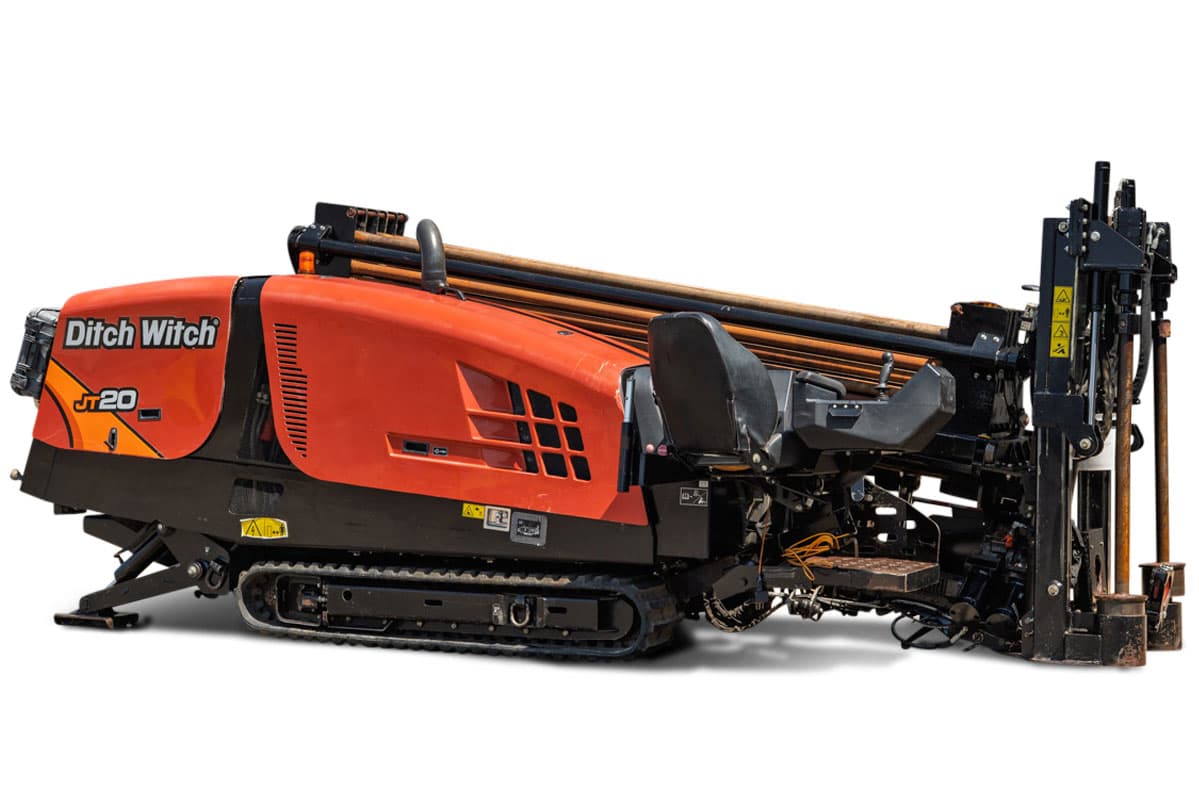
2022 Ditch Witch JT20
$149,000
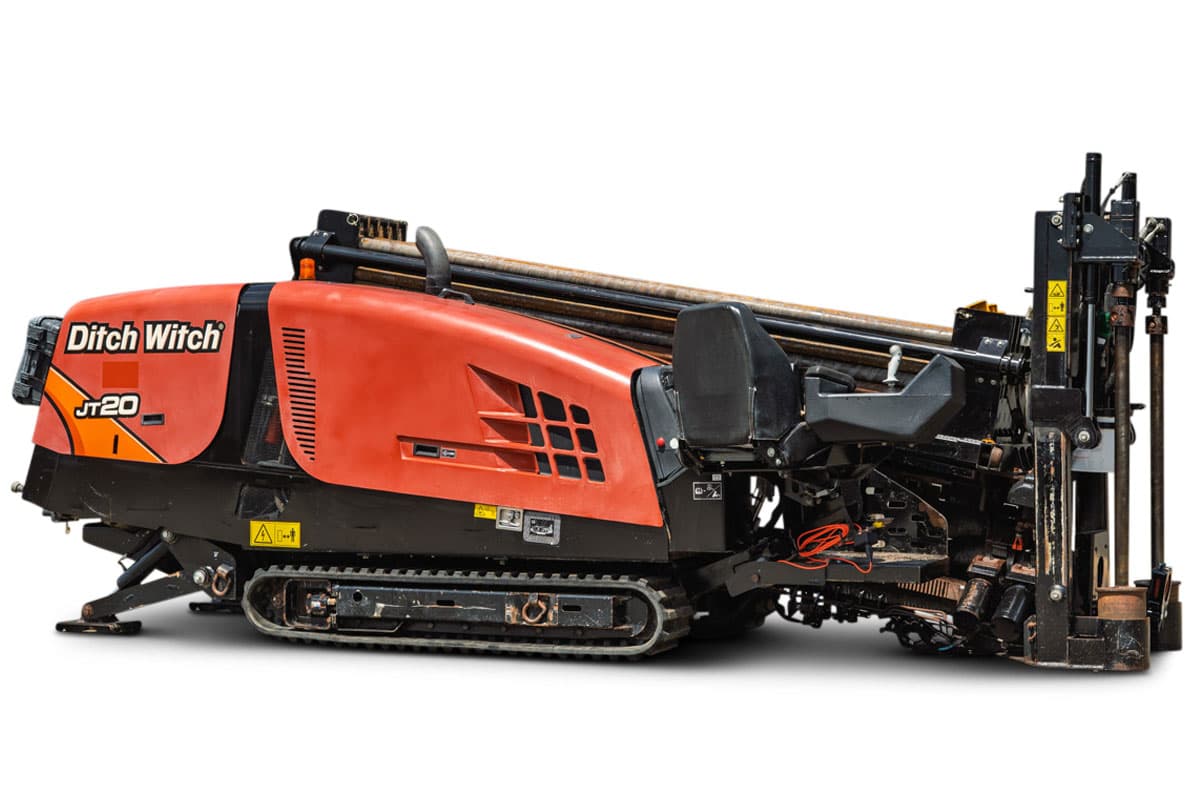
2021 Ditch Witch JT20
$139,000
Want a quote today? Call (877) 288-0280.
Known issues and what to inspect
The JT20's reputation is mechanical simplicity, and the record backs it: there is no OEM-documented pattern failure on this machine. What follows is operator lore from high-cycle fleets plus our own inspection floor, offered as inspection prompts rather than documented defects:
- Rack-and-pinion carriage wear. The carriage rides a rack, and high-cycle fiber duty is exactly the work that wears it. Run the carriage full travel both ways and feel for slop, notchiness, or uneven engagement. A worn rack is a four-figure repair; make the seller price it or fix it.
- Strike Alert. The electric strike system and its self-test are documented in the operator's manual. Run the self-test as part of any inspection. Operators grumble about oversensitivity, but the answer is testing and maintenance, never disabling: a defeated safety system on a utility-strike machine is a liability you do not want to own, and a unit with a disabled or bypassed Strike Alert tells you something about how it was run.
- Rod-loader sensors. The rod loader's sensors are the most common service-call complaint we hear on high-hour units. Cycle the loader through a full rod sequence during inspection, not just one rod.
Beyond the model layer, run the universal checks: fluid path, vise dies, sub saver, engine cold start, and the records conversation. The full generic protocol is in our used drill inspection checklist, and our guide to hours covers the meter question, which for JT20s has a model-specific answer: 4,000-plus-hour units are common and perfectly viable with records, because the design ran unchanged long enough for the fleet to age honestly.
After the succession: parts and prices
Three layers here, each stated at its honest confidence level.
Parts: strong de facto signals, no formal promise. Ditch Witch has published no parts-support commitment for the JT20, and we will not invent one. But two structural facts favor owners. Twelve years of best-seller volume created the deepest parts ecosystem in the compact class, OEM and aftermarket both. And the JT21 itself keeps core JT20 components in production demand: per HDD Broker's analysis of the new machine, the engine, track frames, and rear stabilizers carry over from the JT20, with the hydraulic system and direct-drive motor adopted from the JT24. The machine that replaced the JT20 is, in meaningful part, built from JT20 parts.
Prices: holding so far, stated as inference. We see no post-succession softening in JT20 asking prices, ours or the market's, and the macro backdrop is bullish for compact drills: the federal BEAD broadband build-out has final proposals approved in nearly every state, with roughly two-thirds of funded locations slated for fiber, which is JT20-class work. Successor launches historically cut both ways. As HDD Broker's general manager observed in a Trenchless Technology piece years ago, a new model can flood the used market with the old one and push prices down, or it can raise the predecessor's value, as happened when buyers avoided early Tier 4 machines and bid up the older iron. The JT20 sits in the favorable half of that pattern: proven design, a successor with no used market yet, and a buyer base that does not need the JT21's extra speed. That conclusion is informed inference, not a measured trend; we will know more by winter.
The pattern to remember: discontinued does not mean orphaned. It means the clock starts on parts-channel evolution, which for a machine this common is a slow clock.
What a used JT20 costs
Our own shelf: 11 units, $79,000 to $189,000 as of October 2026. Age and hours set where a machine lands in that range: the oldest high-hour units sit at the bottom, near-new low-hour machines at the top, and most of the fleet in between. The JT20 category page always shows the live shelf. Those are bare-machine asking prices, and the bare machine is only about half the story, because a JT20 earns nothing without a locator, mud system, pipe, and tooling.
The package math lives in our HDD starter package guide and we will not re-derive it here, just headline it: a complete JT20-class entry build typically lands around $150,000 to $190,000 all-in, with the bare rig at $85,000 to $120,000 for a 2015-to-2019 unit around 2,500 hours. The line item that swings hardest is the locator. Used JT20s come through with either SubSite (Ditch Witch's native ecosystem, often $4,000 to $8,000 used) or DigiTrak (roughly $13,000 to $21,000-plus depending on generation and display), and the split runs close to even on the used market. Two otherwise-identical JT20 packages can differ by ten thousand dollars on the locator alone, so price the locator as its own machine: generation, transmitter hours, and compatibility, not just presence. A typical listing includes 38 to 40 rods; new aftermarket JT20-class pipe runs about $279 a rod, so a fresh 40-rod set is roughly $11,000, while used rod lots come in well under that.
JT2020 vs JT20 vs JT21: the three-tier decision
| Tier | What it is | Money | The honest framing |
|---|---|---|---|
| JT2020 Mach 1 | The 2004 predecessor platform | Bargain entry, availability thinning | Condition beats age: a refreshed JT2020 package can price near a tired JT20, which is the trap. Budget for Mach 1-era parts sourcing friction. One New Zealand fiber contractor's verdict on the platform, for what predecessor testimony is worth: "the Ferrari of directional drills." |
| JT20 | The 2013-14 redesign, twelve years of production | $79,000 to $189,000 on our lot | The sweet spot: mature, deepest parts and service ecosystem in the class, meaningful discount to JT21 money, and a design whose used fleet has aged honestly. |
| JT21 | The January 2025 successor: 21,000 lb, 2,250 ft-lb, same 74 hp Deutz family, claimed 40 percent more downhole horsepower via hydraulics | New or near-new money only | Genuinely better, not yet provable used. Our standing advice from the fiber guide: for most buyers right now, buy a well-inspected JT20 today and revisit the JT21 in a year or two. |
The tier decision interacts with how you finance and deploy. If the machine must earn from week one on fiber contracts, the JT20's known-quantity risk profile is the argument; the fiber drill guide ranks it against its Vermeer rivals. If you are weighing buying at all against renting for a season, the rent-or-buy analysis covers that fork, and the financing guide covers the capital side, where a $110,000 JT20 is a very financeable asset.
Ready to look at real machines? Browse our 11 used JT20s, every one inspected on our own floor, or see the full Ditch Witch inventory. Want a package quote with locator, pipe, and tooling included? Tell us your work and your budget and we will spec the whole build honestly, including talking you down a tier if that is what your bores actually need.
Frequently asked questions
Is the JT20 still available new?
Technically yes, for now: Ditch Witch still lists the JT20 and some dealers carry new units, but the JT21 was introduced in January 2025 as its official replacement, so the JT20's production era is closing. No formal discontinuation date has been published. For buyers the practical reality is that the JT20 is now primarily a used-market machine, and the used supply is the deepest in the compact class.
What is actually different between a 2014 JT20 and a 2023 JT20?
Functionally, almost nothing. Ditch Witch's own product manager confirmed the design ran essentially unchanged, with the one significant adjustment being the 2013 emissions-driven engine change from 85 to 74 horsepower, which predates the whole nameplate run. That means model year is a weak signal on this machine. Buy on hours, records, and inspection results, and treat two same-hours units from different years as the same machine wearing different plates.
Will JT20 parts stay available?
No published commitment exists, so nobody can promise it. The structural signals are strong, though: twelve years of best-seller volume built the deepest parts ecosystem in the class, and HDD Broker's teardown of the JT21 notes it reuses the JT20's engine, track frames, and rear stabilizers, keeping core components in active production. Expect gradual channel evolution, not a cliff.
What is the JT20's biggest known issue?
Nothing rises to a documented pattern failure; the machine's record is genuinely clean. The operator-reported wear points are the rack-and-pinion carriage in high-cycle fiber duty, Strike Alert sensor sensitivity, and rod-loader sensors on high-hour units. All three are inspectable in twenty minutes: run the carriage full travel, run the Strike Alert self-test, and cycle the rod loader through a full sequence.
What is the Strike Alert issue I hear about?
Strike Alert is the electric-strike safety system, and its self-test procedure is documented in the operator's manual. Operators sometimes complain about false positives from the sensor, and the wrong response, disabling it, occasionally shows up on used units. Test it during inspection. A working Strike Alert is a safety and liability essential on any machine drilling near utilities, and a bypassed one is a red flag about the previous owner's habits.
Does the JT20 have a DPF?
No, and it never did. The 74 hp Deutz sits under the 75 horsepower threshold where Tier 4 compliance required no exhaust aftertreatment, so the JT20 skipped the DPF era entirely. That is a real advantage for fiber work, where short stop-and-go cycles never give a particulate filter the sustained heat it needs to regenerate, and it is one reason the machine's reliability reputation held up.
SubSite or DigiTrak on a used JT20?
Both come through in roughly equal numbers, and the choice swings package value more than most buyers expect: used SubSite gear often runs $4,000 to $8,000 while DigiTrak systems run about $13,000 to $21,000-plus depending on generation and display. Neither is wrong. Evaluate the locator as its own purchase: generation, transmitter hours, compatibility, and condition, because a $10,000 locator gap can hide inside two similar-looking package prices.
What does a complete JT20 package cost?
Plan on roughly $150,000 to $190,000 all-in for a working entry build: bare rig $85,000 to $120,000, locator, mud system, 40 rods of pipe, tooling, and trailer making up the rest. The bare machine is only about half the bill. Our starter package guide breaks down every line with current used ranges, and the locator ecosystem question above is the biggest single swing inside the total.
Should I buy a JT2020, a JT20, or wait for a used JT21?
For most buyers, the JT20 is the answer: the mature middle tier with the deepest support and honest pricing. The JT2020 is the budget path if you accept older-platform parts friction and inspect hard, and a refreshed JT2020 can cost near a tired JT20, so compare condition, not badges. The JT21 is genuinely better on paper but scarce used and unproven in the field; revisit it in a year or two.
How many hours is too many on a JT20?
Higher than you think, if the records are real. Because the design ran unchanged for over a decade, 4,000-plus-hour JT20s are common, well understood, and viable buys with documentation, and a 4,300-hour unit with a clean file can outlive a 2,500-hour mystery machine. Records beat the meter. Our hours guide gives the class-by-class framework for pricing hours against condition.
Sources and references. Specifications, quotes, and model history were verified against the manufacturer's materials and named trade press in July 2026.
- Ditch Witch JT20 specification sheet (PDF)
- Ditch Witch press release: JT20 launch (2014)
- Ditch Witch press release: JT21 launch (January 2025)
- Ditch Witch: "Faster, More Powerful" JT21 feature with Britton Yunker (April 2025)
- HDD Broker: "Let's Look at the Legacy of the New JT21" (June 2025)
- Trenchless Technology: Ditch Witch JT20XP product profile (2018)
- Trenchless Technology: HDD used equipment market analysis (2016)
- Deals on Wheels (NZ): Ditch Witch JT2020 review
- Telecompetitor: BEAD approval tracker
- Fiber Broadband Association: BEAD funding analysis (April 2026)