
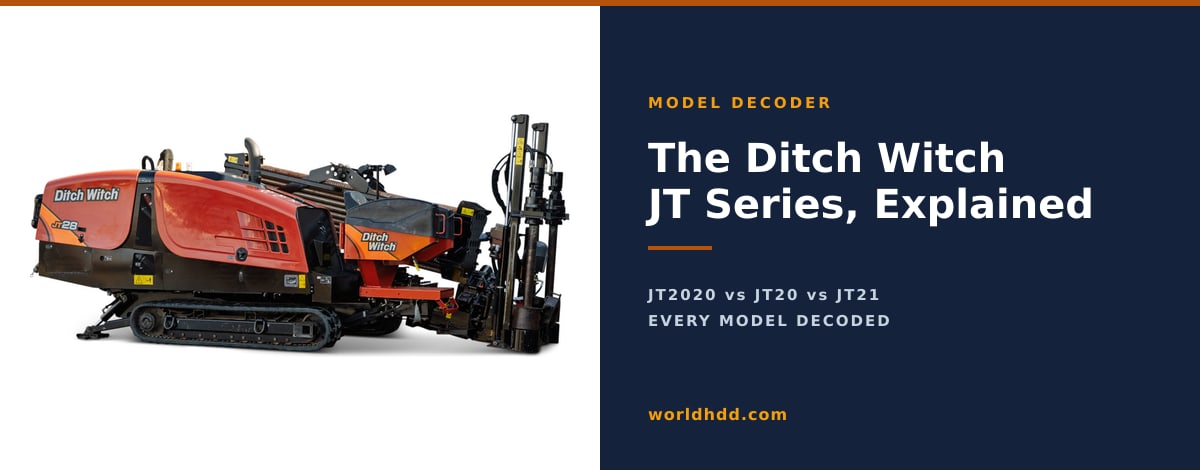
Search for a used Ditch Witch drill and the listings come back speaking three different languages: a JT2020 next to a JT20 next to a JT21, three machines from three different decades wearing nearly the same name. Nobody publishes the decoder, and buyers pay for that gap in mismatched expectations and mispriced deals. This is the map: every JT-series naming era untangled, the current 2026 lineup versus the discontinued models that dominate the used market, real specs from the OEM sheets, and what each machine is actually listed at on our lot right now.
We sell used HDD equipment, and Ditch Witch drills are the deepest part of our yard: 42 JT-series units across ten model subcategories as of July 2026. More than half of them sit in the 20,000 to 28,000 lb class where most utility and fiber work lives, so that is where this guide goes deepest. The depth follows the machines people actually buy, not lineup symmetry.
The three naming eras, decoded
The JT2020-versus-JT20 confusion exists because Ditch Witch has named its drills three different ways over thirty years. Once you can place a listing in its era, most of the confusion evaporates:
| Era | Years | Names you will see | How to read them |
|---|---|---|---|
| 1. The Mach 1 era | 1990s to early 2010s | JT920, JT1220, JT1720, JT2720, then JT2020, JT3020, JT4020, JT8020 and JT100 badged "Mach 1" | The trailing "20" is a family designator, not pullback. The leading digits approximate the pullback class: a JT2020 is a 20,000 lb-class machine (introduced 2004), a JT3020 a 30,000 lb class, a JT4020 a 40,000 lb class. These are the oldest machines still trading, many now 15 to 30 years old. |
| 2. Simplified numeric | 2013 to 2016 launches | JT20, JT25, JT9, JT10, JT40, JT60 | The number now maps directly to pullback: JT20 means roughly 20,000 lb, JT40 means 40,000 lb. The JT25 arrived in 2013, the JT20 in 2013 to 2014, the JT9 in 2015, the JT10 in 2016. This era supplies most of today's used inventory. |
| 3. The modern refresh | 2019 to present | JT24, JT28, JT32 (and AT32), JT120, JT21 | Still pullback-numbered, but the models no longer map one-to-one onto predecessors: the JT24 (announced September 2019) is an all-new machine, the JT28 (2021) replaced the JT25, the JT32 (2021 to 2022) filled a gap that had no predecessor at all, the JT120 (2023) took over the top slot, and the JT21 (January 2025) is the JT20's successor. |
The shopper's rule of thumb
"Mach 1" anywhere in the listing means era 1, a 2000s-or-earlier design. A bare two-digit name with no Mach 1 badge means era 2 or 3, a 2013-or-later design, and the number is the pullback class in thousands of pounds. One wrinkle worth knowing: the JT922 looks like an era-1 name but is actually a 2010 compact that shares drill pipe with the later JT9 and JT10. When in doubt, the model year on the plate settles the era.
Current versus discontinued: the 2026 map
As of July 2026, Ditch Witch's own directional drill page lists the JT5, JT10, JT20, JT21, JT24, JT28, JT32, JT40, JT60, and JT120, plus All Terrain variants (AT32, AT40, AT60, AT120). Two things about that list matter to a used buyer:
- The JT20 is in its succession window. Ditch Witch introduced the JT21 in January 2025 as the JT20's upgraded replacement, and while the JT20 still appears on the lineup page in mid-2026, its era is clearly closing after roughly twelve years as the company's compact workhorse. That is exactly why used JT20 supply is the deepest in the market right now.
- The JT100 has left the lineup. The JT120 and AT120, unveiled in 2023, now hold the top slot. JT100s, including the long-running JT100 Mach 1, trade used only.
Discontinued but heavily traded: the JT9, JT25, JT30, JT100, and every Mach 1 model. Discontinued does not mean unsupported, but parts sourcing differs by era, which the model profiles below get into.
The JT20 insight that reprices the biggest segment of the used market
Ditch Witch HDD product manager Britton Yunker said it plainly when the JT21 launched: "technically we've had a 20-year-old machine with hardly any improvements." The JT20's design was essentially unchanged across its whole run except one emissions-driven engine change in 2013 that took power from 85 to 74 horsepower. A 2015 JT20 and a 2023 JT20 are mechanically near-identical. For JT20s, hours and maintenance records matter far more than model year, so do not pay a big premium for a newer plate on the same machine.
JT series machines on the lot
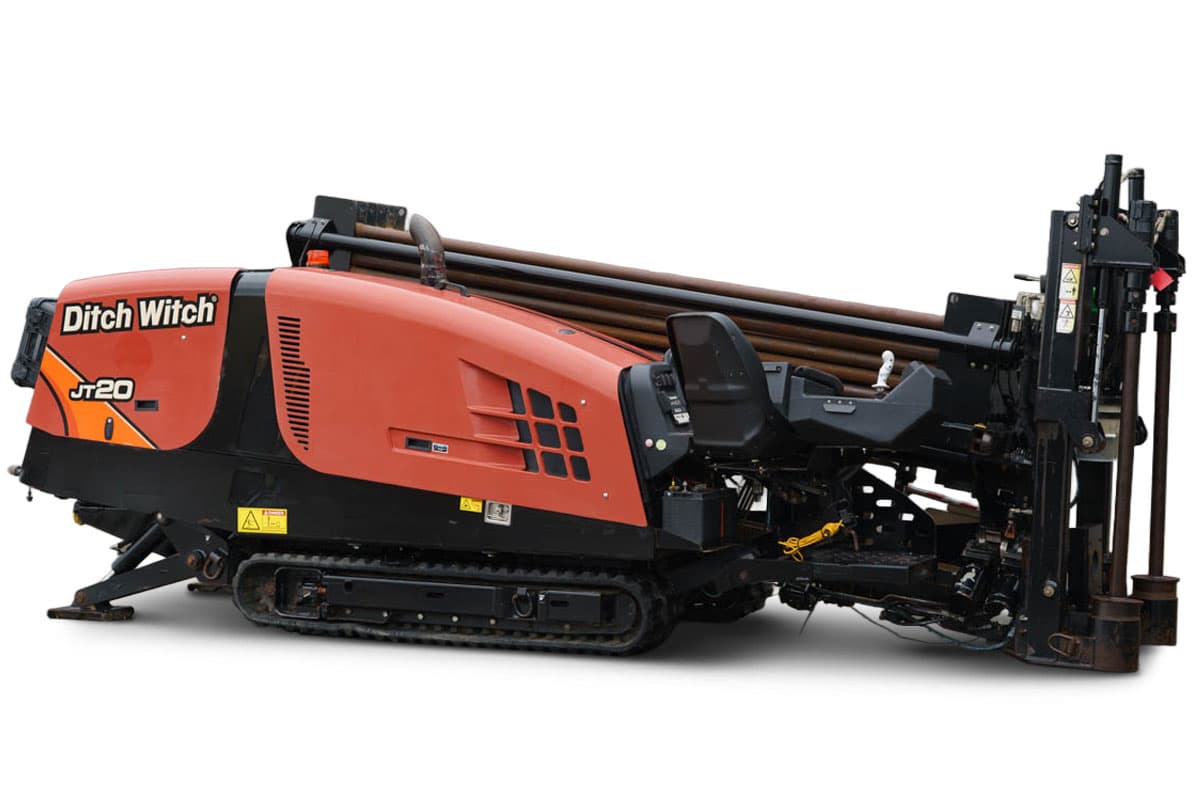
2016 Ditch Witch JT20
$109,000
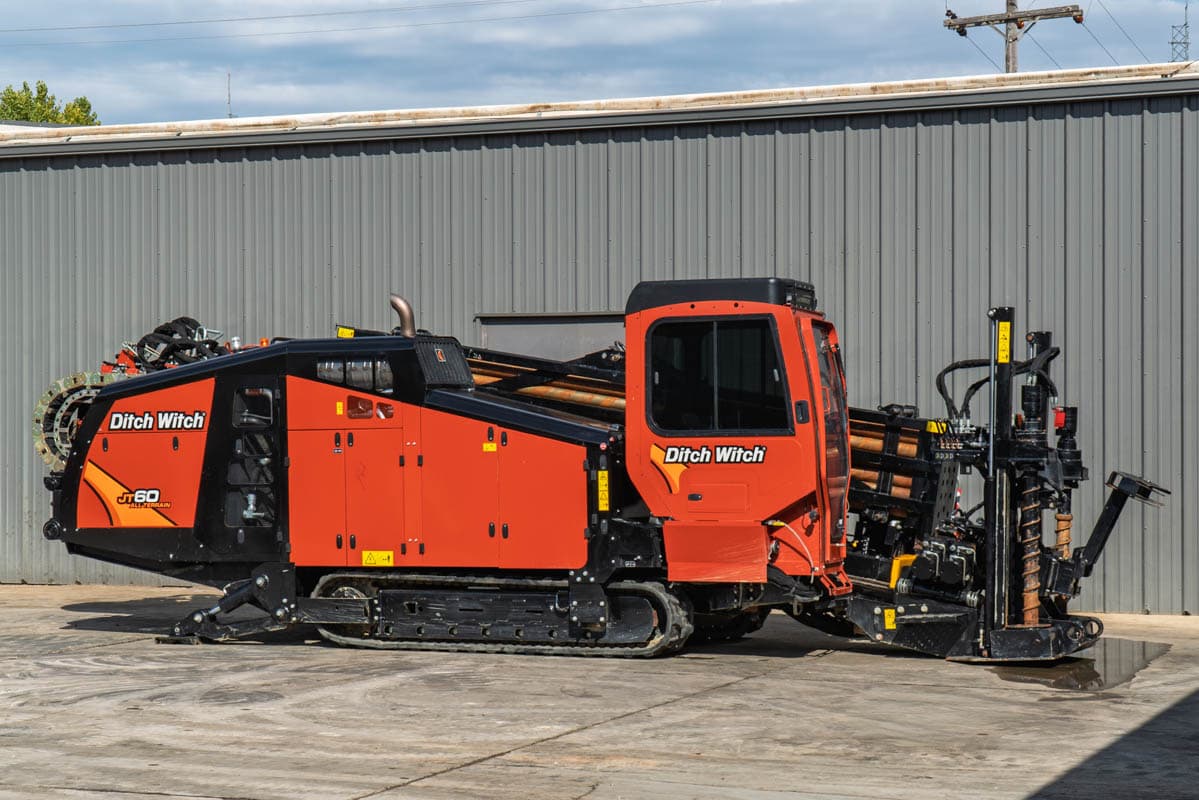
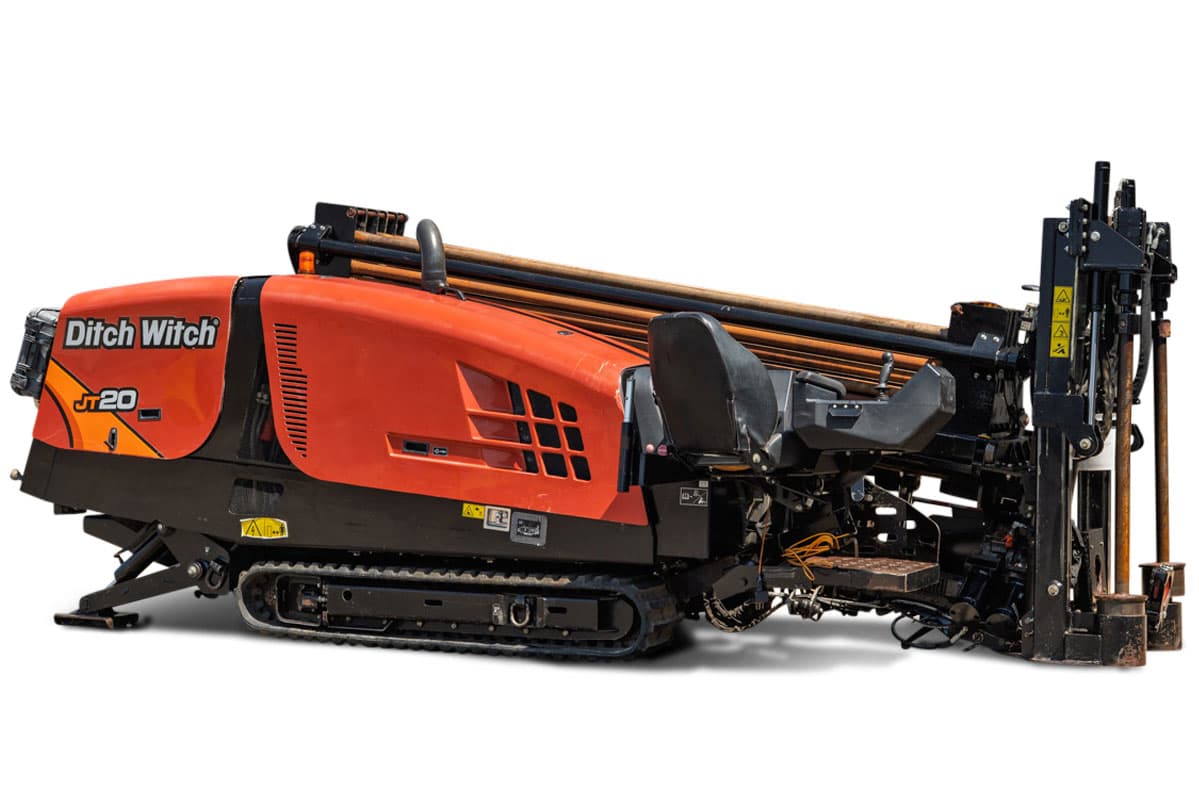
2022 Ditch Witch JT20
$149,000
Want a quote today? Call (877) 288-0280.
Model by model: the used buyer's roster
Full profiles for the models we see most on the lot and in buyer questions, compact entries for the rest. All specs are from Ditch Witch's own spec sheets and press releases; all prices are asking prices on specific machines in our current inventory, read live, so treat them as real data points, not market averages.
Ditch Witch JT20 (2013 to present, succession underway)
The compact benchmark: 20,000 lb pullback, 17,000 lb thrust, 2,200 ft-lb of spindle torque, 35 gpm of drilling fluid, and a 74.5 hp turbocharged Deutz that meets Tier 4 with no exhaust aftertreatment at all. That no-DPF engine is the fiber crew's favorite feature, because short stop-and-go duty cycles never give a particulate filter the regeneration time it needs. Wear points operators flag on used units, worth checking on any candidate even though none are OEM-documented defect patterns: the rack-and-pinion carriage in high-cycle fiber use, Strike Alert sensor behavior (test it, never disable it), and the rod-loader sensors. Model year barely matters; records do. We have 11 used JT20s in stock, $79,000 to $189,000 as of October 2026. The JT20 used buyer's deep-dive is the full single-model treatment.
Ditch Witch JT24 (announced September 2019)
The all-new machine that opened the modern era: 24,000 lb of thrust and pullback, 3,000 ft-lb of torque, 40 gpm of fluid, and a 101 hp Cummins F3.8 with diesel exhaust fluid. It is the fiber-and-distribution sweet spot and it holds value accordingly. Its Vermeer twin is the D23x30 S3 at the same 24,000 lb and 3,000 ft-lb. We have 2 used JT24s in stock, $189,000 to $199,000 as of October 2026.
Ditch Witch JT25 (2013 to 2021, discontinued)
The odd number that outguns its name: 27,000 lb of thrust and pullback and 4,000 ft-lb of torque from a 130 hp Cummins, closer to a JT28 than to a JT24 on paper. Discontinued when the JT28 replaced it in 2021, which is exactly why it trades at a discount to both of its neighbors. Wear parts remain sourceable, but confirm part numbers with a dealer before you buy, not after. We have 7 used JT25s in stock, $98,000 to $189,000 as of October 2026, which makes it one of the strongest value plays in the utility-mid band.
Ditch Witch JT28 (2021 to present)
The JT25's replacement and the current top of the utility-mid band: 28,000 lb of thrust and pullback, 4,200 ft-lb of torque, and a 130 hp Cummins QSB4.5. Its near-exact Vermeer counterpart is the current D24x40 S3, also 28,000 lb and 4,200 ft-lb, a pairing our Ditch Witch vs Vermeer comparison covers in depth. Current production means full parts and dealer support. We have 2 used JT28s in stock, $139,000 to $149,000 as of October 2026.
Ditch Witch JT30 and JT30 All Terrain (discontinued)
The 30,000 lb volume workhorse: 30,000 lb pullback, 24,800 lb thrust, 4,000 ft-lb, 50 gpm, and a Cummins QSB4.5 at 148 hp (Tier 3) or 160 hp (Tier 4). Two things every used JT30 buyer should know. First, the JT30 is not a JT3020: same headline pullback, but the JT30 is a genuine redesign roughly 3,100 lb lighter, so do not assume pipe, tooling, or parts interchange between them. Second, Ditch Witch documents named maintenance procedures for this machine, including carriage wear bars, thrust rollers on a 50-hour inspection interval, and the saver sub, so a well-kept unit should have records showing them. That is excellent ask-the-seller ammunition, and our inspection checklist shows how to use it. Most of the JT30s trading today, including most of ours, are All Terrain units. We have 6 used JT30s in stock, $108,000 to $199,000 as of October 2026, the widest spread of any model on the lot because hours and condition dominate this segment.
Ditch Witch JT10 (2016 to present)
The entry point of the current lineup: a 10,000 lb-class compact with a 66 hp air-cooled Deutz, built for drops, services, and tight residential work. It moves fast on the used market because it is the least expensive way into a current-production Ditch Witch drill. We have 4 used JT10s in stock, $84,000 to $99,000 as of October 2026.
Ditch Witch JT9 and JT922 (compact reference)
The JT9 (2015, 9,000 lb class, 64 hp air-cooled Deutz) and the 2010 JT922 are the JT10's close siblings, sharing drill pipe and tooling across the trio. Practical advice: since parts commonality is widest on the JT10, do not pay a JT9 premium when a similar-hours JT10 is available. We have 1 used JT9 in stock right now; the JT10s above cover the same class with wider parts commonality.
Ditch Witch JT21 (January 2025 to present, compact reference)
The JT20's successor: 21,000 lb pullback, 20,000 lb thrust, 2,250 ft-lb, a 35 gpm fluid pump, and, per Ditch Witch's own JT21 brochure, the same 74 hp Deutz TD2.9 engine family as the JT20, at 12,420 lb operating weight. Ditch Witch claims up to 40 percent more downhole horsepower than the JT20, achieved through hydraulic and drive efficiency rather than a bigger engine. It is a genuine step forward, but as of July 2026 it is new-or-nearly-new money with a thin used market and short field history. Our take for most buyers is in the fiber drill guide: buy a well-inspected JT20 today and revisit the JT21 in a year or two.
Ditch Witch JT32 (2021 to 2022 launch, compact reference)
The gap-filler with no predecessor and no Vermeer equivalent: 32,000 lb of thrust and pullback, 4,200 ft-lb standard spindle torque, 70 gpm, and a 155 hp Cummins B4.5. The AT32 variant adds a 1,200 ft-lb inner spindle for rock. Vermeer's lineup jumps from the 28,000 lb D24x40 to the 40,000 lb D40x55, so if your work sits right at 32,000 lb, this machine is its own category.
Ditch Witch JT40, JT4020 Mach 1, and AT40 (compact reference)
Three 40,000 lb machines that are not the same machine. The current JT40: 40,000 lb thrust and pullback, 5,500 ft-lb, 70 gpm standard or 120 gpm optional, 165 hp Cummins QSB4.5. The JT4020 Mach 1 is the older, heavier design: the same 40,000 lb pullback but 36,000 lb thrust, less torque at 5,000 ft-lb, more engine at 190 hp, and a 120 gpm mud pump. That inversion, more horsepower but less torque than its modern successor, is a useful decoder lesson in itself: era matters more than the number on the hood. The AT40 is the rock variant with its own 2,000 ft-lb inner spindle. We currently have no AT40s and 1 JT4020 Mach 1 on the lot; see the full Ditch Witch inventory for what is live this week.
Ditch Witch JT60, JT100, and JT120 (compact reference)
The big-bore tier. The JT60 runs 60,000 lb of thrust and pullback with 9,000 ft-lb of torque. The JT100 delivers 100,000 lb and 12,000 ft-lb, and although it has now left the current lineup in favor of the JT120, used JT100s remain the standard big-project machine on the secondary market. These trade in a thin, relationship-driven market where units are typically quoted, not sticker-priced. We have no JT100 Mach 1s on the lot; if you are hunting in this class, tell us what you need and we will flag the next one that lands.
What they are listed at: our lot right now
Rather than quote scraped asking prices from across the web, here is our own shelf, by model. These are asking prices on specific machines with specific hours; tooling packages and condition move any of them substantially.
| Model | In stock | Asking range | Liquidity note |
|---|---|---|---|
| JT10 | 4 units | $84,000 to $99,000 | Entry point, moves fast |
| JT20 | 11 units | $79,000 to $189,000 | Deepest supply and fastest-moving; succession-era demand is real |
| JT24 | 2 units | $189,000 to $199,000 | Strong; fiber demand keeps it firm alongside the JT28 |
| JT25 | 7 units | $98,000 to $189,000 | The discontinued discount against JT24/JT28 money; parts-check first |
| JT28 | 2 units | $139,000 to $149,000 | Strong; current production |
| JT30 / JT30 AT | 6 units | $108,000 to $199,000 | Volume workhorse; widest spread, hours and condition dominate |
| JT3020 / JT4020 Mach 1 | 2 units | $99,000 | Cheap-workhorse tier; parts sourcing is the limiter, not price |
| AT40, JT100 Mach 1 | no units | None in stock | Thin, relationship-driven market |
WorldHDD inventory, read live from our current stock every time this page loads. The category pages linked above show the same shelf.
The All Terrain sidebar: what "AT" actually buys you
All Terrain models are Ditch Witch's answer to rock and hard cobble: a two-pipe system in which an inner drive shaft turns the bit independently of the outer pipe that steers, with its own inner-spindle torque rating (2,000 ft-lb on the AT40, 1,200 ft-lb on the AT32). In ground that would stall or deflect a conventional single-pipe machine, that mechanical arrangement keeps cutting and steering separate, and it works.
Two cautions before you pay the AT premium. First, the pipe is not interchangeable with the standard machine's: AT40 All Terrain pipe runs a 3.07 inch body with 3.75 inch tool joints against the standard JT40's 2.81 and 3.13 inches, so confirm exactly which pipe, and how much of it, comes with any used AT unit, because a string of the wrong pipe is worth nothing to you. Second, an AT machine only earns its keep in ground that needs it. If your territory is sand and clay, the standard machine does the same work with less complexity and a cheaper consumables bill. If you routinely hit rock, the AT pays for itself; our sizing guide covers when rock changes the machine category entirely.
Which JT for which work
The short routing table: fiber drops and residential services point to the JT10 or JT20; fiber plus distribution to the JT20, JT24, or JT25; mixed utility with bigger product to the JT28 or JT30; the 32,000 lb band to the JT32; gas main and small crossings to the JT40 class; and big infrastructure to the JT60 and up. For the fuller treatment, the drill sizing guide maps job type to pullback class, and the fiber contractor guide picks specific machines for telecom work. If you are weighing Ditch Witch against Vermeer inside a class, the brand comparison is the deep dive, and the model guides for the Vermeer D20x22 and D60x90 and the Vermeer D24x40 cover the other brand's equivalents in depth.
Ready to look at machines? Browse our 36 used Ditch Witch drills by model, or jump straight to the deep shelves: JT20, JT30, JT25, or JT10. Hunting a model we do not have on the lot this week, like a JT21, JT32, or JT40? Inventory turns fast: tell us what you are after and we will flag the next one that lands.
Frequently asked questions
What is the difference between a JT2020 and a JT20?
Different generations, roughly a decade apart. The JT2020 Mach 1 is a 2004 design from the era when the trailing "20" was a family designator; the JT20 is the 2013 redesign whose number maps directly to its 20,000 lb pullback. They are both 20,000 lb-class machines, but the JT20 is the newer platform with the deeper parts ecosystem. If a listing says "Mach 1" anywhere, you are looking at the older machine.
Is a JT2020 too old to buy?
Not automatically. Age matters less than hours, records, and parts access. A well-maintained JT2020 can still earn its keep, and the price discount against a JT20 is real. The honest caveat is parts: Mach 1-era components increasingly flow through specialty used-parts channels rather than everyday dealer stock, so budget sourcing friction into the price. Run any candidate through a proper inspection before wiring money.
Which JT model is best for fiber work?
The JT20 and JT24 have been the fiber workhorses for years: simple mechanics, fast carriage cycles, and wide parts support, with the JT20's no-aftertreatment Deutz especially suited to short stop-and-go cycles. The JT21 adds real speed and is worth watching as its used market develops. Our guide to used drills for fiber contractors ranks the specific machines.
Is the JT25 still supported now that it is discontinued?
Yes, in practice. The JT25 sold in volume from 2013 to 2021, so wear parts remain sourceable through dealers and the aftermarket. The discipline is to confirm part numbers and availability with your dealer for the specific serial before you buy, not after, and to prefer units with documented service history. The reward for that homework is a genuine discount against JT24 and JT28 money for near-JT28 capability.
Are the JT30 and JT3020 the same machine?
No. They share a 30,000 lb pullback rating and little else. The JT30 is a genuine redesign roughly 3,100 lb lighter than the JT3020 Mach 1, with different pipe, tooling, and parts. Do not assume anything interchanges between them, and do not price one off the other. The JT30 is the newer, more supportable machine; the JT3020 is the budget path with Mach 1-era parts sourcing.
Should I buy an All Terrain (AT) or a standard JT?
Buy AT only if your ground demands it. The two-pipe system earns its premium in rock and hard cobble, where a conventional machine stalls or wanders. In normal soils it is extra complexity and cost for nothing. Remember the pipe difference: All Terrain pipe is not interchangeable with the standard machine's, so verify which pipe comes with any used AT unit and what a replacement string costs.
How many hours is too many on a used JT?
There is no single number; class and records decide. A 4,000-hour JT20 with documented maintenance is routinely a better buy than a 2,500-hour mystery machine, and JT20s with 4,000-plus hours are common and viable precisely because the design ran unchanged for so long. Our guide to hours on a used drill gives the class-by-class bands and the questions that matter more than the meter.
Why are there so many different JT numbers?
Three naming eras. The 1990s-to-2000s Mach 1 era used family designators ending in 20 (JT2020, JT4020). The 2013-to-2016 wave simplified the number to the pullback class (JT20, JT40). The 2019-to-present refresh kept that logic but broke the one-to-one succession: the JT24 was all-new, the JT28 replaced the JT25, the JT32 filled a gap, and the JT21 replaced the JT20. Place the machine in its era and the number tells you what it means.
Is the JT21 worth a premium over a used JT20?
For most buyers right now, no. The JT21 is a real step forward, with a claimed 40 percent more downhole horsepower from the same 74 hp engine class, but it is new-money priced, scarce used, and short on field history. The JT20 is mature, deeply supported, and abundant, which is exactly what you want in a working machine. Buy a well-inspected JT20 today; revisit the JT21 once its used market and track record exist.
What should I check first on any used JT?
Start with the universal list in our used drill inspection checklist: records, hours against condition, carriage and rack wear, and a live function test. Then add the model layer from this guide: rack-and-pinion and Strike Alert on a JT20, wear bars and thrust rollers on a JT30, pipe identity on any AT machine, and parts availability on anything wearing a Mach 1 badge.
Sources and references. Specifications and model history were verified against the manufacturer's official materials and named trade press in July 2026.
- Ditch Witch directional drill lineup (current models)
- Ditch Witch JT20 specification sheet (PDF)
- Ditch Witch JT24 specification sheet (PDF)
- Ditch Witch JT/AT32 specification sheet (PDF)
- Ditch Witch JT40 specification sheet (PDF)
- Ditch Witch press release: JT21 launch (January 2025)
- Ditch Witch press release: JT20 launch
- Ditch Witch press release: JT24 launch (September 2019)
- Ditch Witch press release: JT28 launch (2021)
- Trenchless Technology: Ditch Witch unveils JT21 (Britton Yunker interview)
- HDD Broker equipment library: Ditch Witch