
Someone searching "Vermeer D20x22 specs" usually has a listing open in the next tab. What they find is raw spec PDFs and CAPTCHA-walled aggregators, and what they need is translation: what 19,500 pounds and 2,200 foot-pounds mean for the work, which generation the listing actually is, what moves the price, and what to inspect before wiring money. This guide does that for both ends of the used Vermeer lineup: the D20x22, the compact that carries fiber and residential utility work, and the D60x90, the 39,000 lb machine that bridges big utility and small pipeline jobs. We stock both, four D20x22s across both generations and a D60x90, so the pricing below is our own shelf, not scraped listings.
First, the three-sentence naming decoder. Vermeer's classic two-number names encode pullback in thousands of pounds and rotational torque in hundreds of foot-pounds, which the spec sheets bear out: a D20x22 pulls 19,500 lb at about 2,200 ft-lb, and a D60x90 pulls 60,000 lb at up to 9,250 ft-lb. The famous exception is the D24x40, whose current S3 generation pulls 28,000 lb, not 40,000, and whose real Ditch Witch peer is the JT28; the D24x40 deep-dive untangles that machine, and our Ditch Witch vs Vermeer comparison covers the naming systems side by side. (And yes, buyers regularly type "22x20": the transposed searches all lead to the same machine.)
The quick verdicts
Vermeer D20x22: the right-sized compact for fiber drops, residential services, and tight easements, still in active production with over 4,000 built, which keeps parts and dealer support unambiguous. A clean Series II is the value entry around $89,000; a recent S3 is the premium play up to about $209,000 on our shelf. Buy on hours, records, and the engine plate.
Vermeer D60x90: a genuine step-change machine for gas mains, long fiber trunks, and small crossings, trading in a thin, broker-driven market where condition and package explain price better than vintage. Not a first machine: it needs CDL-class transport, an experienced crew, and steady big-bore work to earn its capital.
The Vermeer D20x22, translated
What the current machine is
Current S3 sheet numbers: 19,500 lb of thrust and pullback, 2,200 ft-lb of torque at up to 250 rpm, 25 gpm of drilling fluid at 1,000 psi, 160 fpm carriage, Firestick 10-foot rods (1.9 or 2.06 inch) with 400 feet onboard, roughly 12,500 to 12,800 lb depending on configuration, and a 74 hp Deutz TD2.9. The number that sells the machine is none of those: it is the 48-inch transport width, which fits through gates and between houses where bigger rigs simply do not go. Minimum bore diameter is 3 inches. It is a drops-and-services machine by design, and per Vermeer it is the smallest drill in its class in active production, with more than 4,000 built.
Worth saying plainly, because competitor listings sometimes imply otherwise: the D20x22 is not discontinued and is not being replaced by the D23x30 or the D24. Those machines are a separate, larger lineage (the D23x30 S3 gave way to the D24 NextGen); the D20x22 S3 replaced the smaller D16x20 and continues in production, receiving a reliability refresh announced in October 2025 that added a rotation-circuit accumulator to protect against pressure spikes, redesigned hose and harness routing, and a new pivot hood. A 2024-or-later unit carries none of those updates, so do not pay refresh money for a pre-refresh machine.
The three generations, and what moves the money
| Generation | Years | What a used buyer should know |
|---|---|---|
| Original | mid-2000s | Cat 3054, 85 hp; 360 ft of rod; no modern diagnostics. Rare now; price as vintage iron, on inspection only. |
| Series II | 2007 to 2015 | Kubota V3800 Turbo (Tier 3), 350 ft of rod, 50-inch width, low 76-inch profile, AutoDrill with the R.A.T.T. oscillation mode. The generation most common in the sub-$130,000 band, and the value play when records are clean. |
| S3 | 2015 to present | Deutz TD2.9 74 hp, S3 controls, semi-automated rod loader. Sold in two emissions variants (Tier 4 interim and Tier 4 Final), so check the engine plate, not the model year, for compliance and resale. October 2025 refresh adds the reliability package above. |
Our shelf, July 2026, all four on the D20x22 category page: a 2010 Series II (about 3,250 hours) at $89,000, a 2016 S3 (about 5,800 hours) at $99,000, a 2022 S3 (about 1,600 hours) at $179,000, and a 2024 S3 (under 500 hours) at $209,000. Market-wide we see Series II units asking roughly $80,000 to $140,000 and S3s roughly $90,000 to $227,000. Read our own four prices and the pattern is the lesson: within a generation, hours and included package (trailer, mixer, locator, tooling) drive price far more than model year. That 2016 S3 at $99,000 is honest high-hours pricing, exactly the dynamic our hours guide teaches you to evaluate.
Known issues on a used D20x22
- The sub saver. Vermeer's own maintenance guidance, which features this machine, recommends replacement at regular intervals, 250 hours recommended, because a bad sub saver quietly ruins an entire basket of drill rod. Ask for the replacement history and inspect thread wear across the rod basket, not just the top row.
- Rod-loader alignment. Misalignment wears pins, box ends, and threads, per Vermeer's tooling guidance. Cycle the loader through several rods and watch it seat.
- S3 fuel-system fault codes. Field reports describe intermittent power loss on the S3's Deutz traced to fuel-rail and fuel-pump electrical faults. Not an OEM-documented pattern, so treat it as a question, not a verdict: ask specifically about recurring engine fault codes, and ask the seller not to clear the display before your inspection.
- The engine plate. Two emissions variants sold under one model name; the plate, not the year, tells you which one you are buying.
Run the full generic protocol from the used drill inspection checklist on top of that model layer.
Job fit
Right for: fiber-to-the-home and drops, residential gas and water services, tight easements (that 48-inch width), and short bores in the 300-to-500-foot range. Wrong for: routinely longer bores, product much past 6 to 8 inches, and rock or heavy cobble, where this class has no dual-rod option and the honest answer is a bigger or different machine. If you are unsure which class your work needs, the sizing guide settles it before you spend anything.
Vermeer drills in stock
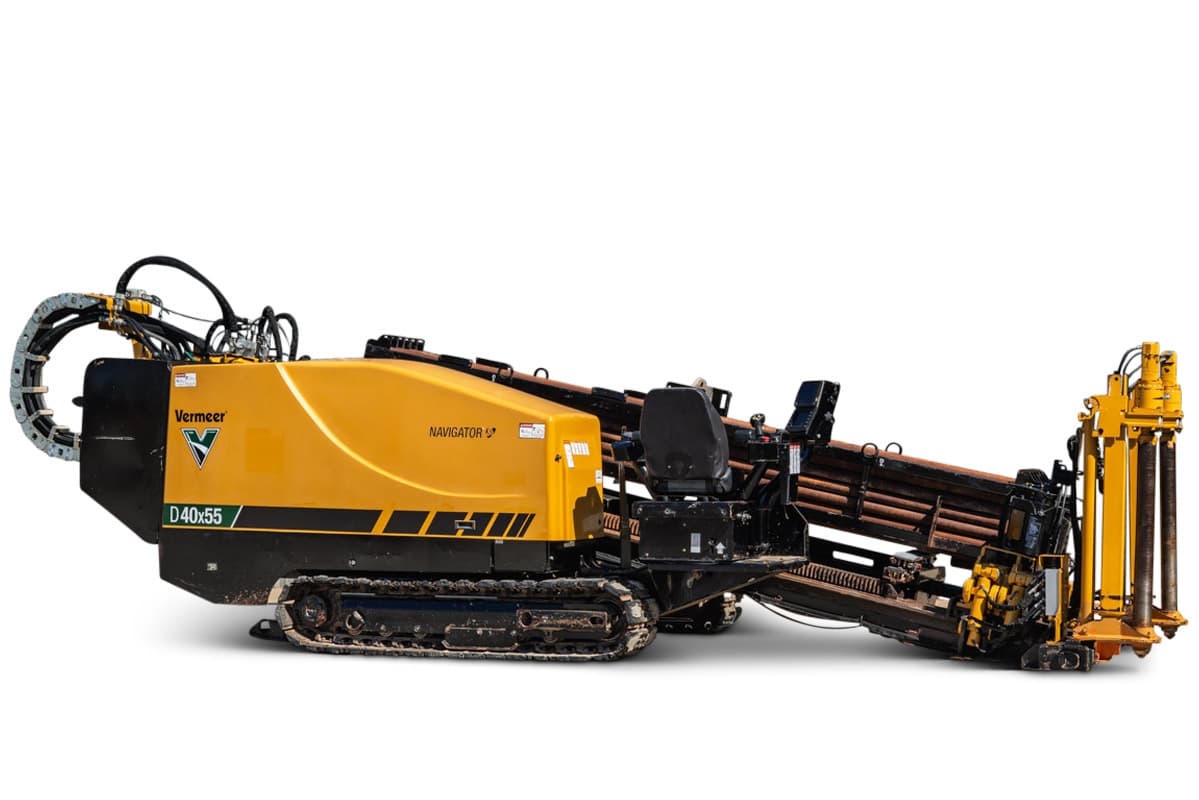
2021 Vermeer 40x55 S3
$299,000
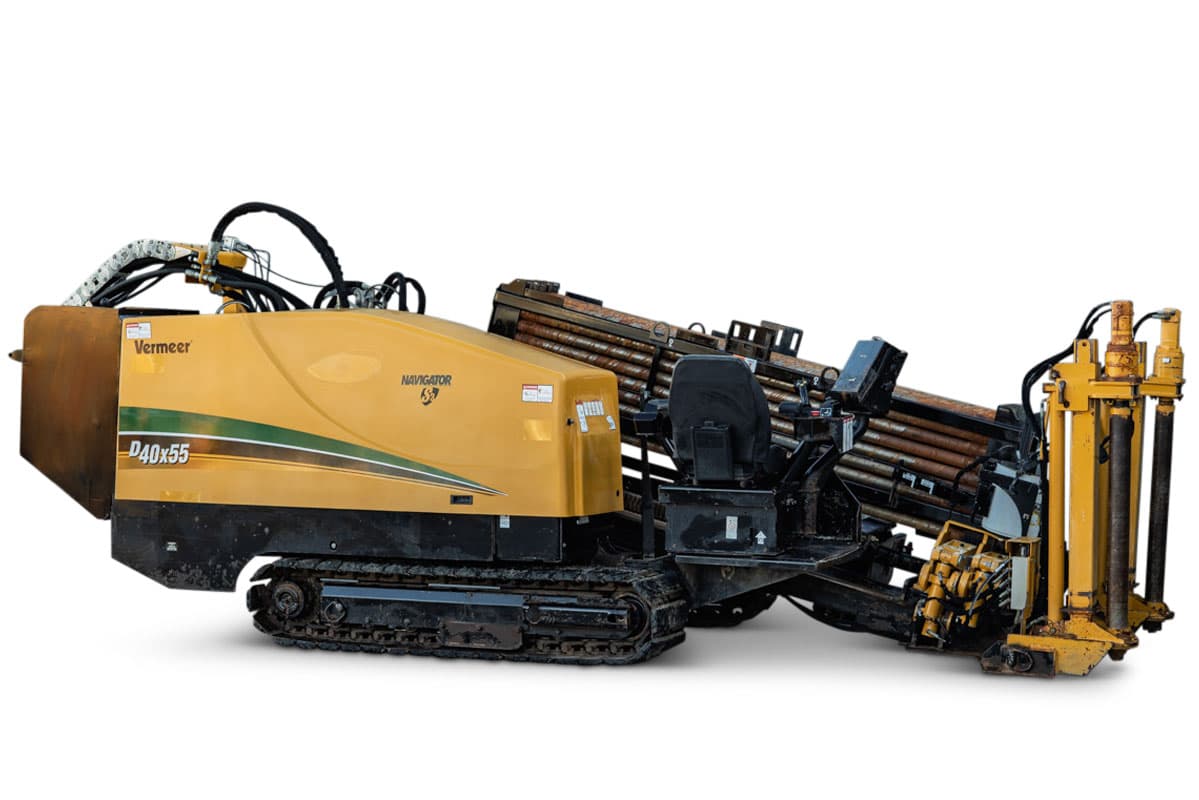
2019 Vermeer 40x55 S3
$199,000
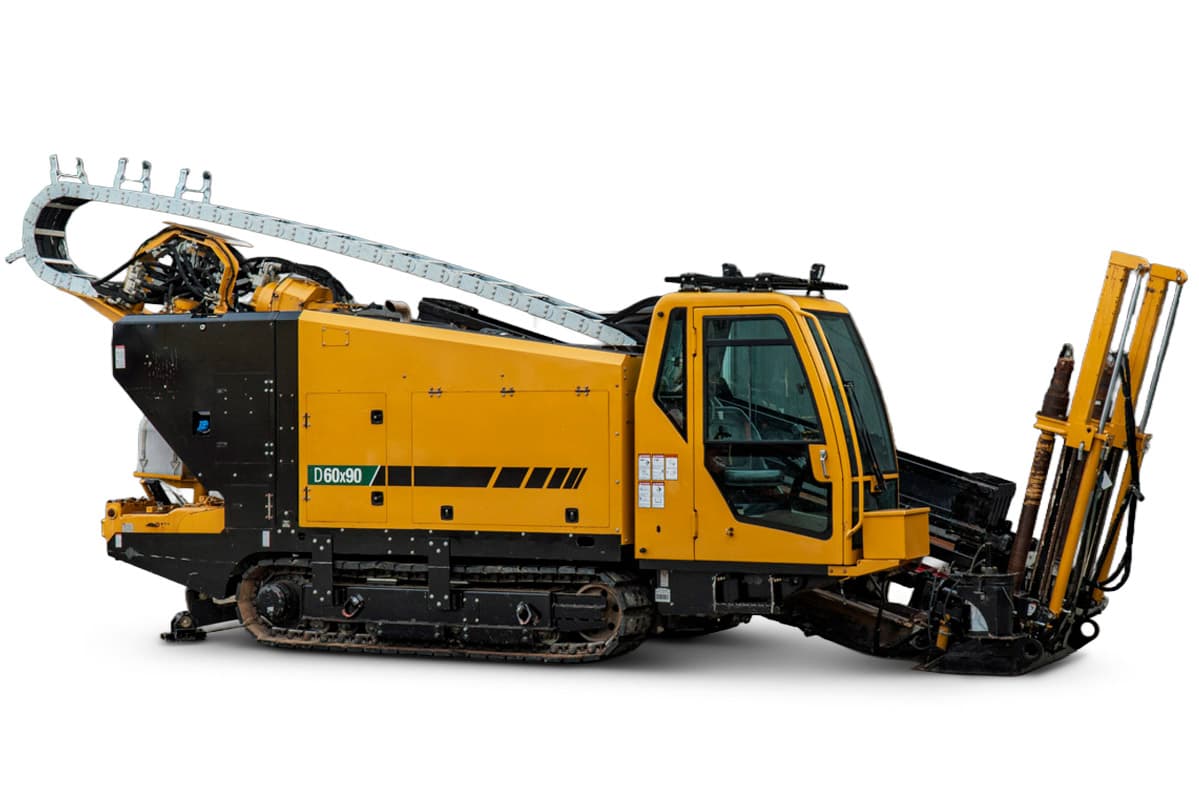
2020 Vermeer D60x90 S3
$469,000
Want a quote today? Call (877) 288-0280.
The Vermeer D60x90, translated
What the machine is
The S3 numbers: 60,000 lb of thrust and pullback, a three-speed rotation drive delivering 9,250, 6,810, or 3,790 ft-lb, a 202 hp Cat C7.1, 150 gpm of mud, and 15-foot Firestick rods in 2.875 or 3.5 inch (600 feet onboard with the smaller, 360 with the larger). It weighs about 39,000 lb depending on configuration, needs about 29.5 feet of transport length and 100 inches of width, and drills bores from 6 inches minimum up through the small-crossing sizes. Two S3-generation upgrades matter daily: a climate cab is standard, and operator-ear noise dropped to 83 dB(A), which Vermeer cites as 12 dB(A) quieter than its predecessor, a genuine order-of-magnitude reduction in perceived loudness on a machine this size.
Generations are simple here: the pre-S3 D60x90 (the 2012-to-2014 units common on today's used market) runs a 185 hp John Deere 6068 with the cab optional; the S3 arrived in December 2015 and remains current with no successor announced. One naming caution: Vermeer's new D60S is an emerging-markets machine, not a D60x90 replacement, so do not let a listing or a rumor tell you the D60x90 is on the way out.
The thin-market reality, used as a tool
D60x90s trade in a thin, broker-driven market: a handful of listings nationally at any time, few apples-to-apples comps. Two real 2026 data points make the point: our own 2014 unit, about 6,690 hours, asks $149,000, while a 2012 unit at a Michigan dealer, 2,583 hours with cab, air hammer, pump upgrade, and 1,740 feet of pipe, asks $264,500. Same vintage neighborhood, $115,000 apart, and the spread is hours and package, not year. The buyer's translation: in this class, list-price anchoring fails, so lean on inspection depth, condition reports, and prior-use history instead, and price the package contents line by line. A machine this size is a financed purchase for most operations; the financing guide covers how used-iron deals at this ticket actually get done.
Known issues on a used D60x90
- The three-speed rotation gearbox. More shift components than a single-speed drive means more to wear, and the factory maintenance schedule includes a rotation-gearbox oil check. Ask for rotation-gearbox service history specifically, not just "maintenance records."
- Prior application. Vermeer positions this machine for utility-to-small-pipeline crossover work. A pipeline-history unit lived through harder cycles and more abrasive cuttings than a distribution-duty unit with identical hours. Ask what the machine actually did, not just how long it ran.
- Mud pump condition. Vermeer's maintenance content flags daily-flush neglect and freeze cracking on mud pumps; on a 150 gpm system, rebuilds run well into five figures, so get a pump assessment and a real quote into the negotiation rather than a guess.
- Transport logistics as a hidden cost. At 39,000 lb and nearly 30 feet, this machine needs CDL-class transport and permits in many states. Budget the logistics before the purchase, not after.
Job fit
Right for: gas distribution mains, long fiber trunk bundles, small-diameter pipeline work, river and highway crossings in the sub-1,800-foot range, and contractors bridging utility and light pipeline markets. Wrong for: true long-distance pipeline (that is the 100,000 lb class and up), everyday fiber work (a capital misfit), and first-time buyers or green crews, for whom this machine's transport, mud, and planning demands multiply every other risk.
Which years and generations to target
The money advice, both models: D20x22: the best value cluster is a documented Series II or early S3 in the $89,000-to-$130,000 band for buyers prioritizing capital, and a 2022-or-newer S3 for buyers prioritizing hours and the newest controls; if you want the October 2025 reliability updates, confirm the unit actually has them. D60x90: generation matters less than history: a documented pre-S3 with utility duty can beat an undocumented S3, though the S3's standard cab and 12 dB noise reduction are real daily-life upgrades worth paying for on noise-sensitive or hot-climate work. On both, the engine plate, the records file, and the package contents decide more than the badge year, and everything rides on inspection: this is exactly the buying situation the inspection checklist was written for.
Shopping the compact end? Browse our 3 D20x22s, both generations, $99,000 to $179,000 as of October 2026. Looking at the big end? Our current D60x90 listing is live, but machines in this class turn over fast and rarely sit on anyone's lot: tell us what you need and we will flag the next one that lands before it ever hits the site. The full Vermeer inventory covers everything in between, and the Ditch Witch JT series decoder maps the other brand's equivalents if you are cross-shopping.
Frequently asked questions
Does the "20" in D20x22 mean 20,000 lb of pullback, and does the "90" in D60x90 mean 90,000 lb?
The first number is the pullback class in thousands of pounds; the second is torque in hundreds of foot-pounds. So a D20x22 is a 19,500 lb machine with about 2,200 ft-lb, and a D60x90 pulls 60,000 lb with up to 9,250 ft-lb; the "90" is torque, not pullback. Vermeer's newest NextGen models are moving to single-number names, but every used classic follows the two-number decode.
What is the difference between a D20x22 Series II and an S3, and is the S3 worth more used?
The Series II (2007 to 2015) runs a Tier 3 Kubota with AutoDrill and the low-profile frame; the S3 (2015 on) brings the 74 hp Deutz, S3 controls, a semi-automated rod loader, and, from October 2025, a reliability refresh. The S3 legitimately carries a premium, typically tens of thousands at comparable hours. Whether it is worth it depends on your duty cycle: daily production favors the S3; a clean Series II is the honest budget play.
Is the D20x22 discontinued or being replaced by the D23x30 or D24?
No. The D20x22 S3 is in active production, with over 4,000 built, and it received a reliability update announced in October 2025, which is not what end-of-life looks like. The D23x30-to-D24 succession is a separate, larger lineage. Any listing or competitor page implying the D20x22 is obsolete is wrong, and the machine's parts and dealer support remain fully current.
What is a fair used D20x22 price under 3,000 hours versus over 5,000?
As of July 2026: under 3,000 hours, expect S3 money from roughly $150,000 up to about $227,000 for late-model low-hour units. Over 5,000 hours, pricing drops into the $90,000-to-$130,000 neighborhood regardless of generation; our 2016 S3 at 5,800 hours asks $99,000, which is what honest high-hours pricing looks like. Included package and records move any of these numbers by five figures.
Why do D60x90 prices vary so much for similar years?
Because the market is thin and the variance is real: hours, package contents, and prior application differ enormously between units. A 2012 with 2,600 hours, a cab, an air hammer, and 1,700 feet of pipe asks $264,500 while a 2014 with 6,700 hours asks $149,000, and both prices are rational. In this class, price the machine's history and contents, not its model year, and let inspection carry the negotiation.
What is the D60x90's three-speed gearbox, and does it need special attention used?
The rotation drive shifts between three speed-and-torque ranges (9,250, 6,810, and 3,790 ft-lb on the S3), letting the operator trade rotation speed for torque. More shift components mean more wear items than a single-speed drive, and the factory maintenance schedule includes a rotation-gearbox oil check. On a used unit, ask specifically for rotation-gearbox service history and shift through all ranges under power during inspection.
Can a D60x90 do pipeline crossings, and what should I ask about prior application?
Yes, small-diameter pipeline and crossing work is half the machine's design brief. That is exactly why prior application matters: a pipeline-history unit endured harder pull cycles and more abrasive cuttings than a gas-distribution unit with the same meter reading. Ask what products, what soils, and what typical bore lengths the machine ran, and weight two same-hours units very differently based on the answers.
What is a sub saver and why does it matter on a used D20x22?
The sub saver is the sacrificial threaded adapter between the spindle and the drill string; it absorbs the makeup-and-breakout wear so the spindle threads do not. Vermeer recommends replacing it at regular intervals, 250 hours recommended, because a worn one damages every rod that passes through it and can quietly ruin a whole basket. On any used unit, ask for sub-saver replacement history and inspect thread condition across the rod basket.
What transport does a D60x90 need versus a D20x22?
A D20x22 at roughly 12,500 lb and 48 inches wide rides a tag trailer behind a heavy pickup, inside most non-CDL setups when the combined weights are managed. A D60x90 at about 39,000 lb and nearly 30 feet of transport length is a CDL-class move, frequently permitted, with real per-move cost. Budget the D60x90's logistics as an operating line item, not an afterthought; it changes the economics of scattered small jobs.
Is a D20x22 too small for gas mains, and is a D60x90 overkill for fiber?
Mostly yes, on both. The D20x22 is a services-and-drops machine; gas distribution mains generally want the 24,000-to-40,000 lb classes for product size and bore length. And a D60x90 running everyday fiber drops is capital and operating cost with no revenue to match. Size to your bread-and-butter work: the sizing guide maps job type to pullback class honestly, including when the answer is "neither of these two."
Sources and references. Specifications, generation history, and maintenance guidance verified against the manufacturer's materials and named industry sources in July 2026.
- Vermeer D20x22 S3 specification sheet (October 2025) (PDF)
- Vermeer: enhanced D20x22 S3 announcement (October 2025)
- Vermeer D60x90 S3 product page and specifications
- NASTT: Vermeer D60x90 S3 launch coverage (November 2015)
- Vermeer ProTips: directional drill maintenance and troubleshooting tips (April 2026)
- Vermeer ProTips: new models and model name changes (November 2024)
- HDD Broker: Vermeer drill lineage history (July 2025)
- HDD Broker equipment library: Vermeer D20x22 S3
- HDD Broker equipment library: Vermeer D60x90 (pre-S3)