"What size directional drill do I need?" sounds like a technical question, but it is really a buying question. You do not want a definition of pullback. You want to know which used machine fits the bores you will actually drill, without overpaying for capacity you will never use or underbuying a rig that cannot finish the job you just won. Buying the wrong size is a more expensive mistake than buying the wrong brand, and it is the one this guide exists to prevent. We will cover the specs you need, but the center of gravity is the decision: match the machine to your work.
We sell used HDD equipment, and that shapes the honest advice here: we would rather right-size you, often into a smaller and used machine, than sell you the most rig. A manufacturer's selection tool nudges toward capability and toward new. A used dealer's interest is in the machine that fits your real work and holds its value, which usually means buying the class your bread-and-butter bores need and subbing out the rare outlier job. That is the lens for everything below.
The short answer
Match the size class to your bread-and-butter work: fiber drops and residential point you to a mini rig (roughly 10,000 to 20,000 lb pullback), fiber and utility distribution to a utility-mid (about 20,000 to 28,000 lb), gas and water main and larger utility to a mid-heavy (about 30,000 to 55,000 lb), and pipeline or infrastructure crossings to a heavy rig (60,000 lb and up). Then refine for your typical bore length, product size, and soil, and lean toward the smaller end if you are unsure, because used machines make trading up or down far less painful than new ones do.
The specs that actually drive sizing
You need a handful of numbers, but only in service of the decision. Here is what each one tells you about whether a machine fits your work:
- Pullback (lb) is the headline number and the primary class indicator: the force that pulls product back through the finished bore. It is what most directly answers "what can this machine install." Rough class mapping: mini 10,000 to 20,000 lb, utility-mid 20,000 to 28,000 lb, mid-heavy 30,000 to 55,000 lb, heavy 60,000 lb and up.
- Thrust (lb) is the push force driving the pilot bore out. It is often a bit lower than pullback (a Ditch Witch JT20, for instance, pulls 20,000 lb but thrusts about 17,000 lb; our Ditch Witch JT series decoder carries both figures for every model) and matters most for tough entry conditions.
- Rotational torque (ft-lb) is the turning force at the drill string. It matters far more in hard ground and with larger reamers. A rig can have plenty of pullback and still stall in clay or rock because it runs out of torque.
- Engine horsepower drives the hydraulics behind everything. More HP supports higher simultaneous thrust, rotation, and fluid flow.
- Mud flow rate (GPM) has to match the bore diameter and length to clear cuttings. Undersized flow causes stuck bores and frac-outs on bigger work, and it can bottleneck a machine whose pullback number looks more than adequate.
- Rod and carriage length affect efficiency on longer bores (fewer rod connections per foot).
Two things buyers get wrong about specs
First, pullback is the headline, but torque and mud flow are often the real binding constraints. In hard ground it is torque that stops the job, and on large-diameter or long bores it is mud flow, not pullback, that decides whether you finish. A rig with a big pullback number and an undersized mud system cannot complete the bores that number implies. Read the whole balanced spec set, not just the pullback figure. Our used HDD mud system buyer's guide covers sizing the fluid side to the rig you are choosing.
Second, nameplate pullback is a maximum, not a working number. As a rule of thumb, size so your routine bores run with headroom, roughly two-thirds to three-quarters of rated pullback, leaving margin for friction, curves, and bad days (real-world loads on long or high-friction bores can climb toward 80 percent and beyond). In practice that means choosing a machine rated comfortably above the pullback your typical job calculates to, not one you will max out every bore.
A reading tip for Vermeer model numbers
Vermeer names a rig by its capability: the first number is pullback in thousands of pounds and the second is rotational torque in hundreds of foot-pounds. A D40x55 pulls about 40,000 lb at 5,500 ft-lb of torque; a D60x90 pulls 60,000 lb at 9,000 ft-lb. Watch the common trap: the D24x40 name describes the original 24,000 lb, 4,000 ft-lb machine (the "40" is torque, not 40,000 lb of pullback), and even the current D24x40 S3, uprated to 28,000 lb, is a utility-mid rig, not a mid-heavy one. When in doubt, read the spec sheet, not the badge. Our Vermeer D24x40 specs and used buyer's guide works through that machine generation by generation, and the Vermeer D20x22 and D60x90 specs and used buyer's guide does the same at the two ends of the range.
The job-to-rig sizing matrix
This is the heart of the decision. Find your bread-and-butter work, confirm your typical bore profile, and read across to the class and the used models that fit it.
| Work type | Typical bore profile | Class (pullback) | Example used models |
|---|---|---|---|
| Fiber drops / residential | ~50 to 300 ft, light conduit, softer soil | Mini (~10,000 to 20,000 lb) | Vermeer D10x15, Ditch Witch JT20 |
| Fiber / utility distribution | ~300 to 1,000 ft, conduit, mixed soil | Utility-mid (~20,000 to 28,000 lb) | Ditch Witch JT24, Vermeer D23x30, Vermeer D24x40 |
| Gas / water main, larger utility | ~500 to 1,500 ft, larger product, variable soil | Mid-heavy (~30,000 to 55,000 lb) | Ditch Witch JT40, Vermeer D40x55 |
| Infrastructure / pipeline / crossings | ~1,000 to 3,000+ ft, high pullback, hard ground | Heavy (~60,000 lb and up) | Vermeer D60x90, Ditch Witch JT100, Vermeer D100x140 |
Treat the bands as a starting filter, not hard cutoffs. They overlap (a JT20 and a Vermeer D20x22 both pull 20,000 lb and sit right on the mini/utility-mid seam), and the formal industry classes are really three (mini, midi, maxi); the four-band split above is a practical refinement. Most importantly, product diameter and soil drive class selection as much as bore length does: a short bore pulling large pipe through rock can demand a bigger machine than a long bore in clean sand.
Once you know your class
The class is the decision this article exists to settle. From there, pick the specific machine: for fiber work, see the best used directional drills for fiber contractors; to choose a brand within the class, see Ditch Witch vs Vermeer; to price the complete setup, see the HDD starter package guide; and before you buy any specific machine, run it through the inspection checklist and check the hour meter.
Drills by pullback, in stock now
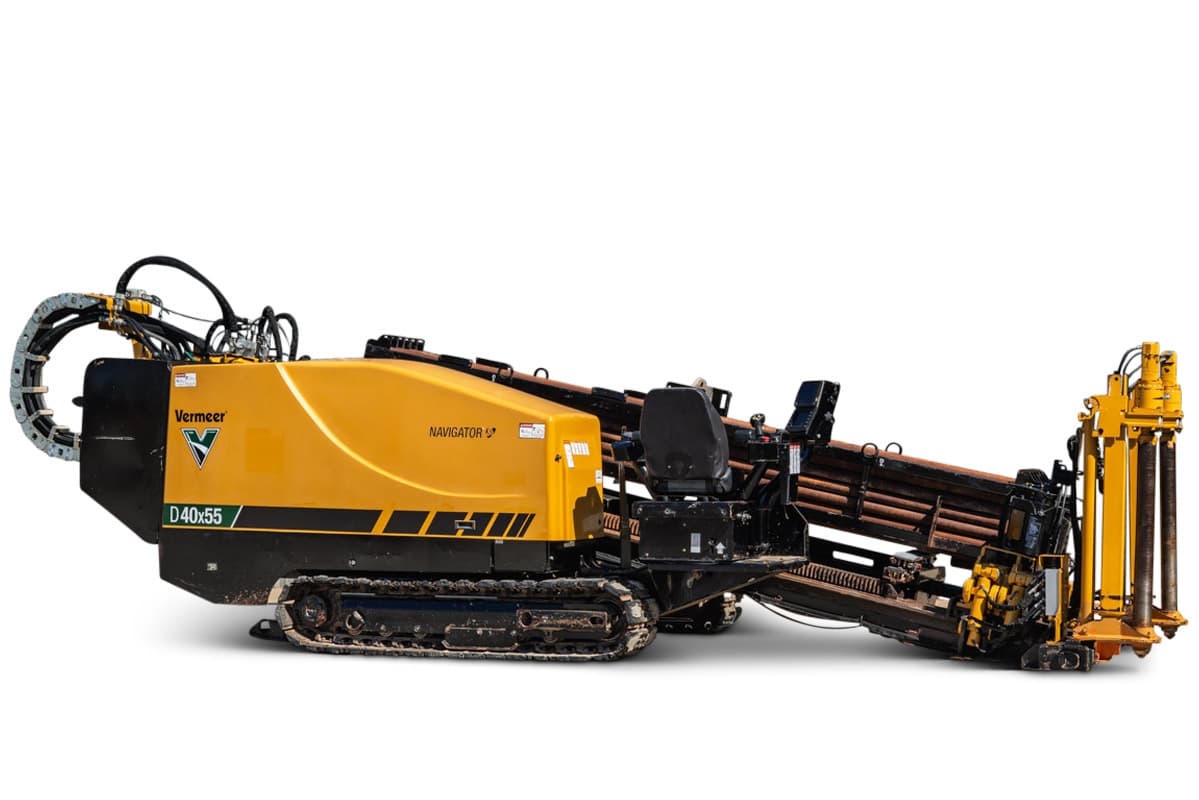
2021 Vermeer 40x55 S3
$299,000
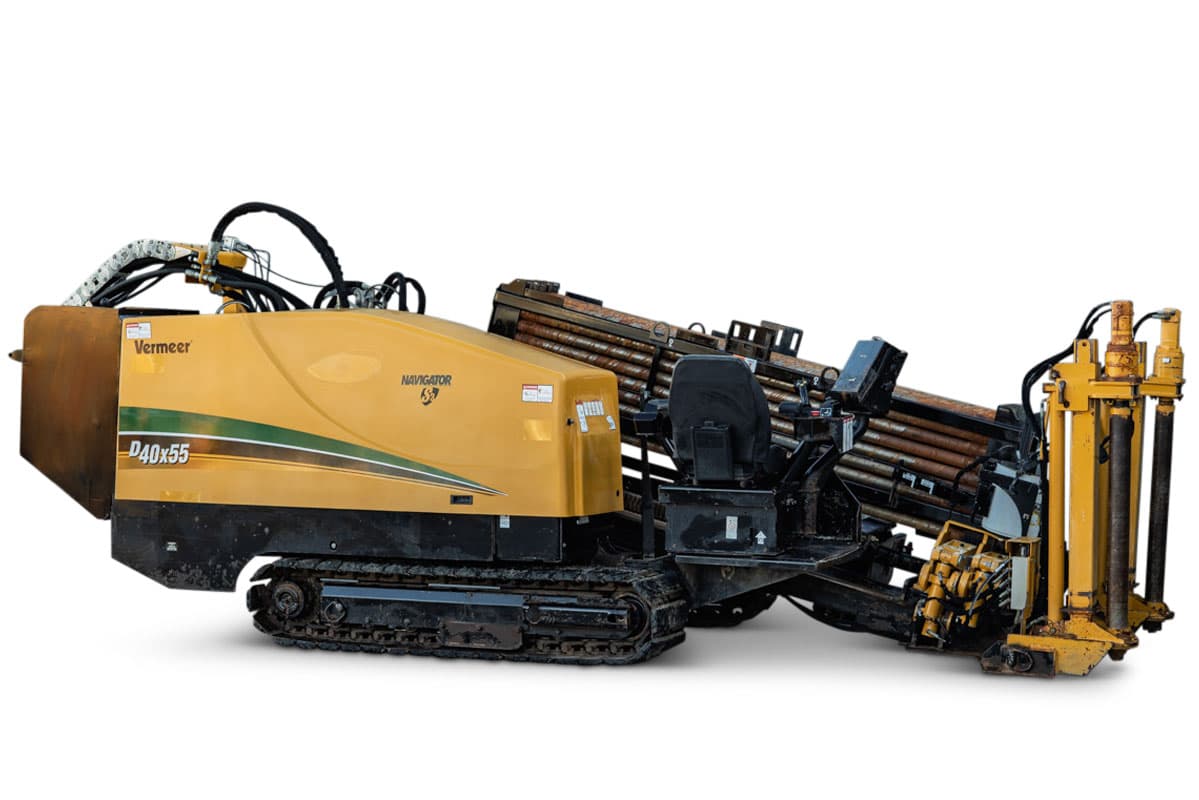
2019 Vermeer 40x55 S3
$199,000
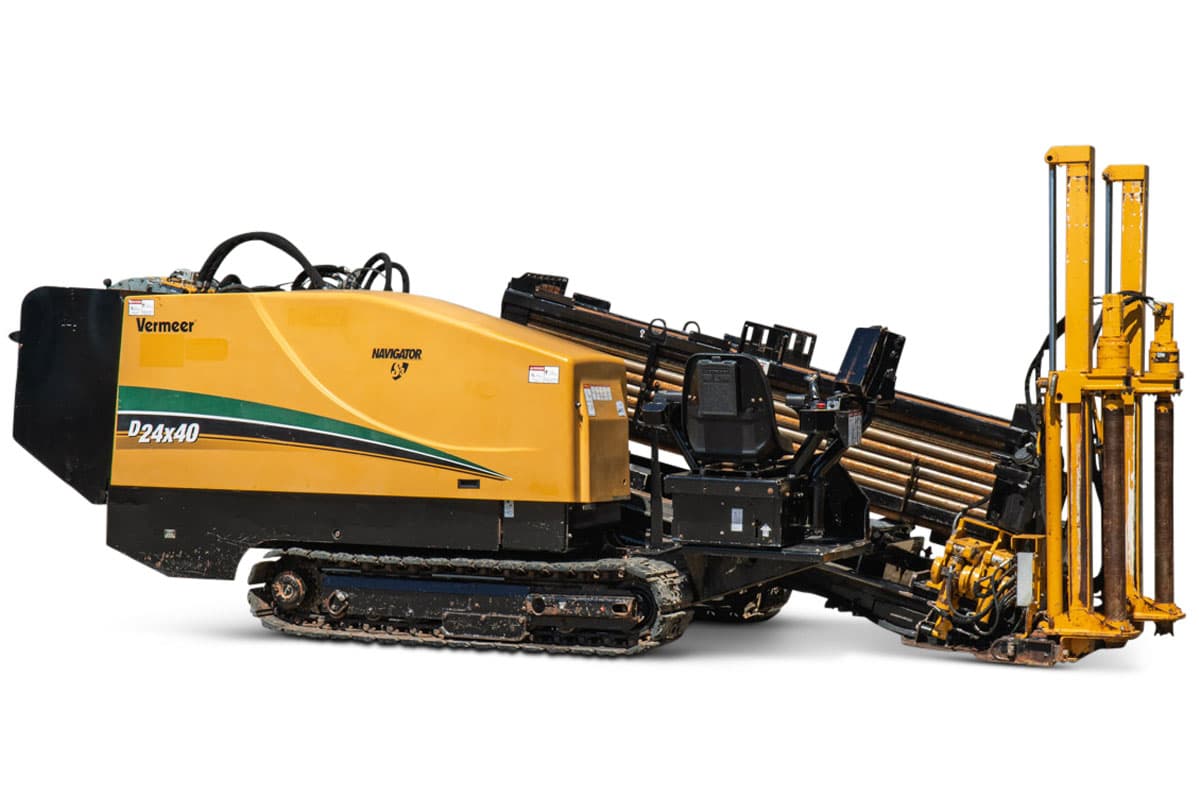
2020 Vermeer D24x40 S3
$179,000
Want a quote today? Call (877) 288-0280.
Estimating the pullback your job needs
You can move from "the bores I drill" to "the pullback I need" with three inputs and a margin:
- Product diameter. Bigger product means a bigger reamer and more force to pull it back.
- Bore length. Longer bores mean more drag on the pulled product, so more pullback.
- Soil. The multiplier (next section).
- Margin. Size for the upper end of your typical work, roughly your 80th-percentile job rather than the average, so you are not maxing the machine every time the job runs a little long or the ground turns.
For a rigorous number, pull-load estimation for polyethylene pipe is formalized in ASTM F1962, the "Standard Guide for Use of Maxi-Horizontal Directional Drilling for Placement of Polyethylene Pipe or Conduit Under Obstacles, Including River Crossings." Two honest caveats: it was written for maxi-HDD (large crossings), and its formulae are commonly adapted to smaller utility and fiber work rather than applied natively, so treat any small-bore figure as an adapted estimate. For a critical or long crossing, have an engineer run the calculation. For everyday sizing, the practical translation is enough: figure the product diameter and bore length you typically run, account for your ground, add margin, and map the result to a class in the matrix above.
Size for your bread-and-butter, sub out the outliers
Buy the class that handles the work you do most, not the once-a-year job that is bigger than everything else you drill. The rare outlier that exceeds your machine is cheaper to subcontract than to carry capacity for all year. Because WorldHDD is used-sales rather than rental, the framing here is genuinely "sub out the bigger job," not "rent up when you need more rig."
Soil is a sizing multiplier
The same bore needs more machine in tougher ground. Soil raises the torque, horsepower, and mud-volume demand for an identical bore geometry:
- Sand and soft soil set the baseline.
- Clay is sticky and swells, driving up torque demand and mud volume, and often pushing the same bore up a step in machine.
- Cobble and mixed ground are unpredictable and hard on tooling, demanding more torque, HP, and fluid.
- Rock is a category change, not just a size step.
Rock changes the equation entirely
If your territory has rock or hard consolidated ground (roughly above 10,000 psi), sizing by pullback alone is a trap. Rock calls for an all-terrain (AT) or dual-rod rock system, sometimes with a mud motor or air hammer, machines built around torque and cutting power rather than just pullback. A conventional single-rod rig chosen on its pullback number will fail in rock no matter how big that number is. Vermeer's own guidance is that contractors drilling a majority of their bores in soft-to-medium rock should be in a dual-rod machine. Know your ground before you size by pullback.
The over-buying and under-buying trap
This is the costly mistake the article exists to prevent, and it cuts both ways.
Under-buying (too small)
- The machine cannot complete the bores you win, so you turn down work or fail mid-bore.
- Running an undersized rig at maximum on every job wears it out faster and means more downtime.
- You outgrow it quickly and eat the transaction cost of trading up sooner than planned.
Over-buying (too big)
- Capital is tied up in capacity you rarely use, which slows your return (the working-capital lesson from the startup cost guide).
- Higher operating cost on every job, even the small ones: more fuel, bigger consumables, pricier maintenance.
- A bigger rig is clumsy on tight residential and suburban sites where a smaller machine maneuvers better.
- You paid for pullback you never use.
Why buying used makes right-sizing more forgiving
Here is the honest dealer's point. Because used machines cost far less than new and hold their value reasonably well, getting the size slightly wrong hurts much less with used than with new. If your work shifts, you can trade a used rig up or down without eating the brutal first-years depreciation a new machine takes. That lowers the stakes of this whole decision, and it is a genuine advantage of buying used that a manufacturer selling new will not point out. Size carefully, but know the used market gives you room to adjust.
The principle that ties it together: size for the work you do most, not the biggest job you might someday win. Buy the class that fits your core bores comfortably and sub out the rare outlier. That discipline usually points to a smaller, used machine than a spec-sheet selection tool would recommend.
The sizing decision, step by step
- Name your bread-and-butter work (fiber drops, distribution, gas or water main, infrastructure). That maps to a base class in the matrix.
- Check your typical bore profile (length and product diameter). That confirms the class or bumps it.
- Know your ground (soft, clay, cobble, rock). That may raise the torque and HP requirement, or flag that you need an AT/rock machine.
- Size for the 80th-percentile job, not the average, so you have headroom without buying capacity you never touch.
- Land on a class, then choose the specific used machine and price the package.
The honest bottom line: most first-time and small contractors are right-sized by a mini or utility-mid used machine. Buy the class that fits your core work comfortably, lean toward the smaller end if you are unsure (used makes trading up easy), and do not let a spec sheet talk you into more machine than your bores require.
The bottom line
The right size is the one that fits the bores you actually drill, with enough headroom for a hard day and not a dollar of capacity beyond that. Start from your bread-and-butter work, refine for your typical bore length, product size, and ground, read the whole spec set rather than fixating on pullback, and remember that rock is its own category. Get the class right and the rest of the buying decision (brand, specific machine, package, financing) falls into place. And because you are buying used, a careful-but-imperfect call is easy to adjust later.
Know your class? Browse used directional drills by brand: Vermeer inventory, Ditch Witch inventory, or the full used directional drill inventory. Ready to pick the specific machine? See the fiber rig recommendations or Ditch Witch vs Vermeer. Not sure what size fits your work? Tell a WorldHDD specialist about your typical bores and we will point you to the right class.
Frequently asked questions
What size directional drill do I need for fiber optic work?
For residential and drop-style fiber, a mini rig of roughly 10,000 to 20,000 lb pullback (a Vermeer D10x15 or Ditch Witch JT20 class) handles the short, light bores well and maneuvers on tight sites. For fiber distribution with longer runs and larger conduit, step up to a utility-mid machine around 20,000 to 28,000 lb (a JT24 or Vermeer D23x30). Match the class to your longest typical bore and your conduit size, not to the occasional outlier job.
How much pullback do I need to install my typical product?
It comes down to product diameter, bore length, and soil, plus a margin. Bigger product and longer bores both raise the pullback required, and harder ground multiplies it. The recognized methodology for polyethylene pipe is ASTM F1962, though it was written for large crossings and is adapted for smaller work, so treat small-bore numbers as estimates and have an engineer run critical or long bores. As a buying rule, size so your typical job uses about two-thirds to three-quarters of the machine's rated pullback, leaving headroom.
What is the difference between thrust and pullback, and which matters more?
Thrust is the push force that drives the pilot bore out; pullback is the force that pulls product back through the finished hole. They are usually close, with thrust often a little lower. For sizing a machine to the work it will install, pullback is the headline spec and the primary class indicator. Thrust matters most for punching through tough entry conditions. Watch the other constraints too: in hard ground, rotational torque can be the real limit regardless of either number.
Is it better to buy a bigger drill than I need, just in case?
Usually not. Over-buying ties up capital in capacity you rarely use, raises your fuel, consumable, and maintenance costs on every job including the small ones, and leaves you with a rig that is clumsy on tight sites. Size for your bread-and-butter work and subcontract the rare outlier job that exceeds it. Because used machines hold value reasonably well, buying the right size now and trading up later if your work grows is cheaper than carrying unused capacity from day one.
What size drill do I need for gas or water main work?
Larger utility work like gas and water main typically calls for a mid-heavy machine in the 30,000 to 55,000 lb pullback range (a Ditch Witch JT40 or Vermeer D40x55), because the bores tend to be longer and the product larger. Confirm against your actual bore lengths, product diameters, and soil, since a utility-mid machine may cover the lighter end of this work while the heaviest crossings push toward a heavy rig.
Can a mini directional drill handle distribution bores, or do I need utility-mid?
A mini rig is built for short, light bores like fiber drops; pushing it into longer distribution runs with larger conduit means running it at maximum on every job, which wears it out and risks not finishing the bore. For steady distribution work, a utility-mid machine (about 20,000 to 28,000 lb) gives the headroom you need. If distribution is only an occasional job, it may be cheaper to subcontract those than to upsize the whole operation.
How does soil type change what size drill I need?
Soil multiplies the demand for the same bore. Sand is the baseline; clay is sticky and raises torque and mud volume; cobble and mixed ground are hard on tooling and demand more torque, HP, and fluid; and rock is a category change. In tougher ground, the same bore can require a step up in machine, and the binding constraint often becomes torque or mud flow rather than pullback. Always factor your ground in before settling on a size.
Do I need a rock or all-terrain drill, or will a standard rig work in my ground?
If a meaningful share of your bores are in rock or hard consolidated ground (roughly above 10,000 psi), you need an all-terrain or dual-rod rock machine, not just a higher-pullback standard rig. Rock work depends on torque and cutting power, often with a mud motor or air hammer, and a conventional single-rod rig will fail in it regardless of its pullback rating. If your ground is soft to medium, a standard rig sized to your bores is fine. Know your ground before you size by pullback.
If I buy used, how hard is it to trade up or down if I get the size wrong?
Much easier than with new equipment. Used machines from established model lines hold their value reasonably well, so if your work shifts you can trade a used rig up or down without absorbing the steep depreciation a new machine takes in its first few years. That is a real advantage of buying used: it lowers the stakes of the sizing decision. Size carefully, but know you have room to adjust as your business grows or changes.
Why does mud flow rate matter when I am sizing a drill by pullback?
Because mud flow, not pullback, is often what actually finishes the bore. Drilling fluid carries cuttings out of the hole; if the flow rate is too low for the bore's diameter and length, you get poor cleaning, rising torque and drag, and stuck bores, no matter how much pullback the machine has. On large-diameter or long bores the fluid demand climbs sharply. A machine with a big pullback number and an undersized mud system cannot complete the work that number implies, which is why you size on the whole spec set.
Sources and references. Pullback and torque ratings were verified against manufacturer spec sheets and HDD Broker's equipment library in 2026. Class bands and bore-profile mappings are general guidance that varies with product diameter and soil.
- Ditch Witch directional drills (official specifications)
- Vermeer horizontal directional drills (official specifications)
- ASTM F1962 (pull-load methodology for PE pipe in maxi-HDD)
- Melfred Borzall, HDD tooling and ground-condition guidance
- HDD Broker equipment library (used machine specs by class)
- WorldHDD: best used directional drills for fiber contractors
- WorldHDD: the complete HDD starter package guide