
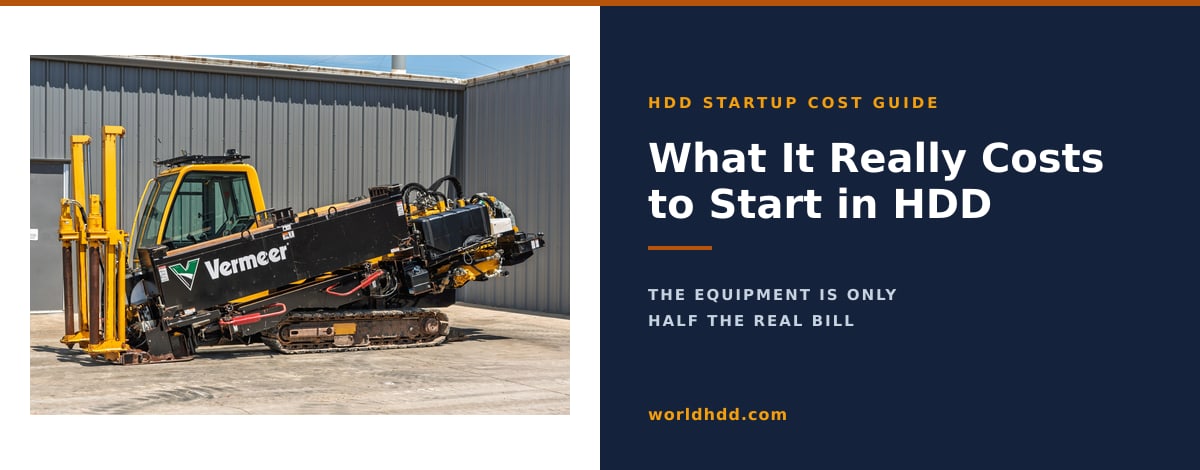
"How much does it cost to start a directional boring business?" is the question that decides whether someone enters this trade at all. Most answers give you an equipment number, and that is exactly the answer that bankrupts undercapitalized startups six months in. The equipment is the visible cost, the part everyone budgets for. The costs below the waterline, insurance, payroll, licensing, and above all the working-capital runway that carries you until your first invoice clears, are the larger mass that actually decides whether the business survives. This guide shows you the whole number, especially the part no equipment quote includes.
We sell complete HDD setups for a living, and we have watched buyers do this both ways: the ones who budgeted only for the rig and ran out of cash with a full order book, and the ones who planned the all-in number and made it. This is the honest cost picture from the dealer's seat, including the costs that do not benefit us to mention. We will keep equipment to a single line and point you to the detailed breakdown elsewhere, because the real lesson of this article is everything else.
The short answer
Starting a directional boring business realistically costs roughly $260,000 to $920,000 all-in for the first year, depending on three things: the equipment tier you buy, whether you run the rig yourself or hire a full crew, and how much operating runway you pre-fund. A lean owner-operator entering on used entry-tier equipment can start around $260,000 to $400,000. A standard hired-crew operation runs about $390,000 to $580,000. A funded operation building for scale runs $610,000 and up. The single most important point: in every scenario, the equipment is only about half of the real number.
The cost iceberg
Picture an iceberg. Above the waterline, the part everyone sees and budgets, is the equipment: rig, locator, mud system, drill pipe, tooling, and trailer. Below the waterline, the larger mass that sinks the unprepared, is everything else:
- Business formation and legal setup
- First-year insurance premiums
- Licensing, bonding, and certifications
- A support vehicle rated to tow the rig
- Yard, storage, or a small shop
- Software and subscriptions
- Crew payroll, which starts before your first invoice clears
- The working-capital runway, the largest hidden cost of all
The insight that defines this article
An HDD contractor completes a job, then waits 30 to 90 days to get paid. Meanwhile payroll runs weekly, fuel and consumables deplete, and loan and insurance payments come due. The contractor who spent every dollar on equipment has nothing left to bridge that gap, and a profitable business fails for lack of cash, not lack of work. Working capital is the cost nobody quotes and the one that matters most.
Cost 1: Equipment (the visible cost)
This is the one cost everyone already plans for, so we will keep it to a single line. A complete used HDD package, rig plus locator plus mud system plus drill pipe plus tooling plus trailer, runs in three rough tiers:
- Entry (used mini class, fiber drops and light utility): about $150,000 to $190,000
- Recommended (used utility-mid, all-purpose): about $220,000 to $290,000
- Premium (used mid-heavy, infrastructure): about $330,000 to $450,000
That is the entire equipment story for this article. For the itemized breakdown, component by component, with what each piece does and what it costs used, see our complete HDD starter package guide. The mud system is the component first-time buyers most often under-spec, and our used HDD mud system buyer's guide prices that piece on its own. The rest of this article covers the costs that guide does not: everything below the waterline.
Machines under $100K
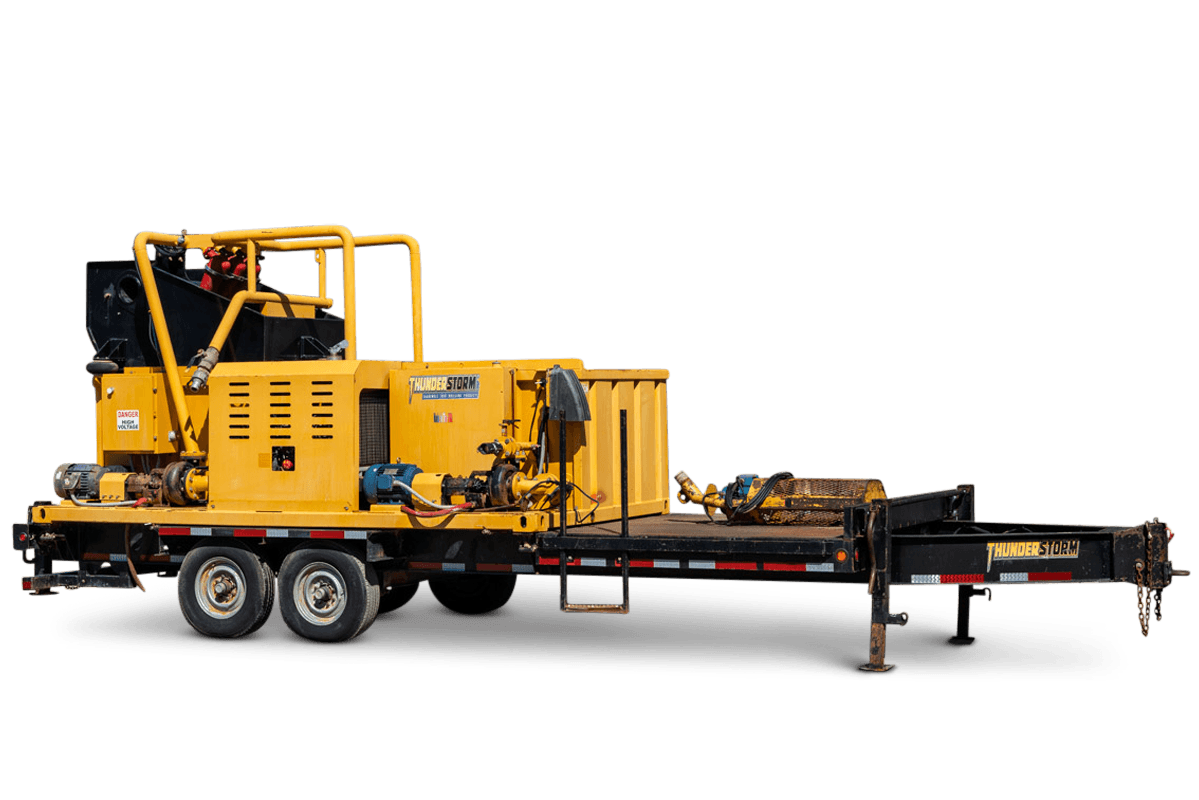
2015 Vermeer Thunderstorm
$69,000
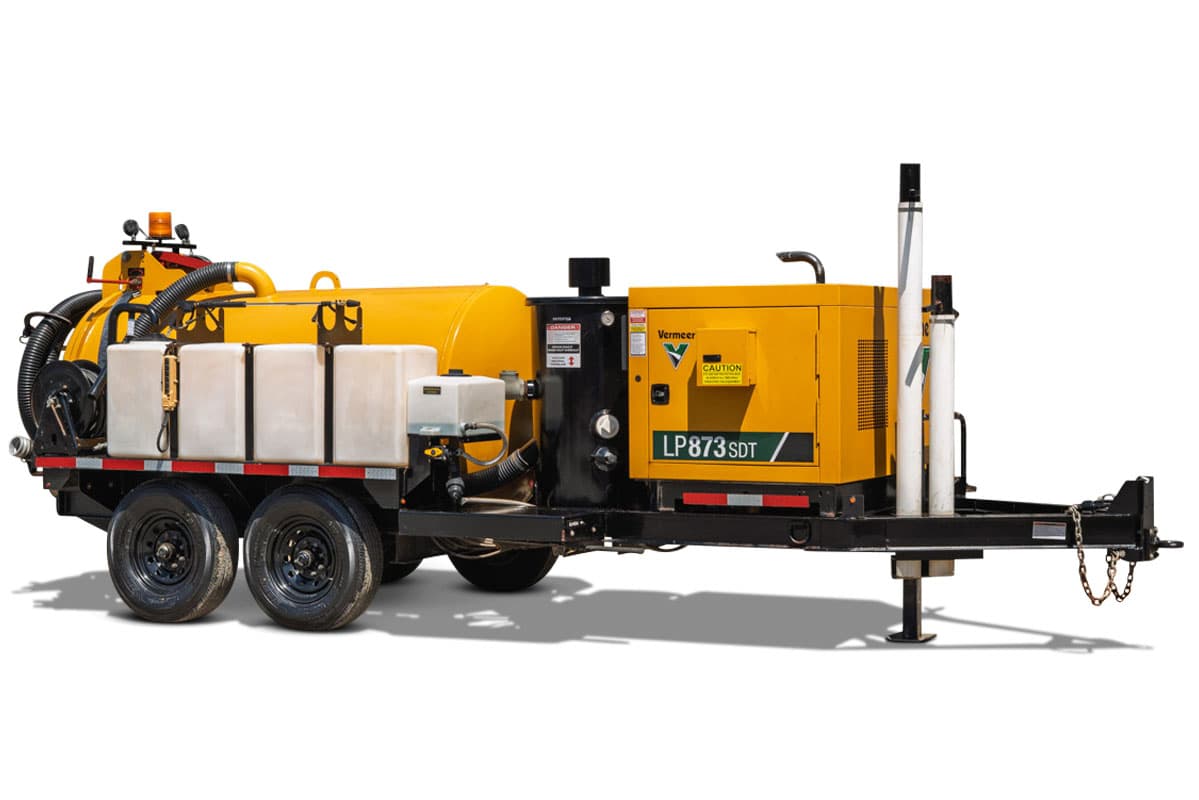
2025 Vermeer LP873SDT
$94,000
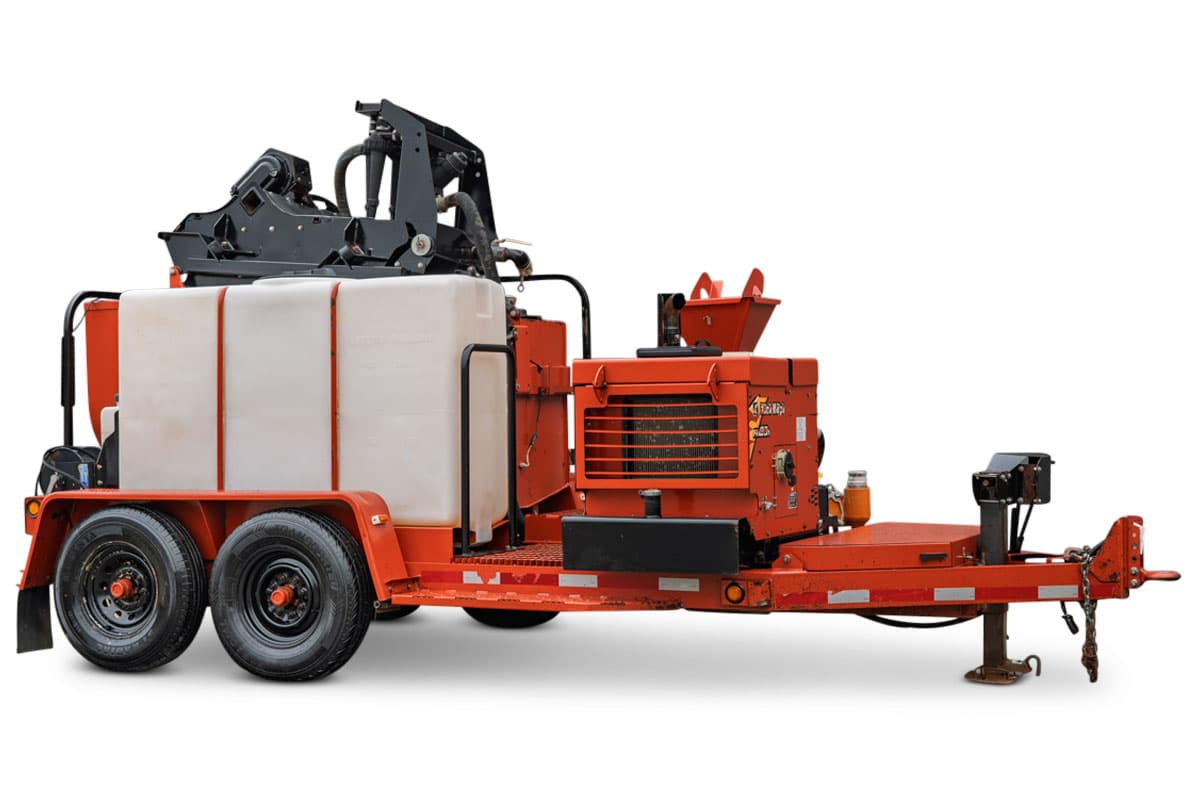
2015 Ditch Witch MR90
$49,000
Want a quote today? Call (877) 288-0280.
Cost 2: Business formation and legal
The smallest of the hidden costs, but real. Setting up the business properly includes:
- LLC or incorporation filing fees, which run roughly $35 to $500 depending on your state (the national average is around $130; Montana and Kentucky are cheapest, Massachusetts the priciest)
- A registered agent (about $100 to $300 a year, or free if you serve as your own)
- An operating agreement (a free template, or $300 to $1,500 for an attorney to draft)
- Business banking, accounting and bookkeeping setup, and an EIN (the EIN is free from the IRS)
- Local business licenses
All in, most new contractors spend roughly $500 to $5,000 here depending on how much they do themselves versus hand to an attorney and CPA. It is the cheapest line in the budget, and the one most worth getting right.
Cost 3: Insurance (first-year premiums)
Our guide on the equipment and operational basics of starting an HDD business covers what coverage levels you need. This section covers what that coverage actually costs in the first year, which is a different and larger question.
HDD work is high-risk in an insurer's eyes, mostly because of utility strikes and fluid spills. It is typically classified under workers' comp class code NCCI 6217 (Excavation and Drivers, NOC), a high-rated excavation class. Broker data puts the workers' comp rate for this class in the rough range of $9 to $16 per $100 of payroll, though the real figure varies widely by state. Here is what a first-year package looks like for a roughly three-person-crew startup. Treat every figure as an estimate that depends on your state, your payroll, your equipment value, and your record:
| Coverage | Typical first-year range | Notes |
|---|---|---|
| General liability ($2M / $4M) | $2,500 to $8,000 | Higher for a brand-new business with no track record |
| Workers' compensation | $4,000 to $12,000 | On roughly $180,000 to $215,000 of payroll at NCCI 6217 rates |
| Inland marine / equipment | $1,500 to $5,000 | Scales with equipment value (around $200,000 to $250,000) |
| Commercial auto (truck and trailer) | $2,000 to $6,000 | A new DOT number tends to mean higher rates |
| Umbrella / excess ($2M to $5M) | $1,200 to $3,500 | Increasingly required by commercial general contractors |
| Environmental / pollution | $2,500 to $5,000 | Increasingly mandated on BEAD and GC work |
| Total first-year insurance package | roughly $13,000 to $40,000 | Most lean startups land in the lower half |
HDD insurance reality
The workers' comp class for excavation and boring is materially more expensive than general construction, because of the utility-strike and spill exposure. A single directional-boring utility strike claim averages somewhere in the $45,000 to $125,000 range by industry estimates, which is why carriers price the work the way they do. A brand-new operation with no claims history pays toward the high end; premiums then climb as you win more work (a larger established operation can pay $50,000 to $150,000 a year and up), but a clean safety record pulls your rates back down over years two and three. One widely cited startup guide puts a new contractor's first-year insurance at $15,000 to $30,000, which sits squarely inside the range above.
Cost 4: Licensing, bonding, and certifications
The cost dimension of the credentials covered in our equipment-needed guide:
- State contractor license. This varies enormously. Roughly 17 states have no state-level general contractor license (local requirements may still apply); where one is required, expect anywhere from a couple hundred dollars to $1,500 or more, with $400 to $800 typical and California, Nevada, and Florida at the higher, more involved end.
- Surety / license bond. Where required, the premium is a percentage of the bond amount based on your credit: roughly 1 to 3 percent for good credit, up to around 10 to 15 percent for poor credit. The dollar cost scales with the required bond amount, so a $50,000 bond at 3 percent is about $1,500 a year.
- Certifications and training. OSHA 10 runs about $60 to $150 per person online, OSHA 30 about $160 to $300, NCCER craft credentials roughly $300 to $1,500, and NUCA training around $175 to $250 per person.
- CDL. If your truck-and-trailer combination exceeds 26,001 pounds, a Class A CDL training program runs roughly $3,000 to $8,000, plus a DOT physical and permit fees.
Budget a few thousand dollars here for a lean solo entry, more for a full crew that all needs certifying.
Cost 5: Support vehicle, yard, and software
Support vehicle. You need a truck rated to tow the rig and trailer at their combined weight. If you do not already own one, a used heavy-duty truck is a real line item, roughly $30,000 to $80,000 used. Adjacent-trade entrants often already have this, which is one of the biggest cost advantages of coming into HDD from another trade.
Yard, storage, or shop. Somewhere to keep the equipment and do basic maintenance. Some owner-operators start from a home property at no cost in year one; others lease, commonly $8,000 to $18,000 a year depending on the market.
Software and subscriptions. Accounting (QuickBooks runs roughly $38 to $115 a month for the plans most contractors use, and note it does not do real estimating), plus bidding or estimating software, and field or job-management software ($40 to $200 a month). Budget roughly $100 to $400 a month, or about $1,200 to $5,000 a year, all in. These are recurring, not one-time.
Cost 6: Crew and payroll
A three-person crew (operator, locator, laborer) is the operational minimum for most commercial work. The cost is not just wages, it is loaded labor cost: wages plus payroll taxes plus workers' comp plus any benefits. Wages first (these are experienced-hand ranges; they sit at the upper-middle of national pay data and run higher in tight broadband-build markets):
| Role | Annual base (experienced) |
|---|---|
| Drill operator (can exceed $90,000 in tight BEAD / fiber markets) | $60,000 to $85,000 |
| Locator (guides the bore path) | $55,000 to $75,000 |
| Laborer (mud, pipe handling, entry level) | $40,000 to $55,000 |
| Three-person crew, wages only | $155,000 to $215,000 |
On top of wages: employer payroll taxes (FICA, FUTA, SUTA) add roughly 11 percent, workers' comp at the NCCI 6217 excavation rate adds materially, and health benefits, if offered, run about $6,000 to $10,000 per person. Fully loaded, a three-person crew costs roughly $200,000 to $300,000 a year, the low end without benefits and the high end with basic health coverage. And it starts the day you hire, before a single invoice has been paid.
The owner-operator lever
If you run the rig yourself and hire only a locator and a laborer, you remove one wage and meaningfully improve year-one cash flow, dropping employee wages to roughly $95,000 to $130,000 a year. Most larger commercial work still requires the full three-person crew, but the owner-operator model is the single biggest way to lower the cost of entry, which is exactly what the lean scenario below does.
Cost 7: Working capital, the startup killer
This is the section that matters most, and the one no other cost article covers. HDD is a complete-then-invoice business:
- Win the job
- Mobilize, drill, and complete it (days to weeks)
- Invoice
- Wait 30 to 90 days to get paid (net-30, net-60, and net-90 terms are standard, and general contractors and utilities are slow payers)
Throughout that cycle, payroll runs weekly, fuel and consumables deplete (a mid-size rig burns around 4.5 gallons of fuel an hour, a full drill-stem set runs about $28,000, and a downhole tooling package about $8,000, per Vermeer-sourced operating data), and loan and insurance payments come due. A contractor with plenty of work but no cash cushion cannot make payroll while waiting to get paid. On top of that, general contractors commonly hold retainage of 5 to 10 percent of the contract value until the project closes, which widens the gap further.
How much runway does a new contractor actually need? Run the math for a three-person crew on steady work:
- Weekly loaded payroll: roughly $5,000 to $7,000
- Weekly fuel (rig and truck): $400 to $800
- Weekly mud and consumables: $200 to $500
- Monthly cash outflow: roughly $24,000 to $36,000
On net-60 terms you fund eight to nine weeks of operations before your first check arrives, which is $48,000 to $72,000 deployed before any revenue returns, and that is running just one crew on steady work. A realistic working-capital cushion for a new HDD contractor is $75,000 to $150,000, held liquid in the bank or an accessible line of credit, and budgeted as a separate line from the equipment. A common construction-CPA benchmark is two to three months of operating expense in reserve, which on $30,000 a month of overhead is $60,000 to $90,000. One widely cited startup guide recommends $100,000 to $150,000 for six months of runway.
The hard truth
More HDD startups fail from undercapitalization than from a lack of work. A contractor who spends every dollar on equipment and keeps zero working capital is one slow-paying general contractor away from missing payroll. The single most important budgeting lesson in this entire article: do not spend your last dollar on the rig.
This is the case for financing
The working-capital reality is the strongest argument for financing the equipment rather than paying cash. Financing preserves the cash you need to survive the payment-cycle gap, which is the gap that actually sinks businesses. See how to finance used HDD equipment, including how a pre-approval that does not affect your credit score lets you keep your capital working.
Three all-in scenarios
Here is the payoff: the all-in first-year cost decomposed, with equipment as a single line and everything else itemized. Watch how the all-in total runs close to double the equipment figure. That is the iceberg made literal.
Scenario A: lean entry (owner-operator)
The owner runs the drill and hires one locator and one laborer. Residential and telecom fiber drops, no large commercial GC requirements.
| Cost category | Range |
|---|---|
| Equipment (entry tier, used) (see the starter package guide) | $150,000 to $190,000 |
| Support truck and trailer (if not owned) | $35,000 to $65,000 |
| LLC formation and legal | $500 to $2,000 |
| State license and bonding | $500 to $1,500 |
| First-year insurance (GL, WC, auto, inland marine) | $12,000 to $22,000 |
| Certifications and training | $1,500 to $3,000 |
| Yard or storage (home storage possible in year 1) | $0 to $12,000 |
| Software and tech | $1,500 to $5,000 |
| Working-capital runway (about 4 months) | $60,000 to $100,000 |
| Lean all-in (first year) | roughly $260,000 to $400,000 |
Scenario B: standard entry (hired crew)
The owner manages and hires a full three-person crew, targeting utility GC work (gas, water, conduit), and leases a yard.
| Cost category | Range |
|---|---|
| Equipment (recommended tier, used) (see the starter package guide) | $220,000 to $290,000 |
| Support truck and trailer | $35,000 to $70,000 |
| LLC formation, legal, accounting setup | $1,500 to $3,500 |
| State license and bonding | $500 to $2,000 |
| First-year insurance (full package incl. umbrella) | $18,000 to $32,000 |
| Certifications and training (crew) | $3,000 to $7,000 |
| Yard lease (year 1) | $8,000 to $18,000 |
| Software and tech | $2,000 to $9,000 |
| Working-capital runway (about 6 months) | $100,000 to $150,000 |
| Standard all-in (first year) | roughly $390,000 to $580,000 |
Scenario C: funded / BEAD entry
A capitalized owner building for scale, hired crew from day one, pursuing BEAD-era prime or sub contracts, with the full insurance stack including environmental.
| Cost category | Range |
|---|---|
| Equipment (premium tier, used) (see the starter package guide) | $330,000 to $450,000 |
| Support truck and trailer (CDL-rated, newer) | $65,000 to $95,000 |
| LLC, attorney, CPA setup | $3,000 to $7,000 |
| State license and bonding (multi-state potential) | $1,000 to $4,000 |
| First-year insurance (full stack incl. environmental) | $28,000 to $50,000 |
| Certifications and training (owner and full crew) | $5,000 to $12,000 |
| Yard lease plus small shop or office (year 1) | $18,000 to $36,000 |
| Software and tech (enterprise) | $7,000 to $15,000 |
| Working-capital runway (6 to 9 months) | $150,000 to $250,000 |
| Funded all-in (first year) | roughly $610,000 to $920,000 |
This explains the famous "$300,000 to $800,000" figure
That widely cited range for starting a directional drilling company is real, and now you can see where it comes from. The spread is driven almost entirely by three variables: the equipment tier, whether you run the rig yourself or hire a crew, and how much operating runway you pre-fund. Notice that the lean floor of about $260,000 is well above the entry equipment package of $150,000 to $190,000. The equipment is roughly half the real number, which is exactly why answering "what does it cost" with an equipment figure alone is off by nearly double.
How long until it is profitable?
Once the money is spent, how long until the business is cash-positive? A realistic timeline:
- Months 1 to 2 (pre-revenue setup): LLC, binding insurance, the state license (which can take weeks to process), equipment delivery and commissioning, hiring, certifications, 811 registration, and right-of-way permit applications (which carry their own lead time). Most new contractors do not turn a bore in month one.
- Months 3 to 4 (first jobs): The first bores happen. Revenue is real but collection is 30 to 60 days out, so cash outflow still exceeds inflow. You are running on your working-capital reserve.
- Months 5 to 6 (break-even zone): With three to four active projects a month at a healthy gross margin, collections begin matching your monthly burn. This is the target break-even window for a well-managed lean startup.
- Months 7 to 12 (early profitability): A three-person crew doing $500,000 to $800,000 in annual revenue at a 30 to 35 percent gross margin generates real gross profit, which then has to cover insurance, yard, software, debt service, and the owner's draw. Net profit is achievable but thin in year one.
- Years 2 to 3: A clean safety record lowers insurance, repeat GC relationships cut the cost of finding work, and the owner's draw can reach six figures. Meaningful net profitability typically arrives in year two or three.
The sinkhole
Contractors who start with under $75,000 of working capital and a hired three-person crew frequently hit month three or four with no cash left, at precisely the moment they have completed jobs but have not yet been paid. This is when businesses fold despite having full order books. The runway has to cover the months between full-cost day one and cash-positive operation. That gap is the entire argument for the working-capital cushion.
The bottom line
Starting a directional boring business costs roughly $260,000 to $920,000 all-in for the first year, and the equipment, the cost everyone fixates on, is only about half of that. The other half, insurance, payroll, licensing, a support truck, a yard, software, and above all the working-capital runway, is what determines whether you survive to profitability. Budget the whole iceberg, not just the tip. Plan the runway. And keep your cash working instead of sinking it all into the rig.
The smartest way to protect your working capital is to finance the equipment and keep your cash for operations. See how to finance used HDD equipment, including a pre-approval that does not affect your credit score. Ready to price the equipment line? Read the itemized HDD starter package guide or browse used directional drill inventory. Building your startup budget and want a real number against current inventory? Talk to a WorldHDD specialist.
Frequently asked questions
What is the realistic minimum to start a directional boring business, all in, not just equipment?
For a lean owner-operator on used entry-tier equipment, plan on roughly $260,000 to $400,000 all in for the first year. That includes the equipment package ($150,000 to $190,000), a support truck if you do not own one, formation and licensing, first-year insurance, and a working-capital runway of $60,000 to $100,000. The equipment alone is only about half. Below that all-in floor, you are usually missing the cash cushion you need to survive until your first invoice clears.
How much should I budget for working capital before my first job pays?
A realistic cushion is $75,000 to $150,000, held liquid and separate from the equipment purchase. The reason is the payment cycle: you complete a job and then wait 30 to 90 days to get paid, while payroll, fuel, and consumables keep flowing out at roughly $24,000 to $36,000 a month for a three-person crew. On net-60 terms you fund eight to nine weeks of operations before the first check arrives. A common construction-CPA benchmark is two to three months of operating expense in reserve.
How much does insurance cost for a new HDD contractor in the first year?
A first-year package for a three-person-crew startup typically runs roughly $13,000 to $40,000, with most lean operations in the lower half. That covers general liability, workers' comp, inland marine on the equipment, commercial auto, and usually an umbrella, with environmental added for BEAD and GC work. HDD's workers' comp class (NCCI 6217, excavation) is materially pricier than general construction because of utility-strike and spill exposure, and a brand-new operation with no claims history pays toward the high end.
What does it cost to run a three-person HDD crew per year?
Fully loaded, roughly $200,000 to $300,000 a year. Base wages for an experienced crew run about $155,000 to $215,000 (operator $60,000 to $85,000, locator $55,000 to $75,000, laborer $40,000 to $55,000). On top of that, payroll taxes add about 11 percent, workers' comp at the excavation rate adds materially, and health benefits, if offered, add $6,000 to $10,000 per person. The crucial part is timing: payroll starts the day you hire, before any invoice has been paid.
Why do people say I need far more than the cost of the equipment?
Because the equipment is only about half the real number. The all-in first-year cost runs close to double the equipment figure once you add insurance, payroll, a support vehicle, licensing, a yard, software, and the working-capital runway. The lean scenario floor of about $260,000 sits well above the $150,000 to $190,000 entry equipment package. Any answer that quotes only the equipment is off by nearly half, and it is exactly that gap that catches undercapitalized startups.
How long before a new HDD business becomes profitable?
Most well-run lean startups reach cash break-even somewhere around months five and six, once three to four active projects a month start matching the monthly burn. Months one and two are pre-revenue setup, and months three and four are usually still cash-negative while you wait on the first collections. Thin net profit is achievable in the back half of year one; meaningful profitability, with a six-figure owner's draw, typically arrives in year two or three as insurance drops and repeat work builds.
Can I start cheaper by running the rig myself instead of hiring a crew?
Yes, and it is the single biggest lever for lowering the cost of entry. Running the drill yourself and hiring only a locator and a laborer cuts employee wages to roughly $95,000 to $130,000 a year, which meaningfully improves year-one cash flow and lowers the working-capital runway you need. The trade-off is that most larger commercial work still requires the full three-person crew, so the owner-operator model fits lean fiber-drop and light-utility entry better than scaling straight into big GC contracts.
How much do licensing, bonding, and certifications cost to get started?
It varies widely by state. A state contractor license, where one is required, runs from a couple hundred dollars to $1,500 or more (about 17 states have no state-level license at all). A surety bond costs a percentage of the bond amount based on credit, roughly 1 to 3 percent for good credit. Certifications run per person: OSHA 10 around $60 to $150, OSHA 30 around $160 to $300, plus NCCER or NUCA training. A CDL program, if you need one, is roughly $3,000 to $8,000.
Is it cheaper to start with fiber drops or go straight to utility work?
Fiber-drop work is the cheaper entry. It fits a used mini-class rig and an owner-operator crew, carries lighter commercial-GC insurance and bonding requirements, and lets you start nearer the $260,000 lean floor. Utility and gas work needs a larger rig, a full crew, a heavier insurance stack (including umbrella and often environmental), and more working capital, which pushes you into the $390,000-and-up standard range. Many contractors start on fiber to build cash and a safety record, then move into higher-margin utility work.
Should I finance the equipment to preserve cash, or pay cash if I can?
For most new contractors, financing the equipment and keeping cash for operations is the safer play, because working capital, not equipment, is what sinks startups. Tying up six figures in a rig and leaving nothing to bridge the 30-to-90-day payment cycle is the classic mistake. Financing preserves that runway. A buyer with deep reserves and a tax situation that favors paying cash may choose differently, but the default for a new operation is to protect the cash. See our financing guide for how the loan-versus-lease and pre-approval details work.
Sources and references. Cost figures were verified against carrier and industry sources in May 2026 and are illustrative planning ranges that vary by state and market. Equipment ranges are summarized from our starter-package guide.
- WorldHDD: the complete HDD starter package guide (itemized equipment cost)
- WorldHDD: how to finance used HDD equipment
- Coverage Axis, directional boring contractors insurance cost (NCCI 6217, per-coverage ranges, utility-strike claim benchmarks)
- Insureon, excavation contractor insurance costs
- Basta CPA, construction cash flow and the working-capital reserve benchmark
- Equipment World, HDD owning and operating costs (Vermeer-sourced consumable and fuel data)
- JIM.com, How to Start a Directional Drilling Company (the widely cited $300,000 to $800,000 range and working-capital guidance)