
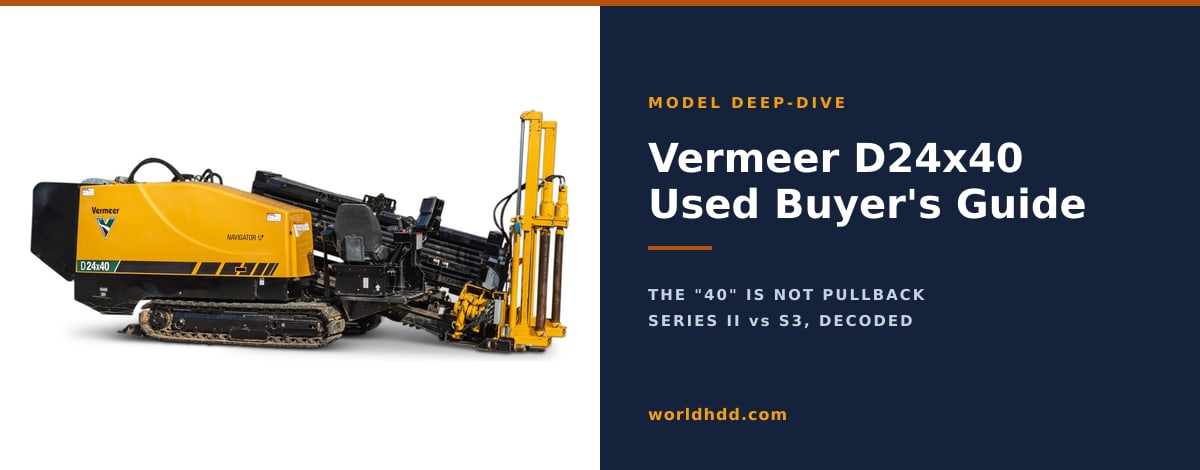
The Vermeer D24x40 carries the most misleading model name in directional drilling, and it misleads twice. The "40" is not 40,000 lb of pullback, so it is not a Ditch Witch JT40 rival, and the current machine is not even the 24,000 lb rig the "24" once described: today's D24x40 S3 pulls 28,000 lb. Add the new Vermeer D24, a completely different machine with a nearly identical name, and buyers have three ways to misprice the same deal. This guide decodes all of it: the real specs by generation, the Series II versus S3 decision, the inspection protocol straight from Vermeer's own maintenance guidance, and what these machines actually cost used, anchored by the four units on our lot right now.
Why trust a dealer on this? Because the confusion costs us money in both directions too. A buyer who thinks a D24x40 competes with a JT40 walks away disappointed; a buyer who thinks it is "just a 24K machine" underestimates the current generation by 4,000 lb. Precision is the whole game with this model, so that is what you get below.
The naming decode: 24, 28, and the imaginary 40
Vermeer's traditional two-number names encode pullback in thousands of pounds and torque in hundreds of foot-pounds, which the spec sheets bear out across the classic lineup: a D20x22 pulls 19,500 lb at about 2,200 ft-lb, a D60x90 pulls 60,000 lb at 9,000 ft-lb (both covered in full in the Vermeer D20x22 and D60x90 buyer's guide). So "D24x40" reads as 24,000 lb of pullback and 4,000 ft-lb of torque, and for the machine that wore the name first, that was true. The catch is that the name froze while the machine kept improving:
- D24x40 Series II (2005 to 2015): 24,000 lb pullback, 4,000 ft-lb. The name matches the machine.
- D24x40 S3 (2015 to present): 28,000 lb thrust and pullback, 4,200 ft-lb. The name now undersells the machine by 4,000 lb.
That uprating moves the S3's true Ditch Witch peer from the JT24 to the JT28, which is a near-exact twin at 28,000 lb and 4,200 ft-lb, at the top of the utility-mid band. And it makes the JT40 comparison a category error in both directions: the JT40 is a genuine 40,000 lb, 5,500 ft-lb machine a full class up. If you are cross-shopping brands in this class, our Ditch Witch vs Vermeer comparison runs the full head-to-head, and the JT series decoder does for Ditch Witch names what this section just did for Vermeer's.
The second trap: the D24 is not a D24x40
In November 2024 Vermeer launched the D24, a NextGen machine with a single-number name, and it is not a D24x40 refresh. Vermeer says so directly: "The D24x40 S3 and D24 are two separate machines, with different specifications and features to be used for distinct applications." The D24 descends from the D23x30 S3 line, peaks at 24,700 lb with 3,080 ft-lb, and runs a 100 hp Cat engine with Automated Rod Exchange. The D24x40 S3 remains in production alongside it: 28,000 lb, 4,200 ft-lb, 125 hp John Deere. Two current Vermeers, near-identical names, different machines. Check the full model name on the plate before you compare anything.
The S3 spec profile, translated for daily work
The current sheet numbers, and what each one means on a jobsite:
| Spec | D24x40 S3 | What it means for you |
|---|---|---|
| Thrust / pullback | 28,000 lb | Top of the utility-mid band; handles fiber trunk, gas and water distribution, and mixed utility product |
| Max spindle torque | 4,200 ft-lb (low), 3,500 (medium), 2,000 (high) | The three-tier gearing lets you trade torque for spindle speed; low gear is the clay-and-reamer number |
| Max spindle speed | 270 rpm | Fast rotation for the pilot bore in soft ground |
| Max carriage speed | 240 fpm | Vermeer bills this as class-leading; in high-cycle work, carriage speed is cycle time, which is production |
| Engine | John Deere 4045, 125 hp, Tier 4 Final (Tier 3 option) | Check the engine plate, not the model year: both emissions variants sold in the same years, and the difference matters for compliance and resale |
| Mud pump | 50 gpm at 1,050 psi | Enough fluid for the bore sizes this class installs |
| Drill rod | Firestick, 10 ft, 2.38 in | Common, well-supplied pipe size |
| Weight | ~21,750 lb (22,250 with cab) | Still a tag-trailer machine, but at the top of that range |
| Noise at operator ear | 82.9 dB(A) open station, 75.7 in cab | The quiet-machine advantage for ordinance-sensitive urban work, and roughly 9 dB quieter than the Series II |
Rounding out the package: an automated rod loader is standard, and the DigiTrak Aurora touchscreen display runs the guidance side. The machine's character is high-cycle urban utility work: fast carriage, deep torque reserve, and a noise profile that keeps neighborhoods and inspectors calm.
Series II vs S3: the used buyer's decision
| What changed | Series II (2005-2015) | S3 (2015-present) |
|---|---|---|
| Pullback | 24,000 lb | 28,000 lb |
| Max torque | 4,000 ft-lb | 4,200 ft-lb |
| Rod handling | Semi-automated loader | Fully automated loader |
| Noise at operator ear | ~92 dB(A) (per HDD Broker's equipment library) | 82.9 dB(A), roughly 9 dB quieter |
| Emissions | Tier 3 era | Tier 4 Final standard, Tier 3 option: read the engine plate |
| Electronics | Pre-S3 controls | Common S3 platform: shared parts and training across the S3 family, but CAN bus diagnostics increasingly need a dealer |
The honest summary: the S3 is a meaningfully better machine, 4,000 lb stronger, quieter by nearly an order of magnitude in perceived loudness, and easier on the crew. The Series II is the value play: the same family DNA at a $30,000 to $50,000 discount against comparable-hours S3 units, if you accept the older controls, the louder station, and the semi-auto loader. For a one-rig contractor doing daily high-cycle work, the S3's speed and noise advantages compound; for a second machine or lighter duty, a clean Series II is real value.
Used D24x40s available now
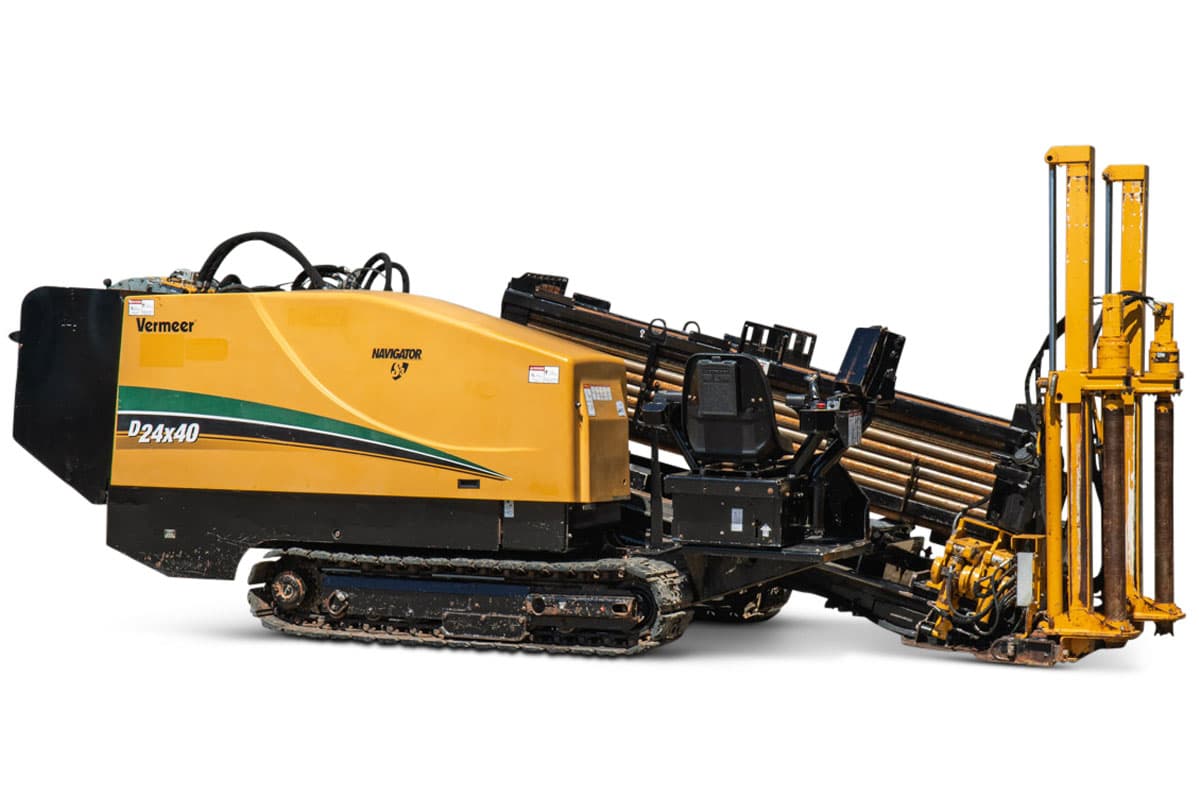
2020 Vermeer D24x40 S3
$179,000
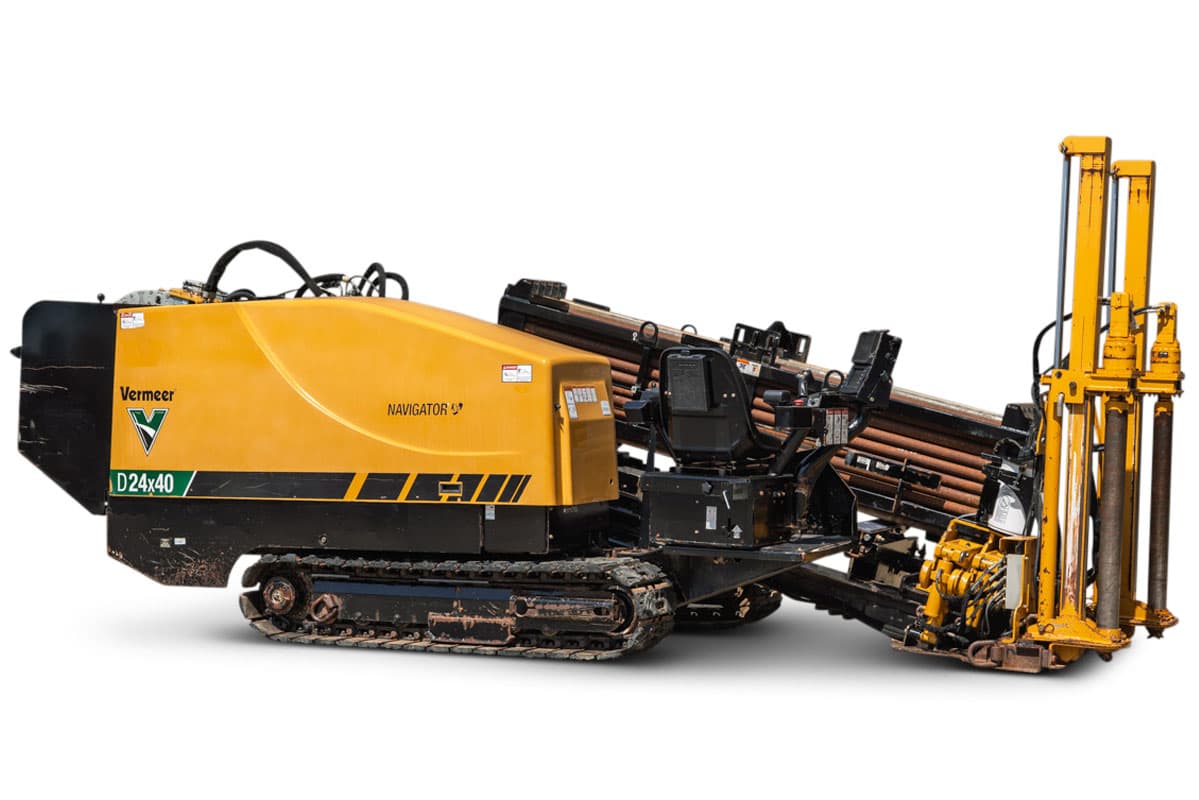
2020 Vermeer D24x40 S3
$179,000
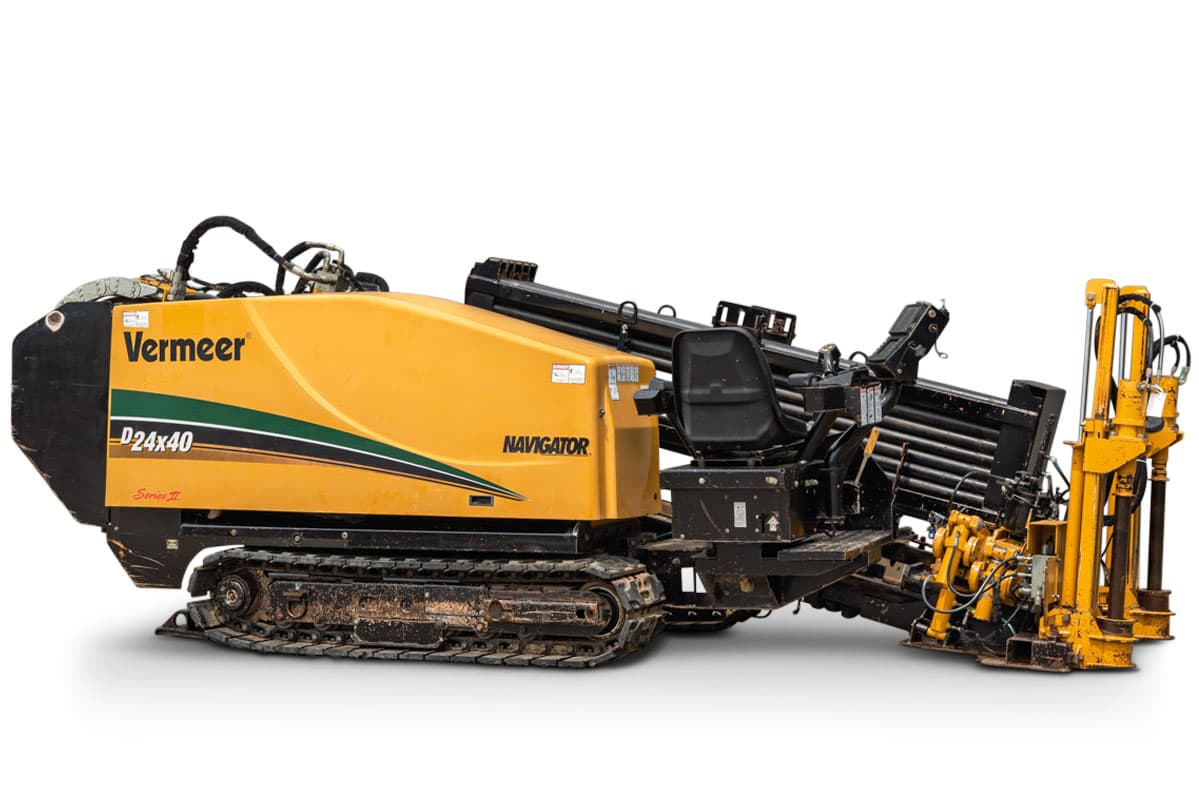
2014 Vermeer 24x40 Series II
$99,000
Want a quote today? Call (877) 288-0280.
Lineage and production status
The family tree runs longer than most buyers realize: the D24A of 1993 begat the original D24x40 in 1995, the D24x40A in 1997, the Series II in 2005 (about 2,500 built), and the S3 in 2015. The important present-tense fact: the D24x40 S3 is in current production as of 2026. It was not retired, and it was not renamed in Vermeer's NextGen transition; the D24 NextGen replaced the D23x30 S3, a different lineage. For a used buyer, current production means live parts channels, active dealer support, and applicable Vermeer programs, which is not something every model in this guide's price range can claim.
No, there is no D24x40DR
Buyers searching for a dual-rod D24x40 find nothing because it does not exist. Vermeer's dual-rod utility line consists of the D23x30DR S3 (24,000 lb, the smallest dual-rod model) and the D40x55DR S3 above it. If your ground is rock and you want a Vermeer dual-rod in this size neighborhood, the D23x30DR is the machine to look at; the D24x40 is a conventional single-rod rig, full stop.
Known issues and the inspection protocol
Vermeer publishes unusually specific maintenance guidance for this machine, which turns a used inspection from guesswork into a checklist. The model-level items, sourced from Vermeer's own maintenance and training content:
- Vise dies. Vermeer's dealer network runs model-specific vise-die training for the D24x40 S3. Wire-brush the dies clean and look at the tooth profiles: flat or rounded teeth cause rod slipping. Then read the rods themselves: clean tooth-bite marks are normal, but smeared slip marks betray past die neglect even if the dies were recently replaced.
- Carriage wear pads. Wiggle-test the carriage for play and ask for the pad replacement history against total hours. A machine with thousands of hours and no pad record either has undocumented service or overdue wear.
- Thrust and rotation encoders. These feed AutoDrill and the bore data. Vermeer's published failure modes are specific: set screws loosening and the gear falling off, the encoder mount breaking, and the gear slipping on the pinion. Verify set screws and gear seating during inspection.
- Sub saver. Vermeer recommends thread-gauge checks and replacement at regular intervals, 250 hours recommended. The sub saver touches every rod in the string, and a neglected one quietly ruins an entire rod basket. Ask for the replacement history.
- The CAN bus reality. Mechanical work on the S3 stays independent-shop-friendly, but fault-code diagnostics increasingly want a Vermeer dealer's tools. Before you buy: ask the seller not to clear fault codes, then photograph any codes on the display during your inspection. A wiped display the morning of your visit is its own data point.
Layer these on top of the universal process in our used drill inspection checklist, and weigh hours with the framework in the hours guide. This model rewards that discipline more than most, because its documented wear points are all inspectable in an hour.
What a used D24x40 costs
Our lot, July 2026, all four units live on the D24x40 category page:
| Unit | Hours | Asking |
|---|---|---|
| 2014 D24x40 Series II | ~4,300 | $109,000 |
| 2019 D24x40 S3 | ~5,650 | $129,000 |
| 2021 D24x40 S3 | ~3,370 | $179,000 |
| 2023 D24x40 S3 | ~1,690 | $269,000 |
Those four sit consistently inside the broader market bands we see in July 2026: higher-hour Series II and early S3 units roughly $80,000 to $130,000, mid-hours S3s roughly $150,000 to $245,000, and low-hour recent S3s $250,000 and up, with near-new full packages (trailer, locator, mud system, rod string) reaching into the low $400,000s. The price drivers, in order: package completeness (a $430,000 listing is mostly package; strip it and the bare rig is $270,000 to $300,000), generation (Series II trades $30,000 to $50,000 below comparable-hours S3), hours, locator generation, and cab. One market caution: listings with wildly implausible meters circulate (we have seen a "22,000-hour" 2016), so treat any anomalous meter as a data error until documents prove otherwise. Our 2019 unit at 5,650 hours and $129,000 is a teachable comp: honest high hours, priced like it, which is exactly how hours should work. All prices as of July 2026; a $130,000 to $270,000 machine is a financed purchase for most buyers, and the financing guide covers how that works on used iron.
Job fit: step down, stay, or step up
Stay if your work is mixed utility and fiber trunk in the 300-to-1,200-foot range with product up to the high single digits in inches, especially high-cycle urban work where the carriage speed and low noise pay daily. That is this machine's home. Step down to a D23x30, the new D24, or a JT24-class rig if your bores are mostly drops and distribution that never touch the S3's torque reserve; the sizing guide will talk you out of paying for headroom you will not use. Step up to a D40x55 or JT40-class machine for gas mains and small crossings, and to a dual-rod (D23x30DR or D40x55DR) if rock is your daily reality rather than your occasional surprise.
Cross-shopping this machine? Browse our 6 D24x40s, both generations, $99,000 to $294,000 as of October 2026, or the full Vermeer inventory. Want the JT28 comparison priced side by side, or a package quote with locator and tooling? Tell us your work and we will spec it honestly, including pointing you at the smaller machine if that is what your bores need.
Frequently asked questions
Why does it say "40" if it only pulls 24,000 to 28,000 lb?
Vermeer's classic names encode pullback in thousands and torque in hundreds: "24x40" meant 24,000 lb of pullback and 4,000 ft-lb of torque, which was accurate for the original and Series II machines. The S3 was then uprated to 28,000 lb and 4,200 ft-lb while keeping the name. So the "40" was always torque, never pullback. Read the spec sheet, not the badge, on every Vermeer with a two-number name.
Is the D24x40 the same as the new Vermeer D24?
No. They are two machines Vermeer sells at the same time. The D24 NextGen (launched November 2024) descends from the D23x30 S3 line: 24,700 lb peak, 3,080 ft-lb, 100 hp Cat, Automated Rod Exchange. The D24x40 S3 is the stronger conventional machine: 28,000 lb, 4,200 ft-lb, 125 hp John Deere. Vermeer states plainly that they are separate machines for distinct applications.
Is the D24x40 S3 discontinued?
No. It is in current production as of 2026 and was not part of Vermeer's NextGen renaming; the D24 replaced the D23x30 S3, a different lineage. For a used buyer that matters: current production means live parts channels, active dealer support, and a machine Vermeer still stands behind, which supports both operating confidence and resale.
What actually changed from Series II to S3?
The big four: pullback rose from 24,000 to 28,000 lb, torque from 4,000 to 4,200 ft-lb, the rod loader went fully automated, and operator-ear noise dropped roughly 9 dB to 82.9 dB(A). The S3 also brought the common S3 control platform and a Tier 4 Final engine option. The Series II remains the value tier at a $30,000 to $50,000 discount for comparable hours.
How does the D24x40 compare to the Ditch Witch JT40?
It does not; that is the trap the name sets. The JT40 is a true 40,000 lb, 5,500 ft-lb machine a full class above. The D24x40 S3's real Ditch Witch peer is the JT28: both 28,000 lb, both 4,200 ft-lb, a near-exact match. Compare the D24x40 to the JT28 and the JT40 to the D40x55, or you will misjudge capability and price in the same breath.
Is there a dual-rod D24x40DR?
No, and there never was. Vermeer's dual-rod utility line consists of the D23x30DR S3, the smallest dual-rod model at 24,000 lb, and the D40x55DR S3 above it. If you need rock capability in this size range from Vermeer, the D23x30DR is the machine to evaluate. The D24x40 itself is a conventional single-rod drill in every generation.
What are the most common problems to check on a used one?
The documented wear points are all inspectable: vise dies (worn tooth profiles cause rod slip; check the rods for slip marks too), carriage wear pads (wiggle-test for play, ask for replacement history), the thrust and rotation encoders (loose set screws, gear seating, mount damage), and the sub saver against Vermeer's recommended 250-hour replacement interval. On the electronics, ask the seller to leave fault codes unclear and photograph what you find.
What is a fair used price in 2026?
As of July 2026: roughly $80,000 to $130,000 for higher-hour Series II and early S3 units, $150,000 to $245,000 for mid-hours S3s, and $250,000-plus for low-hour recent machines, with near-new full packages reaching around $400,000. Package completeness moves price more than any other factor, then generation, then hours. Our own four units run $109,000 to $269,000 across both generations.
What jobs is the D24x40 right for?
Mixed utility and fiber trunk work in the several-hundred-foot range, and especially high-cycle urban drilling: the fast carriage cuts cycle time, and the 82.9 dB(A) operator-ear rating makes it a good citizen on noise-sensitive contracts. If your work is mostly drops and light distribution, step down a class and keep the capital; if it is gas mains and crossings, step up. Size to your bread-and-butter bores.
Does it hold value better than a JT40?
They are different classes, so the honest comparison is depreciation behavior, and there the sample is small: directionally, the D24x40 holds value well at comparable age and hours, helped by current-production status and steady utility-mid demand. We would not put a number on the gap with the data available, and neither should anyone else. Buy the class your work needs first; residual value follows condition and records more than badge.
Sources and references. Specifications, generation history, and maintenance guidance verified against the manufacturer's materials and named industry sources in July 2026.
- Vermeer D24x40 S3 product page and specifications
- Vermeer D24x40 S3 specification sheet (PDF)
- Vermeer ProTips: new models and model name changes (November 2024)
- Vermeer ProTips: directional drill maintenance and troubleshooting tips (April 2026)
- Vermeer D24 product page
- HDD Broker: "Where did the Vermeer D24 Come From? A Drill History" (July 2025)
- HDD Broker equipment library: Vermeer D24x40 S3
- HDD Broker equipment library: Vermeer D24x40 Series II
- Vermeer Southeast service training videos (D24x40 S3 vise die and carriage wear pad maintenance)