
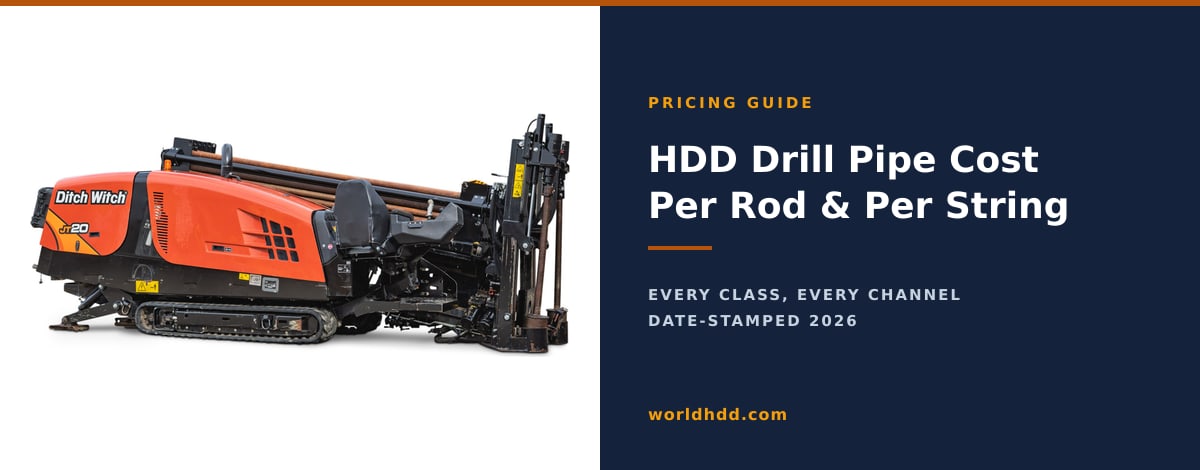
Drill pipe is the consumable that shapes every used-rig deal: a worn string is a five-figure deduction, a good one is five figures of included value, and yet pipe pricing lives scattered across retail SKU pages and auction lots where nobody adds it up. So here is the consolidated answer. A new aftermarket string for a mini-class drill runs roughly $8,000 to $12,000, a used one $4,000 to $7,000, and the numbers scale steeply from there by rig class, construction quality, and channel. This guide puts the per-rod and full-string prices in one table, explains why forged costs more than welded, gives you the no-mixing rule that protects whatever you buy, and shows how to price the string inside a rig deal, which is where most readers will actually use it.
One thing to know about us up front: we are a used equipment dealer, and as of July 2026 we do not have drill pipe in stock as standalone inventory; pipe moves through our yard almost entirely attached to rigs, which is how most used pipe trades everywhere. That makes us a fair referee on pricing, and it shapes the advice at the end: if you need a string or a top-off, the smart plays are buying the rig with the pipe, or telling us what you need so we can source it with the next deal.
The pricing table: per rod and per string, by class and channel
| Class (example rigs) | New aftermarket, per rod | Used, per rod | Full string, used | Full string, new aftermarket |
|---|---|---|---|---|
| Mini (JT9/JT10/JT20, D10x15; 6 to 10 ft rods) | $209 to $279 | ~$100 to $175 | ~$4,000 to $7,000 | ~$8,400 to $11,200 |
| Utility-mid (JT24, D20x22/D23x30/D24x40; 10 ft) | $249 to $299 | sold in lots; varies with condition | ~$12,000 to $20,000 (estimate) | ~$10,000 to $12,000 |
| Mid-heavy (JT40, D40x55; 10 to 15 ft) | $379 to $549 | thin per-rod market | ~$20,000 to $35,000 (estimate) | ~$19,000 to $33,000 |
| Heavy (JT100, D60x90 and up; 15 to 20 ft) | $519 to ~$1,000 | no clean per-rod comps | bundled with rigs; directional only | ~$26,000 to $60,000 |
How to read it honestly. The new-aftermarket column is the hard data: those are live July 2026 retail prices from the online pipe channel (PilotTrack, UniHDD, RadiusHDD, Elite Underground and peers), and you can reproduce them today. The used columns get softer as the class gets bigger, and we will not fake precision: mini-class used rods genuinely trade around $100 to $175 (a current 170-rod JT20 lot is listed at $100 a rod), but mid-heavy and heavy used pipe almost never trades per-rod at all; it moves bundled with rigs or in odd lots (a current D60x90 rack with nine rods asks $6,300, and a lot of JT100 Mach 1 rods asks $340 a rod). Where the table says estimate, treat it as a negotiation frame, not a price sheet. OEM pipe (Vermeer Firestick, Ditch Witch branded) is not retail-listed anywhere; it is dealer-quote-only, and our working estimate is a 20 to 40 percent premium over quality aftermarket. Volume pricing exists but is mostly unpublished: one retailer posts tiered discounts of roughly 4 percent at 16-plus rods and 8 percent at 40-plus, and the others quote volume on request, so ask.
For historical context, a Trenchless Technology feature back in 2008 put a complete string at "$25,000 and upward" depending on rig size. Today the online aftermarket channel, which barely existed then, retails a fresh utility-mid string for around $10,000 to $12,000. The comparison is loose (classes and rod counts vary), but the direction is real: the aftermarket channel has been good news for pipe buyers.
Why pipe costs what it costs
Construction is the big lever
Drill rod is made three ways, as the manufacturing explainers in the industry lay it out: one-piece integral forging (the tube and tool joints forged from a single piece, no joint between them), inertia or friction welding (forged-end tubes joined to tool joints by a spun-friction weld), and press-fit plus MIG welding, the oldest and cheapest method. Vermeer's Firestick is the flagship of the forged tier, made exclusively from V145 steel rated at 145,000 pounds, and Vermeer's own comparison piece frames three-piece welded aftermarket rod as carrying "a potential failure point" at the weld. Two fairness notes keep that honest. First, the strict better-worse ranking is the OEM's framing; the manufacturing explainer itself notes any of the three processes can produce quality pipe when done right, and the aftermarket's track record backs that up: Premier (Tejas Tubular's HDD line, forging and friction-welding pipe in Houston since 1998) claims over 550,000 rods in the field without a single weld failure. Second, one-piece forged is not an OEM exclusive; several aftermarket sellers list one-piece forged S135 rod. So the real tiers are quality-of-manufacture tiers, not OEM-versus-aftermarket tiers.
Vermeer proved that point from inside its own catalog: the Silver Series is Vermeer's lower-cost rod line under Firestick, built from S135 rather than V145 but with the same column wall thickness, threaded in the same facility, and subject to the same inspection process, positioned by Vermeer itself as a close second in performance. When the OEM sells a two-tier ladder, the lesson for buyers is that a legitimate quality-price ladder exists; the thing to avoid is not "aftermarket," it is the bottom tier of unknown provenance.
The thread you cannot see
Why does no-name pipe that "fits" still fail? Often at the thread root. Connection fatigue engineering is real and documented: enlarged and cold-rolled thread root radii measurably multiply fatigue life, and fatigue cracks initiate in the first threads near the shoulder. A generic thread can match the OEM's dimensions closely enough to make up, while missing the root geometry and surface treatment that determine how many make-and-break, bend-and-rotate cycles the connection survives. Ask who forges the pipe and what steel and thread spec it carries, not just who sells it or whether it threads on.
Size scales price, but not linearly
Bigger classes cost more per rod than length alone explains, because diameter and wall grow with length: a 6-foot mini rod at $209 and a 20-foot heavy rod at $1,000 differ by far more than length. Price per foot rises with class, which is one more reason not to buy more rig, and therefore more string, than your work needs.
How long rods last, and when to replace
Replacement is condition-triggered, not hours-triggered; the industry guidance is explicit that HDD tooling has no fixed service intervals, and ground conditions dominate: abrasive sand can wear a string faster than harder rock, so two identical meters mean nothing across two different territories. The condition thresholds worth carrying, consistent with our inspection checklist: watch the box-end tong surface, because once roughly 0.075 inch of that surface is gone the joint's torque rating is compromised; and any bent rod comes out of service immediately, no exceptions. Related but distinct: the roughly 10 percent figure you hear on a 10-foot rod is the maximum allowable bend per rod while steering, an operating limit, and habitually steering at or past it is precisely what puts bends and fatigue into a string. A seller's steering habits are wear history; ask about them.
The no-mixing rule
Vermeer's rod-buying guidance says it plainly: "do not mix drill rods from different sources in the same rack." Different steel, heat treatment, and thread geometry behave differently under the same load even when the threads make up, and mixed wear levels mean the weakest rod sets the string's limit without telling you which one it is. "When you lose track of what is on the string, you lose control of how it behaves." Standardize on a rod, mark the racks clearly, and make it a crew habit. When you buy a used rig whose basket is a brand medley, price it as the disposal-and-replacement project it is.
And when a string does wear out: there is no HDD-specific buyback or core program, so plan the exit honestly. Straight, in-spec pipe sells in discounted lots; bent or out-of-spec rod is scrap steel value, period.
Pricing the string inside a rig deal
This is where the table earns its keep, because most used pipe changes hands attached to a machine. A typical used rig comes with around 40 rods, and the swing between a healthy string and a junk one is the full replacement cost in the table above: $4,000 to $7,000 on a mini, $10,000 to $20,000 on a utility-mid, more above that. So inspect the string as its own line item (the checklist shows how: joints, tong surfaces, straightness, thread condition, and the basket-wide sub-saver damage pattern), then do the arithmetic in the negotiation, the same way the hours guide teaches you to price meter readings. A rig priced $8,000 under market with a worn 40-rod string is not underpriced. The model guides flag where this bites hardest: rod baskets are a named checkpoint on both the Ditch Witch JT series (All Terrain pipe is class-specific and expensive) and the Vermeer model guide (a neglected sub saver quietly ruins a whole basket). For where pipe sits in a complete first setup, the starter package guide carries the full build math this article's numbers reconcile with.
Need a string, a top-off, or an honest read on the pipe in a deal you are weighing? We source and swap pipe with rig deals continuously, even though we rarely list it standalone: tell us your rig model and rod count and we will quote what we can actually get, or check the drill pipe page, which lists no standalone pipe items today. And if you are buying the rig too, that is usually the better pipe deal in the first place: browse the current inventory, strings included and inspected.
Looking for drill pipe?
We do not have one on the lot this minute. Tell us what you are after and we will call you when the right machine lands.
Tell us what you needFrequently asked questions
How much does a full set of rods for a JT20 cost?
New aftermarket JT20-class rods run about $279 each in July 2026, so a fresh 40-rod set is roughly $11,000. Used mini-class rods trade around $100 to $175 in lots, putting a used set at about $4,000 to $7,000 depending on condition. Most used JT20s come with around 40 rods included, which is why the string's condition belongs in the rig negotiation.
Is used drill pipe safe to run?
Condition is everything; age and hours are not the test. Check straightness (any bend disqualifies a rod), tool-joint tong surfaces (roughly 0.075 inch of surface loss compromises the torque rating), and thread condition across the lot, not just the top rods. A passing used string is a legitimate buy at 40-to-65 percent of new money. An unknown mixed lot is not a bargain at any price.
What is the real difference between Firestick and Premier pipe?
Construction and steel. Firestick is Vermeer's one-piece forged rod in V145 steel with no weld between tube and joint; Premier (Tejas Tubular's HDD line, in the market since 1998) friction-welds forged-end tubes to tool joints and claims over 550,000 rods fielded without a weld failure. Firestick is the premium spec at dealer-quote pricing; Premier is the benchmark quality aftermarket. Both are far above the no-name press-fit tier.
How long do HDD rods actually last?
Until their condition says stop; there is no valid hours number. Industry guidance is explicit that drill pipe has no fixed replacement interval, and soil dominates wear: abrasive ground can consume a string dramatically faster than soft clay at the same meter reading. Inspect on condition triggers (tong-surface loss, bends, thread wear) and treat any quoted lifespan-in-hours as marketing, not engineering.
Can I mix rod brands in one string?
No. Vermeer's guidance is direct: do not mix rods from different sources in the same rack, and do not mix wear levels either. Different steel, heat treatment, and thread-root geometry behave differently under identical load even when the threads fit, and the weakest rod silently sets the whole string's limit. Standardize per rack, mark the racks, and when buying used, discount a mixed basket accordingly.
Why does forged pipe cost more than welded?
A one-piece forging has no weld zone, which removes the classic failure point and costs more to manufacture. Well-executed friction welding narrows the real-world gap considerably, which is why the quality aftermarket exists, but the forging process plus premium steel (V145 versus the standard S135) keeps the top tier priced above everything else. You are paying for fatigue life at the connection, the part you cannot inspect from outside.
What is the OEM versus aftermarket price gap?
OEM pipe is not retail-listed anywhere; it is dealer-quote-only, and our working estimate from quotes we see is a 20 to 40 percent premium over comparable quality aftermarket rod. Note the OEMs themselves acknowledge the ladder: Vermeer sells its own lower-cost Silver Series line under Firestick, same wall thickness and inspection, different steel grade. Quote both channels before assuming either direction wins.
Should I buy a used string or a new one?
If the rig deal includes a passing string, keep it; that is the cheapest pipe you will ever own. Topping off or replacing: used lots at 40-to-65 percent of new money make sense for lighter duty and known provenance, while high-volume or critical work favors new quality pipe, where the known fatigue life is what you are buying. Whatever you choose, do not mix it into an existing rack of something else.
Can I sell worn-out drill pipe?
There is no HDD buyback or core-charge market, so set expectations accordingly. Straight, in-spec pipe sells in discounted lots to crews running lighter duty; bent, cracked, or out-of-spec rod is scrap steel value only. The disposal math is one more argument for the no-mixing rule: a clean, single-brand, evenly-worn rack is sellable, while a medley is a scrap run.
Does rod length change the price per foot?
Yes, and more than linearly, because class scales with length: longer rods come on bigger machines with larger diameters and heavier walls. A 6-foot mini rod around $209 works out to roughly $35 a foot, while a 20-foot heavy-class rod near $1,000 runs about $50 a foot. Budget by rig class rather than by footage, and remember the same scaling applies to every replacement you will ever buy.
Sources and references. Prices, construction claims, and wear guidance verified against live retail listings, manufacturer materials, and named trade press in July 2026.
- PilotTrack HDD: drill pipe retail pricing
- RadiusHDD: drill pipe retail pricing
- Elite Underground Tools: heavy-class rod pricing and volume tiers
- Vermeer ProTips: "Building a Smarter HDD Drill Rod Buying Strategy" (July 2026)
- Vermeer ProTips: Firestick vs standard drill rod (May 2026)
- Vermeer: Silver Series drill rod introduction
- Tejas Tubular / Premier: HDD drill pipe manufacturing
- TuffRod: drill rod manufacturing processes explained
- Trenchless Technology: when to replace HDD drill pipe (2023)
- Trenchless Technology: HDD tooling longevity (August 2025)
- Trenchless Technology: "Drill Pipe: More Than a Supporting Player" (2008)