
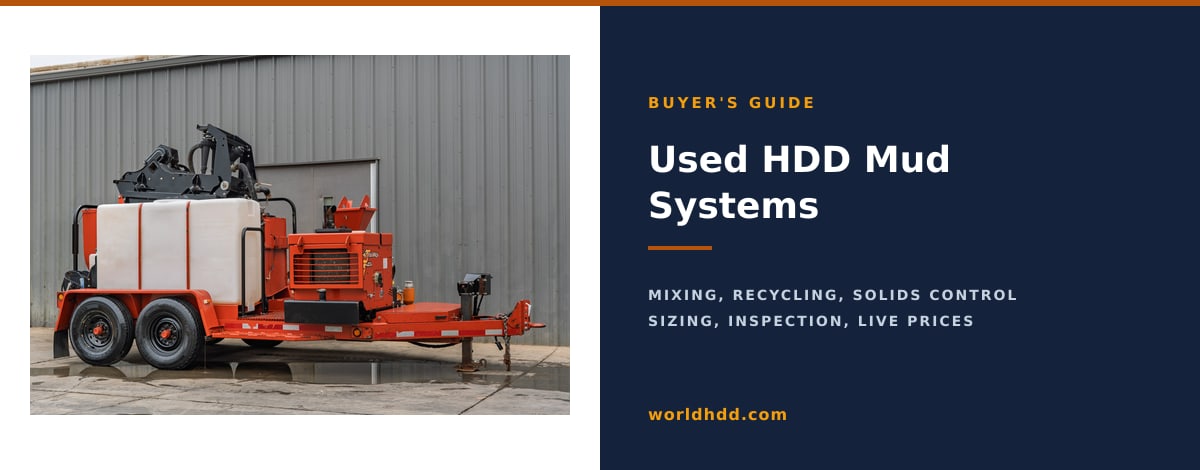
The rig gets the attention and the mud system decides whether the bore goes in. It is the part most first-time buyers under-budget, and it is the part the used market explains worst, because almost everything written about mud systems is written by a manufacturer selling a new one. This guide does the other job: how to match a used mixing or recycling system to the fluid pump on your rig, what the three machines people lump together as "a mud system" actually do, the nine things to put your hands on before you hand over money, and what this equipment trades for right now.
One thing worth saying before the advice starts. Three unrelated machines share a shelf and a search term here, and buyers get burned by it constantly. Right now we have 17 mud mixing systems, 2 mud recyclers and 27 vacuum excavators on the lot. Only the first two are mud systems in the sense this guide means. Sorting them out is the first section, and once you can tell them apart the rest of the buying decision gets much simpler.
The three machines people call a mud system
Mixing systems hydrate and blend drilling fluid and hold it ready for the rig. A power pack, a venturi hopper, jets, a centrifugal pump, and one or more tanks. That is the whole machine. Ditch Witch builds the FM5X and FM13X; Vermeer builds the MX125 and MX300; StraightLine builds the PM170. They are supply-side only. Nothing that returns from the bore goes through them.
Mud recyclers, also called reclaimers or solids control units, take the contaminated fluid coming back out of the bore, screen the cuttings out on a shale shaker, pull the fines out through hydrocyclone cones, and put cleaned mud back in the tank to be used again. This is the family with the fewest models and the least written about it. Ditch Witch builds the MR90. Mud Technologies builds the MCT series, which mixes and reclaims in one unit. American Augers builds the M300DH and its larger siblings for pipeline-class work.
Vacuum excavators pothole, expose utilities, and suck spoils and returns off the ground. Ditch Witch FX and HX units, the MV800, Vermeer LP and CV units, Ring-O-Matic and McLaughlin vacs. They collect slurry. They do not separate it, clean it, or give it back.
A vacuum excavator is not a mud recycler, and this is where money gets lost
These two get confused constantly, including in equipment listings. Ditch Witch's own trailer vacuum excavator literature lists the FX20, FX25, FX30, FX50, FX65 and MV800 as one product family, and its drill brochures list "mud mixers" (the FM5X and FM13X) and "vacuum excavators" as two separate lines of the HDD system. A vac has a blower, a spoils tank and a boom. A reclaimer has a shaker deck, cone manifolds and a clean-side tank. If the machine you are looking at has no shaker screens, it will never return a gallon of usable mud to you, whatever the listing calls it. Ask the seller which of the two functions the unit was built for, and if the answer is vague, ask for a photo of the shaker deck.
Most crews need a mixing system on day one, a vacuum excavator as soon as they work near existing utilities, and a reclaimer only when the arithmetic in the fluid budget says so. If you are still assembling the whole outfit rather than replacing one piece, The Complete HDD Starter Package: Rig, Locator, Mud, Pipe, Tooling, and Trailer puts all six components and their budget shares in one place. For the third machine in the taxonomy above, a separate machine and a separate purchase, see our used vacuum excavator buyer's guide for HDD crews.
Match the system to the fluid pump on your rig
Everything about sizing starts with one number that is printed on your rig's spec sheet and nowhere else: the maximum flow of its onboard drilling fluid pump. That figure sets how fast the machine can empty a tank, and therefore how much tank you need and whether recycling makes sense at all. Here it is for the classes we actually stock, taken from manufacturer spec sheets rather than from dealer summaries.
| Rig | Thrust / pullback | Fluid pump, max flow | Max pressure | On our lot |
|---|---|---|---|---|
| Vermeer D20x22 S3 | 19,500 lb | 25 gpm | 750 psi | 3 D20x22s |
| Ditch Witch JT20 | 20,000 lb | 35 gpm | 1,000 psi | 10 JT20s |
| Vermeer D23x30 S3 | 24,000 lb | 35 gpm | 1,300 psi | 5 D23x30s |
| Ditch Witch JT24 | 24,000 lb | 40 gpm | 1,200 psi | 2 JT24s |
| Ditch Witch JT25 | 25,000 lb class | 50 gpm | 1,200 psi | 6 JT25s |
| Ditch Witch JT28 | 28,000 lb | 50 gpm | 1,200 psi | 2 JT28s |
| Vermeer D24x40 S3 | 28,000 lb | 50 gpm | 1,050 psi | 7 D24x40s |
| Ditch Witch JT30 All Terrain | 30,000 lb | 50 gpm | 1,500 psi | 6 JT30s |
| Vermeer D60x90 S3 | 60,000 lb | 150 gpm | 900 psi | 2 D60x90s |
The number on the mixer's spec sheet is not the number that has to match
This is the single most common sizing mistake, and it comes from reading the wrong line on the wrong document. A Ditch Witch FM5X lists a maximum pump discharge of 160 gpm. An FM13X lists 270 gpm and a maximum flow to the boring unit of 220 gpm. A Vermeer MX300 lists 350 gpm of pump flow. Set those against a JT28 that draws 50 gpm and it looks like any mixer on the lot is four to seven times more machine than you need.
It is not, because those are recirculation and transfer numbers. The mixer's pump spends its life driving fluid around the tank through the jets to shear the bentonite, and moving mixed fluid to the rig in a hurry. It is not metering fluid down the hole. On a mixing system the constraint that actually bites is tank volume, because the tank is what runs dry.
On a reclaimer the number genuinely does have to match, and it is a different number: the recycle flow rate. A Ditch Witch MR90 is rated at 90 gpm of recycle and 225 gpm of supply to the drill. The 90 gpm is the figure to compare against your rig, and it is the reason that machine comfortably covers anything up to the 50 gpm utility classes with headroom to spare, and is nowhere near enough for a D60x90 pushing 150 gpm. Read the recycle line, not the supply line.
Sizing the tank, with the arithmetic shown
The working rule is a tank of roughly ten to twenty times your rig's maximum gpm, in gallons. It is a rule of thumb rather than a specification, but the arithmetic behind it is worth seeing.
Take a JT20 at 35 gpm in cohesive clay. A 500 gallon tank is about fourteen minutes at full flow, and you are rarely at full flow, so in practice that is most of a rod run. One mixing package with a 500 gallon tank keeps the crew fed, and mixing fresh and hauling off is usually the cheaper answer. A Ditch Witch FM5X comes in 300, 400 or 500 gallon tanks and an FM13X in 400, 500 or 950, so the entry-class machines are sized for exactly this.
Now take a D24x40 S3 at 50 gpm in sand. The same 500 gallon tank is ten minutes. A thousand gallons is twenty. Add mixing time and the crew is stopping to make mud three or more times an hour, and sand drinks fluid faster than clay does in the first place. This is the point where two tanks, or one much larger tank, or a reclaimer stops being a luxury.
At the top of the table the arithmetic stops being a judgement call. A D60x90 S3 at 150 gpm empties a 1,500 gallon tank in ten minutes. At that class recycling is not an upgrade, it is how the machine is operated. If you are not yet sure which rig class your work calls for, Directional Drill Sizes Explained: What Size Do You Actually Need? is the place to settle that first, because the rig decides the mud system and not the other way around.
Mud handling equipment in stock
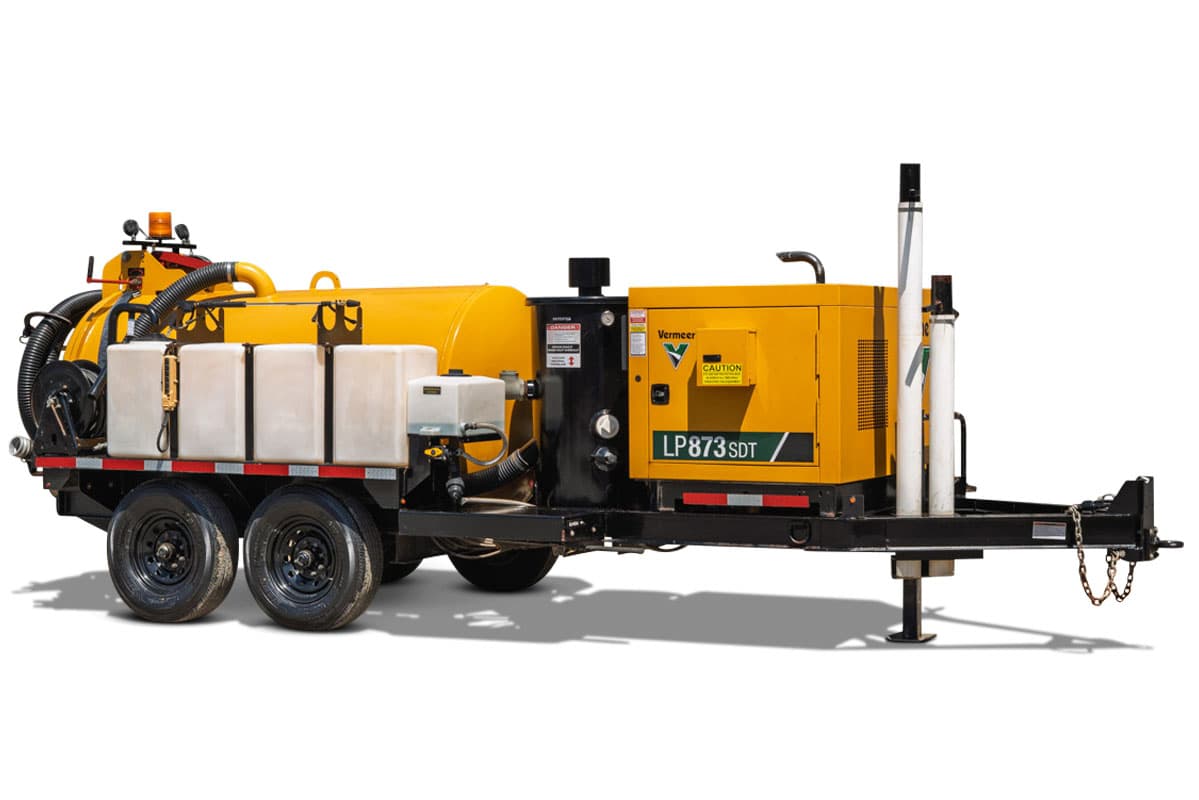
2025 Vermeer LP873SDT
$94,000
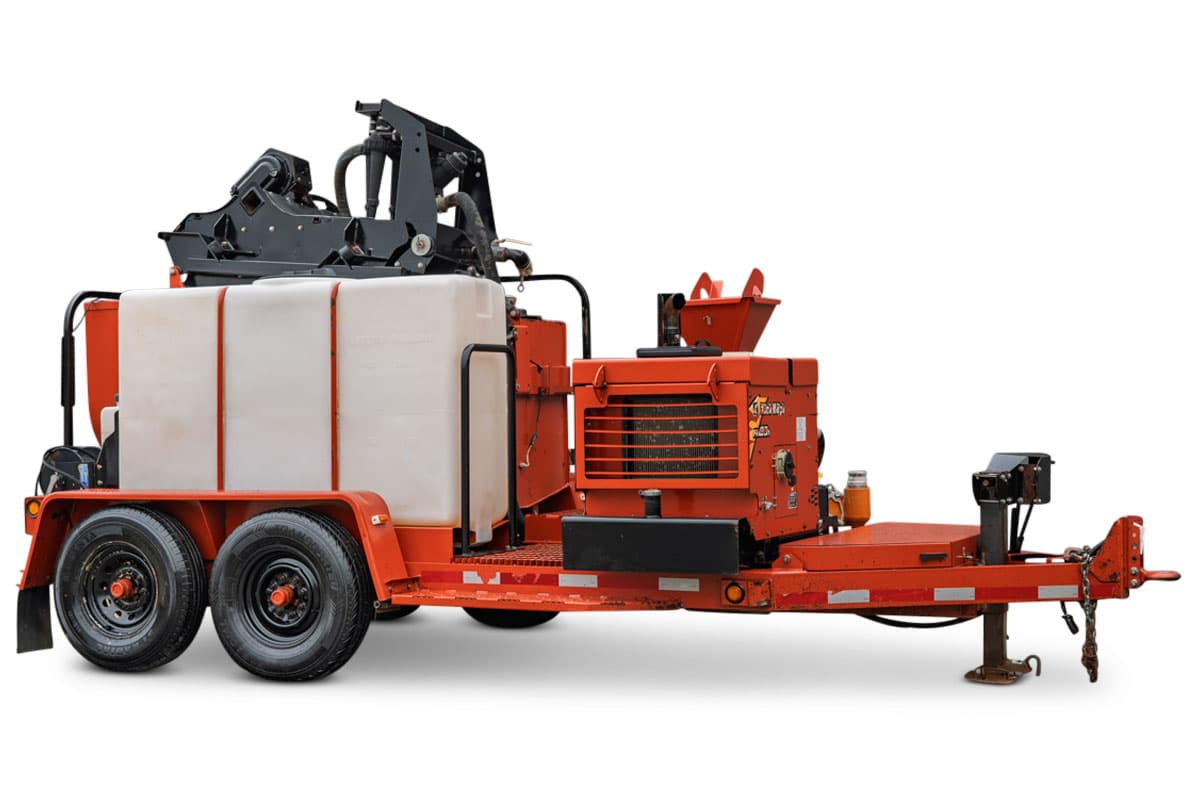
2015 Ditch Witch MR90
$49,000
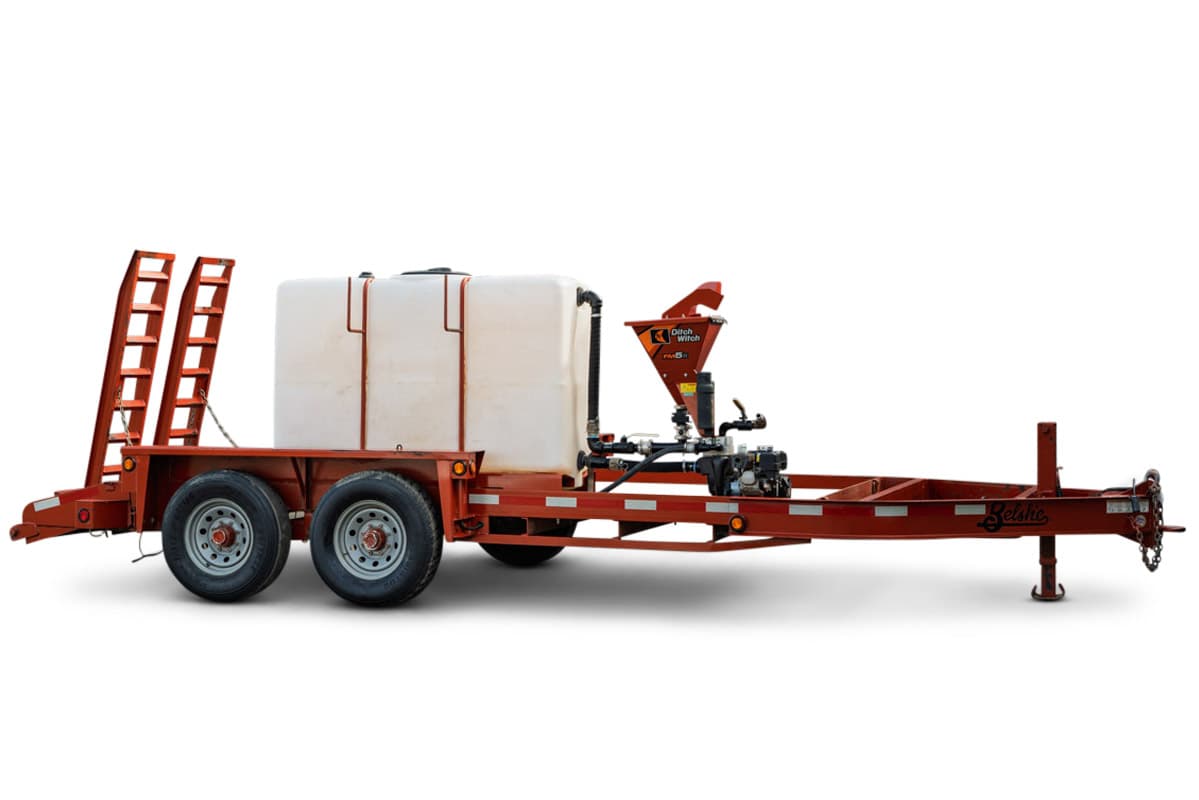
2019 Belshe WB14-2EP
SALE PENDING
Want a quote today? Call (877) 288-0280.
What the system is actually mixing
You need enough fluid knowledge to buy the right machine, not a chemistry course. Three things matter.
Bentonite is the default for most utility work. It is a sodium clay that has to be sheared into water to hydrate properly, which is the entire reason a mixing system has a venturi hopper and jets instead of a paddle. Properly sheared, it builds viscosity that carries cuttings and lays a filter cake on the borehole wall. Badly sheared, it goes down the hole as lumps, which wears pumps and does nothing for hole stability. A worn hopper throat is therefore not a cosmetic problem, and it is the first thing on the inspection list below.
Polymer additives, PAC and PHPA among them, come out in sand, gravel and loose ground where bentonite alone will not stabilise the bore, and where discharge is restricted. Polymer needs far less shear and dissolves readily. Plenty of experienced crews run both together. One practical consequence for the buyer: polymer-rich fluid is harder to clear off shaker screens, so if you run polymer regularly and you are buying a reclaimer, budget for more screen changes than the seller quotes.
Viscosity is what you actually measure in the field, with a Marsh funnel, in seconds per quart. Utility work generally runs in the forty to eighty second range as standard industry practice. Thicker carries cuttings better and pumps harder; thinner pumps easily and supports the hole less. The relevance to this purchase is simple: a mixing system that cannot shear consistently cannot hold a consistent funnel time, and a crew that cannot hold funnel time is guessing.
When a reclaimer starts paying for itself
This is the decision the trade press dances around, so here is the honest version. The break-even depends on three numbers that are all local to you: what a bag of bentonite costs in your market, what a tanker load of contaminated fluid costs to dispose of, and how much bore you put in per day. We are not going to invent those figures. Bentonite pricing varies by region and grade, and disposal cost varies enormously by locality, regulation and how contaminated the returns are. Get both from your own suppliers before you run the numbers.
What we can tell you is the shape of the thing. Running mix-and-haul, every gallon is bought twice: once as fresh water and additive, and once as a disposal fee. A reclaimer turns a large share of that volume around and puts it back in the tank, so it attacks both costs at once. It also removes the stop. A rig at 50 gpm without recycling has a crew making mud several times a shift, and that downtime is real money that never shows up on a quote.
The threshold most contractors land on: under about 20,000 lb of pullback, doing short residential work in cohesive soils, mix-and-haul usually still wins. At 24,000 lb and up, in sand or loam, on bores past about 500 feet, or anywhere disposal is expensive or awkward, a reclaimer starts to make sense quickly, and crews in that profile commonly report recovering the cost inside the first operating season. Treat that as the experience of people in your position rather than as a promise, and run it against your own disposal invoices.
One more thing that argues for buying used here. A mud system is mostly tank, frame, shaker deck and plumbing, and Trenchless Technology has put the serviceable life of a well maintained system at up to twenty years. The wear is concentrated in consumables. That is an unusually good profile for a used purchase, provided you know which consumables to look at.
How to inspect a used HDD mud system before you buy
Nine checks, in the order you would actually walk the machine. This is the section no manufacturer blog will write for you, because every item on it is a reason to pay less.
Separate mixer hours from engine hours
Many mixing systems meter the mixing unit and the power source independently, and trailer packages often pair a nearly new mixer with a much older trailer or truck. A unit showing two hours on the gauge is not a two hour machine until you have seen the service record for whatever turns it. Ask for both, in writing, before you value anything else on the machine.
Put your hand in the hopper and look at the venturi throat
Erosion and pitting at the throat is the defect that quietly ruins fluid quality. A worn jet will not shear bentonite completely, and you get lumpy under-hydrated mud that wears the pump and does nothing downhole. Replacement jet nozzles are a routine low-cost consumable, so a worn jet is a negotiating point rather than a walk-away; a worn or holed hopper body is a much larger job. Get current part pricing from a dealer before you make the offer, not after.
Run the centrifugal pump and listen to it
Bring it up briefly with no load and listen for bearing rumble. Then look at the impeller for cavitation pocking and at the shaft seal for weeping, which is common on high-hour units. Pump rebuild and replacement costs vary a great deal by size and by local labour rates, so get a quote from a pump shop while you are still negotiating and price it into the offer.
Look inside the tank, in the corners
Steel tanks pit from the bottom corners up, and that is where you will find it. Polyethylene tanks do not rust but they craze under years of sun and split if they have ever been left full through a hard freeze. Check every baffle is still attached and still straight, since a loose baffle turns into a sloshing hazard on the road.
Work the drain valve and every other valve on the manifold
Seized drains and ball valves stuck part-open are chronic on equipment that has sat, and they are cheap individually and expensive in aggregate. Operate all of them. A manifold where half the handles will not move is telling you how the machine spent the last two seasons.
Check the suction hoses for collapse
A hose that has gone oval or kinked has been run dry repeatedly, which is a fact about the operator rather than the hose. Replace the hose and inspect everything downstream of it more carefully.
Inspect the cam-lock fittings
Look for scoring on the cam arms and cracks at the ears. Scored or cracked cam-locks let go under pressure, and they let go at the worst moment. These are inexpensive and should simply be replaced before the machine goes to work.
On a reclaimer, pull the shaker screens and start it cold
Lift the screens and look for tears, blinded sections and missing mesh, then run the shaker from cold and listen to the bearing boxes for knocking or grinding. Screens are an ongoing operating cost whose price varies by mesh, brand and supplier, so treat a full set of tired screens as a line item rather than a surprise.
On a reclaimer, check the hydrocyclone cone apexes
The polyurethane cone bodies wear at the apex where the underflow exits, and a worn apex misclassifies solids and quietly drops your cleaning efficiency. Apex inserts are a cheap replacement; a cone body worn through is not. And if the machine is trailer-mounted, finish at the tongue: check the welds, the coupler, the safety chains and the corrosion around the tank mounts, because a compromised frame under a full tank is the one defect on this list that can disqualify a machine outright.
For the rig itself rather than the fluid side, The Used Directional Drill Inspection Checklist covers the same ground for the drill, and the two inspections usually happen on the same visit.
Cannot get to the yard before you decide? Our team can walk you through inspection photos of the shaker deck, the hopper throat or the tank interior on any unit we have listed, before you spend a day travelling. Call (877) 288-0280 or tell us which unit you are looking at.
What used mud equipment costs
Here is what each of the three categories is asking on our lot right now. These figures are read live from inventory when you load this page, so they are current rather than a snapshot from whenever this was written.
| Category | What it is | In stock now | Asking range |
|---|---|---|---|
| Mud mixing systems | Venturi hopper, jets, tank and supply pump. Trailer packages and truck-mounted units. | 17 units | $18,001 to $98,000 |
| Mud recyclers | Shale shaker, hydrocyclones, clean and dirty tanks. True solids control. | 2 units | $49,000 to $99,000 |
| Vacuum excavators | Blower, spoils tank, boom. Potholing and cleanup, not fluid recycling. | 27 units | $29,000 to $199,000 |
Three things about that table are worth a sentence each, because the numbers alone do not explain their own shape.
The entry point is lower than most first-time buyers expect. The bottom of the mixing range is a tow-behind trailer carrying a Ditch Witch FM5X or FM13X and a 300 to 500 gallon tank. That is a small fraction of the rig it feeds, which is exactly why under-budgeting the mud system is such a common mistake: skimping here saves very little and costs a great deal in mixed-badly fluid.
The cheapest genuine solids control is closer than people think. The bottom of the recycling range is a used Ditch Witch MR90, and it lands in the same territory as a mid-hours vacuum excavator. Contractors who assume recycling starts in six figures usually have not priced the utility-class option.
The top of the recycling range is a different market, not an expensive version of your machine. It is a pipeline-class cleaning system, the American Augers M300DH, rated at 300 gpm and built for rigs in the 100,000 to 240,000 lb pullback range. If you are buying for a 25,000 lb utility rig, the top of that range is simply not addressed to you and you can ignore it without missing anything. That single machine is why the range looks so wide.
Financing a used mud system
Used mud equipment finances the same way used rigs do. WorldHDD does not lend; we connect buyers with First Pacific Funding, and pre-approval does not affect your credit score. Turnaround is typically 24 to 48 business hours. Approval is never guaranteed and neither are rates, so treat any number you are quoted elsewhere as an estimate until it is in writing from the lender.
Mud equipment may also qualify for Section 179 expensing in the year you place it in service, which changes the effective cost of buying before year end rather materially. Consult your CPA about Section 179 or bonus depreciation for your situation; this is not tax advice. How to Finance Used HDD Equipment: Loans, Leases, Rates, and Section 179 goes through the structures in detail, and you can start an application from our HDD equipment financing page.
Frequently asked questions
What is the difference between a mud mixing system and a mud recycler?
A mixing system blends fresh water with bentonite or polymer and holds the prepared fluid ready for the rig's onboard pump. It is supply-side only and never touches what comes back out of the bore. A mud recycler, also called a reclaimer or solids control unit, takes the contaminated returns, screens the cuttings out on a shale shaker, removes fines through hydrocyclone cones, and puts cleaned mud back into the supply tank. Most crews run a mixing system alone. Recycling gets added when soil conditions, bore length or disposal costs justify it.
How many gallons per minute does a directional drill use?
It depends entirely on the rig, and the figure is on the manufacturer's spec sheet. Per those documents: the Vermeer D20x22 S3 is rated at 25 gpm, the Ditch Witch JT20 at 35 gpm, the Vermeer D23x30 S3 at 35 gpm, the Ditch Witch JT24 at 40 gpm, the JT25, JT28, JT30 and Vermeer D24x40 S3 all at 50 gpm, and the Vermeer D60x90 S3 at 150 gpm. Your fluid supply has to keep up with that number, which in practice means sizing the tank rather than the mixer's pump.
What size mud mixing system do I need for a 20,000 to 25,000 lb drill?
Rigs in that class draw between 25 and 50 gpm depending on model. A tank of 400 to 800 gallons covers most soil conditions, using the rough guide of ten to twenty times the rig's maximum gpm in gallons. Sand and gravel drink fluid faster than clay, so err upward if that is your ground. A single trailer-mounted package with a 500 gallon tank and a centrifugal supply pump is the common configuration, and a reclaimer becomes worth pricing if you regularly work sand or run bores past about 500 feet.
Do I need a mud recycler for a small HDD rig?
Usually not. Under about 20,000 lb of pullback, on short residential bores in cohesive soils, mixing fresh and hauling off is normally the cheaper answer. Recycling starts earning its keep at 24,000 lb and above, in sandy or loamy ground, on longer bores, or wherever fluid disposal is expensive. The break-even turns on your local bentonite and disposal pricing, so get both before deciding.
What should I inspect on a used HDD mud mixing system?
Six things on a mixer: the venturi throat for erosion, the centrifugal pump for bearing noise and shaft seal weeping, the tank interior for corner pitting or UV crazing, the suction hoses for collapse from running dry, the cam-lock fittings for scoring and cracks, and the service records for the engine as distinct from the mixer hour meter. On a reclaimer add three more: shaker screens for tears and blinding, shaker bearing boxes for noise from cold, and hydrocyclone cone apexes for wear-through.
How much does a used HDD mud system cost?
It depends which of the three machines you mean, which is why the categories are worth separating. On our lot right now, mixing systems ask $18,001 to $98,000, mud recyclers $49,000 to $99,000, and vacuum excavators $29,000 to $199,000. The top of the recycling range is a pipeline-class cleaning system rather than anything a utility contractor would buy, so read the bottom of that range if you are running a 25,000 lb rig. These figures are read live from inventory, so they are current as you read them.
When should I use bentonite versus polymer?
Bentonite is the default for most utility HDD, especially in clay and other cohesive soils where it supports the borehole wall and carries cuttings well. Polymer additives such as PAC and PHPA come out in sand, gravel and loose ground where bentonite alone will not hold the bore, and where discharge is restricted. Many crews blend both. Soil, regulation and bore length drive the call, and a drilling fluids supplier can give you a site-specific recommendation.
Can I use a vacuum excavator as a mud recycler?
No. Vacuum excavators such as the Ditch Witch FX and HX units, the MV800 and the Vermeer LP and CV units are built for potholing, utility exposure and spoils removal. They collect slurry but they do not separate cuttings from fluid or return cleaned mud to a supply tank. A reclaimer does that with a shale shaker and hydrocyclones. A vac is genuinely useful on a bore site and many crews own both, but the two are not substitutes.
Is financing available for used mud equipment?
Yes. WorldHDD connects buyers with First Pacific Funding, and used mud equipment is eligible. Pre-approval does not affect your credit score and usually takes 24 to 48 business hours. Approval and rates are never guaranteed. Some buyers also expense qualifying equipment under Section 179 in the year of purchase; consult your CPA about your own situation, as this is not tax advice.
What is the lifespan of an HDD mud system?
Trenchless Technology has put it at up to twenty years with proper maintenance. Tanks, frames, shaker decks and structural components are long-lived; jets, pump seals, screens and cones are consumables on a replacement cycle. Maintenance history matters more than the hour meter on this class of equipment, which is what makes it a good used buy when the records are there.
What is solids control and why does it matter?
Solids control is the business of getting drill cuttings out of the fluid returning from the bore so the mud can be reused instead of disposed of. For utility HDD that means a shale shaker screening the coarse material and hydrocyclone cones pulling out the fines. Doing it well cuts bentonite consumption, cuts disposal volume, and holds fluid properties where they need to be for a stable hole. On long or coarse bores, poor solids control is one of the more common roads to borehole trouble.
Ready to match a system to your rig? Browse our 17 mud mixing systems if you need supply. Browse our 2 mud recyclers if the arithmetic above says recycling pays. Browse our 27 vacuum excavators if what you actually need is potholing and cleanup. If you would rather describe your rig and your ground and have someone else do the matching, call (877) 288-0280 or send us the details, and we will tell you what fits and what is worth waiting for. Financing runs in parallel through our HDD equipment financing page, and if you are still building out the rest of the outfit, What Equipment Do You Need to Start a Directional Drilling Business? and How Much Does It Cost to Start a Directional Boring Business? cover what else belongs on the list.
Sources and references. Every flow, pressure and capacity figure above is taken from an OEM specification sheet or brochure, or from named trade press. Verified August 2026.
- Ditch Witch JT20 product literature: 35 gpm at 1,000 psi
- Ditch Witch JT24 product literature: 40 gpm at 1,200 psi, and the FM5X / FM13X mud mixer line
- Ditch Witch JT25 brochure: 50 gpm at 1,200 psi
- Ditch Witch JT28 brochure (November 2025): 50 gpm at 1,200 psi
- Ditch Witch JT30 All Terrain specifications: 50 gpm at 1,500 psi
- Ditch Witch MR90 mud recycler literature: 90 gpm recycle, 225 gpm supply, two-screen deck and six hydrocyclones
- Ditch Witch FM5X specifications: 300 / 400 / 500 gallon tanks, 160 gpm pump discharge
- Ditch Witch FM13X specifications: 400 / 500 / 950 gallon tanks, 270 gpm pump discharge, 220 gpm to the boring unit
- Ditch Witch trailer vacuum excavator literature: the FX20 through FX65 and MV800 product family
- Vermeer D20x22 S3: 25 gpm at 750 psi
- Vermeer D23x30 S3 spec sheet: 35 gpm at 1,300 psi
- Vermeer D24x40 S3: 50 gpm at 1,050 psi
- Vermeer D60x90 S3: 150 gpm at 900 psi
- Vermeer MX125 spec sheet: 300 and 500 gallon tank options
- Vermeer MX300 spec sheet: 350 gpm pump flow, 750 and 1,000 gallon tanks
- American Augers M300DH: 300 gpm cleaning capacity for 100,000 to 240,000 lb pullback rigs
- Vermeer ProTips: choosing a mud mixing system for directional drilling (December 2022)
- Trenchless Technology: "Mud System Buying: Do Your Homework" (March 2011), on shaker types and system service life